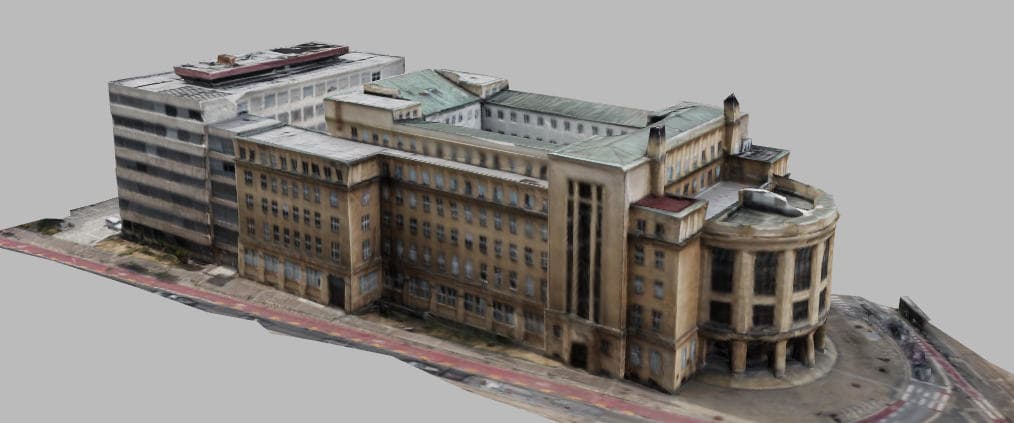
Along Letná Street in Košice, the main building of the Technical University of Košice stands as an architectural expression of Slovakia's postwar industrial and educational ambitions. Completed in 1972, the six-storey structure embodies the rational aesthetic of twentieth-century modernism. A rhythmic arrangement of vertical pilasters and rectangular windows defines its principal façade, while horizontal bands of glazing and granite-clad end walls create a measured interplay of transparency and solidity. Nearby, the curved forms of Aula Maxima, the university's ceremonial assembly hall, offer a sculptural counterpoint to the disciplined geometry of the administrative building. Together, they establish the architectural identity of a campus conceived around scientific inquiry and technological progress.
The intellectual heritage of the university belongs to a broader tradition of higher education in present-day Slovakia, stretching back to the founding of Universitas Cassoviensis in Košice in 1657 and the establishment of the Mining Academy in Banská Štiavnica under Empress Maria Theresa in 1762. The first formal attempt to establish higher technical education in Košice came in 1937 with the creation of the Dr. M. R. Štefánik State Technical College. However, the territorial changes following the First Vienna Award of 1938 forced the institution to relocate successively to Prešov, Martin and Bratislava, where it laid the foundations of today's Slovak University of Technology.
Košice regained its own institution of higher technical education in 1952, when a Czechoslovak government decree established the Technical College with three founding faculties: Heavy Engineering, Mining and Metallurgy. Closely aligned with the industrial development of eastern Slovakia, the college expanded considerably over the following decades, incorporating electrical engineering, civil engineering and other specialised disciplines. In 1991, it adopted its present name, the Technical University of Košice. The subsequent establishment of faculties devoted to economics, manufacturing technologies and the arts, together with the integration of military aviation education in 2005, broadened its academic horizons beyond its original industrial foundations.
Today, the university encompasses nine faculties and supports interdisciplinary research through facilities such as the University Science Park TECHNICOM. Its participation in international academic networks reflects an increasingly interconnected approach to education, scientific discovery and technological innovation.
Born from the industrial aspirations of the twentieth century, the Technical University of Košice has evolved alongside the society it serves. Its history mirrors eastern Slovakia's gradual transformation from an economy rooted in heavy industry towards one increasingly shaped by knowledge, creativity and innovation. Across successive generations, its enduring purpose has remained the same: to transform intellectual curiosity into practical knowledge, and knowledge into new possibilities for the world beyond the university.