Bridge of the Slovak National Uprising
Most Slovenského národného povstania
Bratislava, Bratislava Region, Slovakia
On August 26, 1972, a striking new silhouette emerged above the Danube in Bratislava. Suspended from a single inclined pylon, the Bridge of the Slovak National Uprising, known as Most SNP, embodied the bold engineering ambitions of postwar Czechoslovakia. Its slender steel deck stretched across the river without a single supporting pier in the water, while a saucer-shaped structure perched high above the roadway gave the bridge an unmistakably futuristic appearance. What began as a solution to the city's growing transportation needs would become one of its most recognizable architectural landmarks.
Construction began in 1967 under a design developed by architects Jozef Lacko, Ladislav Kušnír, and Ivan Slameň, together with structural engineers Arpád Tesár and Jozef Zvara. The bridge's asymmetrical cable-stayed structure extends 430.8 meters, with a main span of 303 meters connecting the historic Old Town to Petržalka on the opposite bank. Four lanes of traffic occupy the upper deck, while cantilevered pathways below accommodate pedestrians and cyclists. Rising 84.6 meters, the inclined A-frame pylon supports a circular restaurant and observation platform, reached by an elevator concealed within one of its legs. From nearly 95 meters above the Danube, visitors encounter sweeping views of the city's rooftops, distant hills, and winding river.
Yet the bridge's architectural audacity came at a profound historical cost. Its construction required the demolition of substantial portions of Podhradie, the historic neighborhood beneath Bratislava Castle, including parts of the old Jewish Quarter and the Neolog Synagogue near St. Martin's Cathedral. Centuries of urban memory disappeared to make way for a modern transportation corridor. The bridge thus became a paradox of twentieth-century urban planning: an extraordinary achievement of structural engineering built upon the irreversible loss of a historic landscape.
Originally named in honor of the Slovak National Uprising of 1944, the bridge was renamed Nový most, or New Bridge, in 1993 before regaining its original name in 2012. Its architectural and historical significance was formally recognized in 2018, when it received designation as a National Cultural Monument.
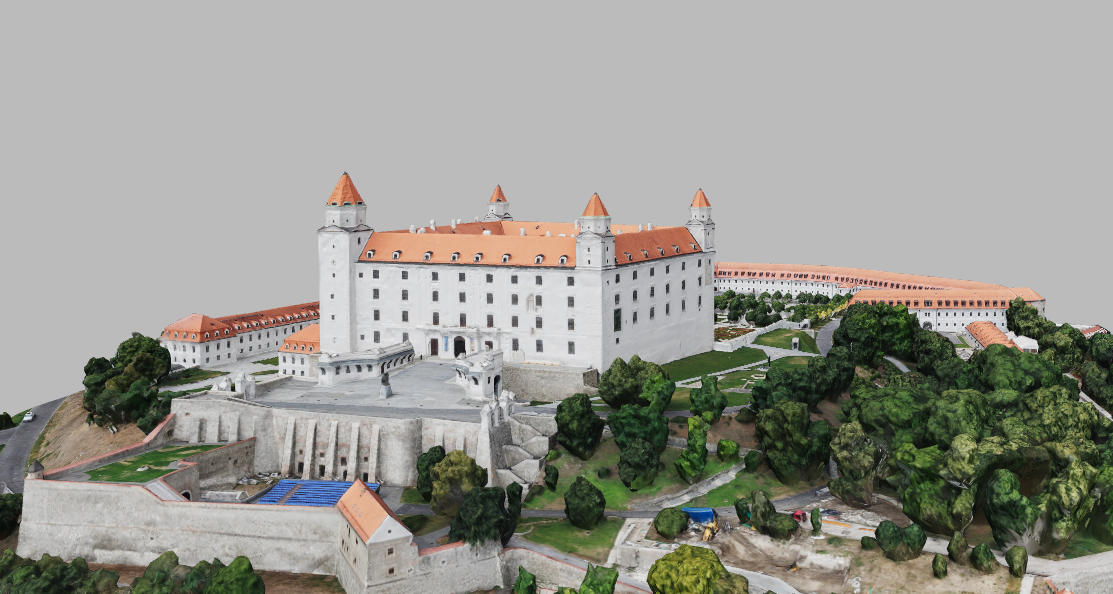
Today, Most SNP remains both an essential crossing and a defining feature of Bratislava's skyline. Beneath its soaring cables, traffic flows steadily between the riverbanks, while above, visitors look out over a city shaped by centuries of change. The castle rises over the Old Town, the Danube continues its quiet passage, and the vanished streets of Podhradie survive only in photographs and memory. Suspended between these different layers of time, the bridge stands as more than a monument to modern engineering. It is a reminder that cities are shaped as much by what they preserve as by what they choose to build.