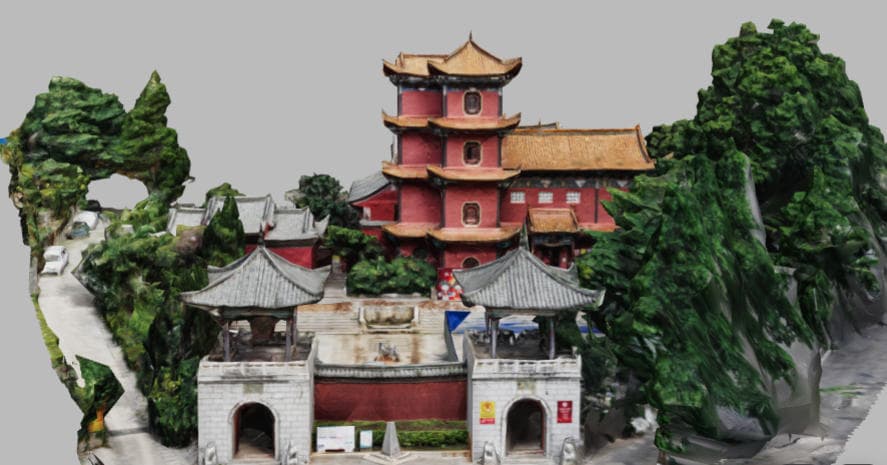
Rising twenty-two meters above the waters of South Lake in Mengzi, the Yingzhou Pavilion stands on a stone foundation over one meter high. Its green and yellow glazed tiles catch the Yunnan sunlight, while wind bells suspended from the eaves chime in the lake breeze.
The pavilion began in 1690, when acting magistrate Wang Laibin directed its construction. He named it Yingxian Pavilion to honor the collective effort of the community. War destroyed this original structure in 1858. In 1889, local builders reconstructed the pavilion, renaming it Yingzhou Pavilion. They raised thirty wooden columns, anchoring six central pillars to form a cup-shaped timber truss that supports the hexagonal, pyramidal roof.
The building is a silent record of social change. In 1899, local residents gathered here to coordinate protests against colonial expansion, marching to burn foreign trading firms. By 1926, the communist leader Du Tao chose the secluded upper floors for secret meetings of the Southern Yunnan District Committee. In the summer of 1938, the pavilion welcomed the displaced minds of the National Southwest Associated University. Scholars Wen Yiduo, Chen Yinke, and Zhu Ziqing walked along the lake, using the quiet space to read and write during the Sino-Japanese War.
Architecturally, the pavilion functions as a giant writing brush in a traditional landscape puzzle. Local scholars designed the surrounding area so the three nearby hills represent a brush-holder, the fields represent an inkstone, and the lake represents an inkwell. Visitors climbing the wooden stairs encounter a red-and-gold plaque and literary couplets composed by local gentry like Zhou Sihui. On the second floor, a plaque reads "Pengshan is not far," while the third floor offers a view of the water under a plaque reading "Water and Sky are of One Color." Designated a provincial cultural relic in 1987, the pavilion remains a place where the scent of lake water and the sound of wind bells connect modern visitors to centuries of scholarly devotion.