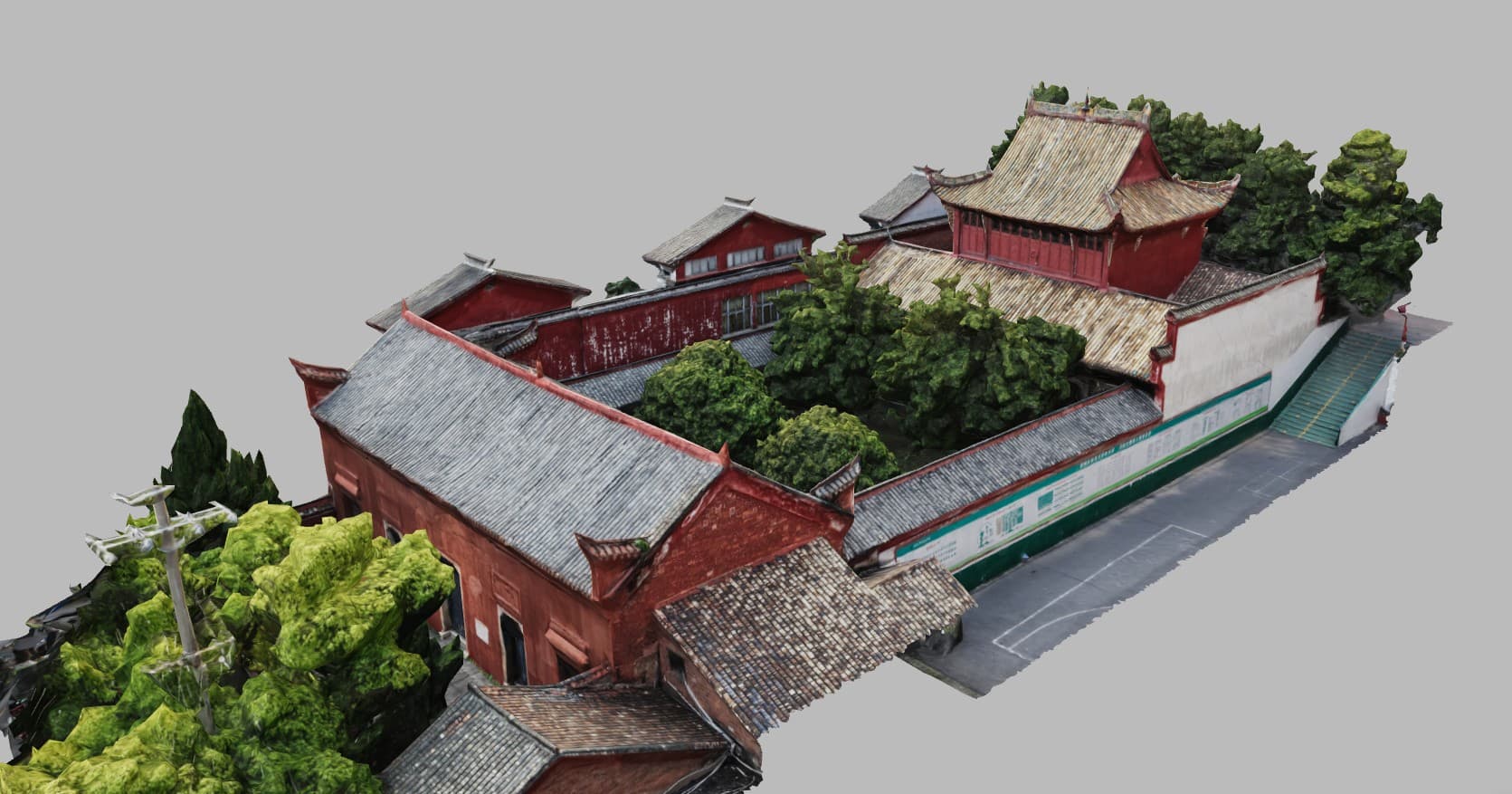
The Liling Confucian Temple stands on Dongzheng Street, its red walls and glazed tiles catching the Hunan sun. First built on Qingyun Mountain during the Song Dynasty, the temple has a history of displacement and survival. Prefectural Governor Zhang Sijing rebuilt it in 1306, only for war to destroy it at the end of the Yuan Dynasty. A local magistrate reconstructed it in 1369, and in 1743, workers relocated the entire complex to its current home near the Liling riverfront.
The architecture carries the weight of unfulfilled local ambitions. At the entrance, the Dacheng Gate features twenty parallel doors. The two central, bright-red doors are the Zhuangyuan Gates, reserved exclusively for imperial examination champions. Because Liling produced forty jinshi and hundreds of lesser scholars yet never a single top-ranking zhuangyuan, these central doors remained closed during ancestral ceremonies.
Beyond these silent gates lies a courtyard leading to the Dacheng Hall. Visitors ascend stone steps to reach this elevated hall, which sits 1.2 meters higher than the front hall and spans 408.5 square meters. The cool depths of ancient wells, weathered stone lions, and stone drums remain on the grounds, carrying the physical marks of centuries of use.
In the twentieth century, the temple transitioned from classical education to revolution. In May 1922, Mao Zedong, Yang Kaihui, and Li Lisan arrived at the site, which then housed the Liling A-Grade Normal Training School. Mao returned in January 1927 during his investigation of the Hunan peasant movement, addressing a dense crowd of seven hundred teachers, students, and farmers in the front yard. Today, the temple exists as a quiet space where the echoes of imperial examinations and revolutionary speeches meet.