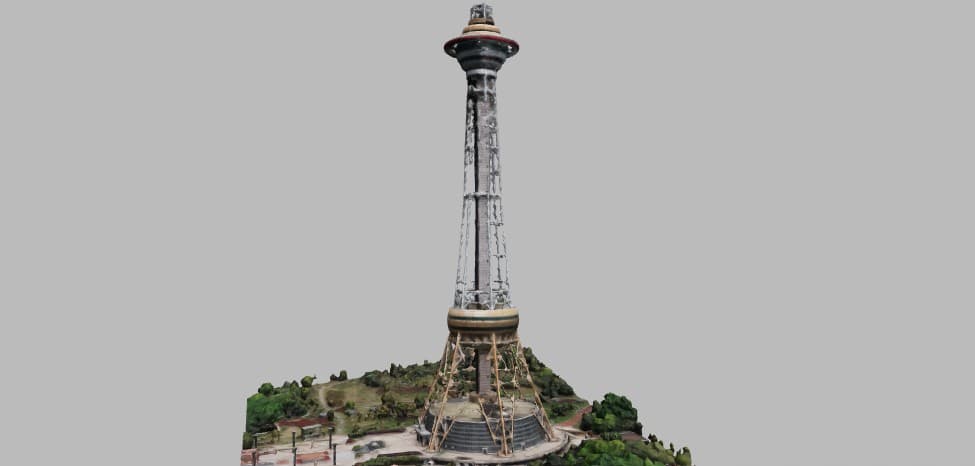
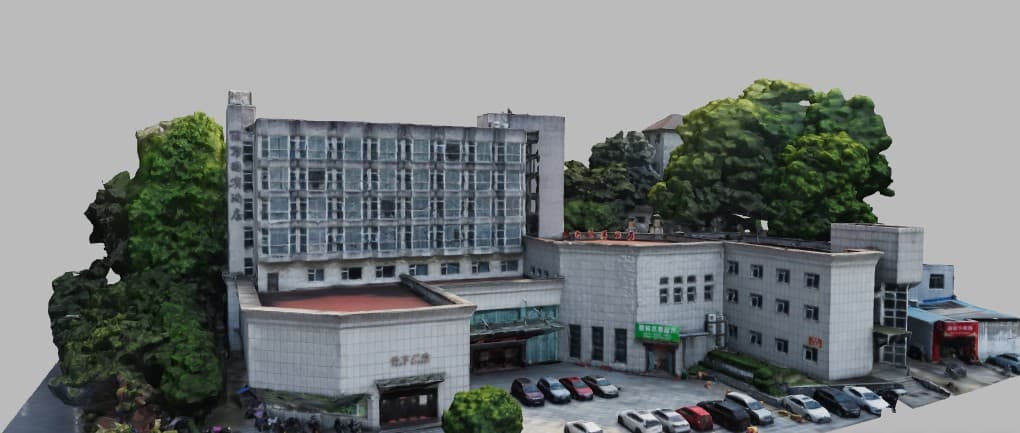
On the summit of Benlong Mountain, in the central Luosong District of Zhuzhou, stands the Shennong Pavilion. This nine-story, fifty-two-and-a-half-meter-tall tower rises from a peak rich with memory. Long ago, legend says Emperor Yan Shennong climbed these slopes to gather wild herbs, taming a golden dragon to cure a devastating plague. To honor him, early ancestors built a wooden Yao Pavilion on this high ground.
Centuries later, the peak took on an industrial purpose. In 1938, the chemical expert Hou Debang directed the construction of the Yongli Water Tower on this exact spot, supplying the Nanjing Yongli Jiuda Chemical Industry Company. When that concrete tower was demolished in the 1970s, it left an empty space. In February 1991, the Zhuzhou government funded a new monument. Completed on September 20, 1992, the current pavilion won Hunan's First Prize for Outstanding Engineering Design in 1995.
The architecture bridges different eras. The first two floors feature glazed double-eave flared corners that catch the morning light. Above them, a rectangular frame structure rises to a roof of overlapping cross ridges, capped by a four-cornered pointed glass dome. Inside, the building spans two thousand seven hundred fifteen square meters. On the second floor, visitors encounter the statue of Emperor Yan in his dedicated hall. The third floor houses the Chinese Root-Seeking Hall, tracing ancestral lineages. The fourth through eighth floors house five distinct halls dedicated to traditional blessing culture: Yuanfu, Daofu, Shifu, Rufu, and Hefu.
At the very top, on the ninth floor, hangs the Blessing Bell. Visitors pull the heavy rope, sending a deep, metallic chime out over the city. From this height, the cool wind from the Xiang River sweeps through the open platform. Looking out, you see the river winding past the modern urban skyline of Zhuzhou, a view that connects ancient mythology, wartime industry, and the quiet green spaces of Shennong Park.