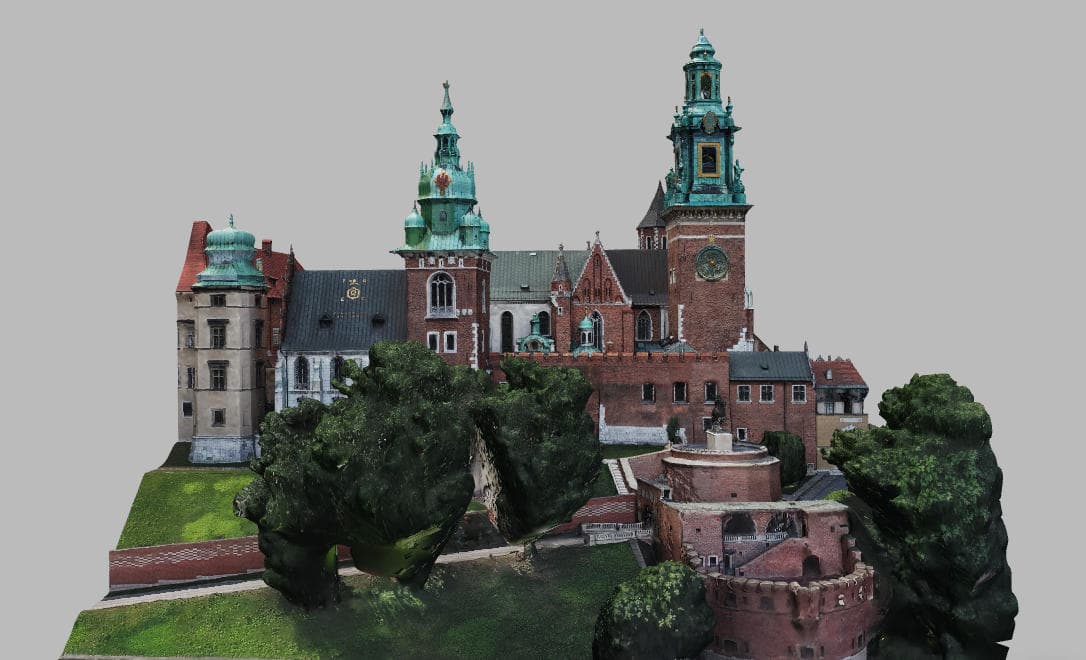
High above a bend in the Vistula River, Wawel Royal Castle crowns the limestone hill that has for centuries occupied a central place in Poland’s history. Its architectural composition reflects the ambitions of successive generations of monarchs, bringing together the defensive solidity of medieval Gothic architecture, the graceful proportions of the Italian Renaissance and the ceremonial grandeur of the early Baroque. At the heart of the palace lies a magnificent courtyard enclosed on three sides by galleries rising through three storeys. Slender columns, rhythmic arches and a broad overhanging roof create a remarkable interplay of light, shadow and perspective, recalling the elegance of Italian palaces while adapting their architectural language to Central European traditions.
The royal chambers reveal the artistic sophistication of the Renaissance court. In the Envoys’ Hall, carved wooden heads gaze down from an elaborate coffered ceiling, while the celebrated Flemish tapestries commissioned by King Sigismund II Augustus depict biblical narratives, imagined landscapes and intricate heraldic compositions. These treasures testify to the cultural ambitions of the Jagiellonian dynasty and its participation in the intellectual and artistic life of Renaissance Europe.
The origins of the royal residence date to the mid-eleventh century, when Wawel emerged as an important centre of the Polish state. During the fourteenth century, Władysław I the Elbow-high and Casimir III the Great expanded the medieval stronghold into an imposing Gothic residence. Its most profound transformation began around 1504 under Alexander I and continued under Sigismund I the Old. Architects including Francesco Fiorentino, Benedykt of Sandomierz and Bartolomeo Berrecci helped create a palace that became one of the foremost Renaissance residences in Central Europe. During Poland’s Golden Age, Wawel flourished as a centre of political authority, artistic patronage and humanist learning.
The castle’s fortunes gradually changed following a devastating fire in 1595 and the permanent relocation of the royal court to Warsaw around 1610. Subsequent invasions and fires diminished its former splendour. After Poland lost its independence in 1795, Wawel eventually fell under Austrian military control, and its royal chambers were converted to serve the practical needs of an occupying army.
The recovery of the castle in 1905 marked the beginning of a remarkable cultural revival. Restoration undertaken first by Zygmunt Hendel and later by Adolf Szyszko-Bohusz became a collective national endeavour, supported in part by public donations. Established as a museum in 1930, the castle faced renewed adversity during the Second World War, when it became the residence of Nazi Governor-General Hans Frank. Many of its most precious treasures were evacuated abroad for safekeeping, with the royal tapestries finally returning from Canada in 1961.
Today, Wawel Royal Castle stands among Poland’s most significant cultural institutions. Its history encompasses the splendour of monarchy, the humiliation of foreign occupation and the determination of a nation to reclaim its heritage. No longer the seat of kings, Wawel has acquired a different and perhaps more enduring significance: it belongs not to a dynasty, but to the collective memory of a people whose cultural identity has survived the rise and fall of political power.