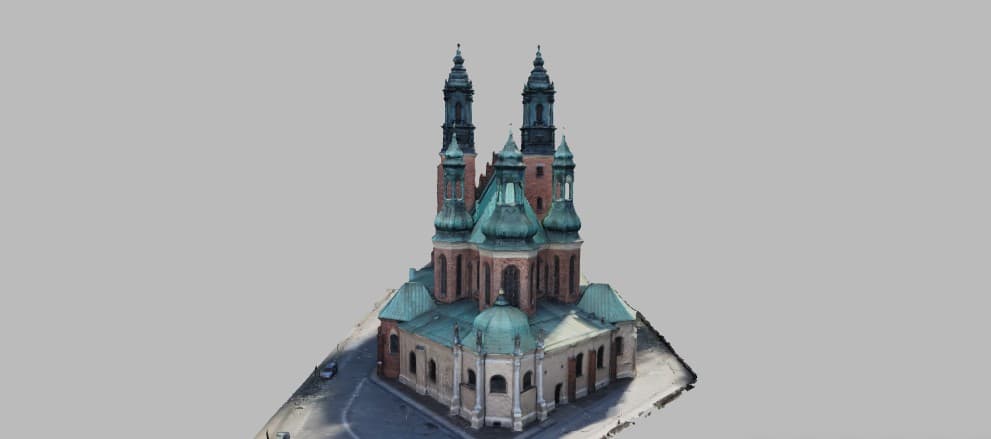
At the foot of Wawel Hill in Kraków's historic Stradom district stands the Church of Saint Bernardino of Siena, a sanctuary whose architecture bears the imprint of both religious devotion and military necessity. Its early Baroque design combines a three-aisled basilica, a transept and an imposing twin-towered façade. Unlike the soaring domes characteristic of many Baroque churches, its crossing dome is largely concealed beneath the roofline, an unusual arrangement reflecting the strategic demands of the neighbouring royal castle. Within, geometric stucco ornamentation and elaborately carved eighteenth-century altars lend the interior a richness that contrasts with the relative restraint of its exterior.
Among the church's artistic treasures are the monumental religious canvases of Franciszek Lekszycki, a seventeenth-century Bernardine friar whose work absorbed the dramatic visual language of Peter Paul Rubens and Anthony van Dyck. The Chapel of Saint Anne preserves a late Gothic wooden sculpture of Saint Anne with the Virgin and Child, attributed to the workshop of Veit Stoss, alongside the celebrated Dance of Death, a seventeenth-century painting traditionally attributed to Lekszycki. Its haunting procession of skeletons and figures from different social estates reflects the Baroque preoccupation with mortality and the transience of earthly distinction. In the Chapel of Saint Simon of Lipnica, a marble mausoleum dating from 1662 enshrines the saint's relics, illuminated by a stained-glass window designed by Józef Mehoffer.
The origins of the sanctuary reach back to 1453, when the preaching of John of Capistrano inspired the establishment of Poland's first Observant Franciscan community. Supported by Cardinal Zbigniew Oleśnicki and King Casimir IV Jagiellon, the friars settled beneath Wawel Hill, where their dedication to Saint Bernardino of Siena gave rise to the name by which the order became known in Poland: the Bernardines. An initial wooden sanctuary was subsequently replaced by a brick Gothic church, which endured repeated fires and flooding over the following centuries.
Its greatest catastrophe came in 1655, during the Swedish Deluge. Acting on the orders of Polish commander Stefan Czarniecki, defending forces burned the surrounding suburbs to prevent their use by the besieging army. The medieval church and monastery were destroyed. Reconstruction began in 1659 under the direction of military engineer and architect Krzysztof Mieroszewski, and by around 1680 the present Baroque sanctuary had emerged from the ruins.
Today, the church and monastery remain an active centre of Franciscan life and pilgrimage. For more than five centuries, the Bernardine community has witnessed the shifting fortunes of Kraków, enduring natural disasters, military destruction and successive transformations of the city. While the neighbouring Wawel Castle recalls the ambitions of kings and the rise and fall of political power, the sanctuary beneath it preserves a quieter dimension of history: the continuity of faith, the fragility of human existence, and the enduring capacity of devotion to survive the passage of time.