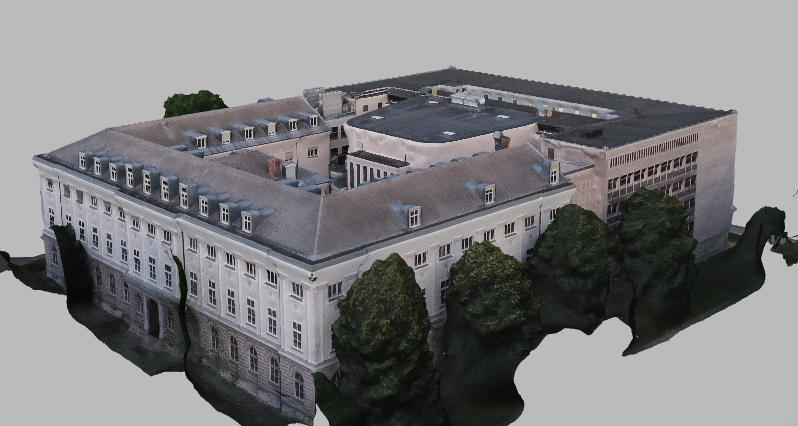
In April 1895, a devastating earthquake destroyed the original provincial mansion on Ljubljana's Congress Square. Between 1899 and 1902, a replacement palace rose on the site, designed by Czech architect Jan Vladimír Hráský and revised by Josip Hudetz. Built in the Neo-Renaissance style with German Renaissance decorative influences, the three-story building features corner turrets, ornate window surrounds, and a central ceremonial balcony overlooking the square.
The building gained a new purpose in 1919. Following the collapse of Austria-Hungary and the establishment of the Kingdom of Serbs, Croats, and Slovenes, the University of Ljubljana was founded by royal decree. The former Carniolan Provincial Mansion became its central administrative seat, serving an institution initially organized into five faculties: Law, Philosophy, Medicine, Theology, and Technology. Within the palace, a monumental staircase leads through vaulted corridors to ceremonial halls and richly decorated administrative chambers.
The palace witnessed the political and institutional changes of the twentieth century. The university expanded its academic disciplines and research activities, while its historic headquarters remained at the centre of Ljubljana. Architect Jože Plečnik's broader urban interventions reshaped the surrounding public spaces, incorporating the building into a setting of landscaped paths, monuments, and memorial busts commemorating university founders and scholars. Following Slovenia's independence in 1991, institutional reforms further consolidated the university's administrative structure.
Today, the University Palace serves as the Rectorate of the University of Ljubljana and houses its Historical Archives and Museum. Protected as a cultural monument of national significance, the building retains its Neo-Renaissance exterior, vaulted corridors, and ceremonial interiors. Overlooking Congress Square, it connects the city's former provincial administration with more than a century of Slovenian higher education.
Metadata
Significance
Founded in 1919, the University of Ljubljana is Slovenia's oldest and largest university and a major centre of higher education and scientific research. Its central Rectorate occupies the Neo-Renaissance University Palace on Congress Square, a protected cultural monument of national significance incorporated into Jože Plečnik's broader urban design of central Ljubljana. Comprising 23 faculties and three art academies, the university continues to play a central role in the country's academic, scientific, and cultural life.
@misc{FUNES_university_of_ljubljana_2026,
  author       = {Fengze Cao, Yixuan Xie},
  title        = {{University of Ljubljana (Univerza v Ljubljani) -- 3D Cultural Heritage Record}},
  year         = {2026},
  publisher    = {FUNES.WORLD},
  howpublished = {\url{https://funes.world/entities/university-of-ljubljana}},
  note         = {Technique: Photogrammetry; Format: .glb; License: CC BY-NC 4.0}
}
Academic References & Sources (6)
## Overview
The University of Ljubljana (Slovenian: Univerza v Ljubljani, Latin: Universitas Labacensis) is a public research university located in Ljubljana, Slovenia. Established in 1919, it is the oldest, largest, and highest-ranked institution of higher education and scientific research in the country. The university's central seat and Rectorate are housed in the historic University Palace (formerly the Carniolan Provincial Mansion) on Congress Square in central Ljubljana, while its constituent faculties, art academies, and research facilities are located across the capital and in secondary locations such as Portorož.
## Historical Development
Academic activity in Ljubljana traces its roots to 17th-century Jesuit academies and the Central Schools established during the French administration of the Illyrian Provinces (1810–1813). Following the dissolution of the Austro-Hungarian Empire and the creation of the Kingdom of Serbs, Croats, and Slovenes after World War I, the University of Ljubljana was officially founded by royal decree in 1919.
The university initially operated with five founding faculties: Law, Philosophy, Medicine, Theology, and Technology. In late 1919, the university was granted the former Carniolan Provincial Mansion (Kranjski deželni dvorec), built between 1899 and 1902, to serve as its central administration building. Throughout the 20th century, the institution expanded through the division of broad technical departments into independent faculties and the incorporation of art academies. Legislative reforms in the post-independence period consolidated the university into a single unified legal entity under the governance of the Rectorate, alongside spatial expansions into northern Ljubljana (Bežigrad) and modern campus developments elsewhere in the city.
## Architectural Features
The central seat of the university—the University Palace—is situated on the eastern side of Congress Square (Kongresni trg). Built between 1899 and 1902 to replace the original provincial mansion destroyed in the 1895 Ljubljana earthquake, the palace was designed by Czech architect Jan Vladimír Hráský and revised by Viennese-trained Czech architect Josip Hudetz.
Designed primarily in the Neo-Renaissance style with German Renaissance decorative influences, the three-story building features a articulated main facade fronting Congress Square. Key exterior elements include corner turrets, decorative window surrounds, and a central ceremonial balcony positioned directly above the main entrance portal. The interior is structured around a monumental central staircase leading to vaulted hallways, ornate ceremonial halls, and stuccoed administrative chambers. The building is integrated into Jože Plečnik's broader mid-20th-century spatial layout of central Ljubljana, with the surrounding entry park featuring semi-circular paths, public monuments, and memorial busts of university founders and scholars.
## Current Status
The University of Ljubljana operates as Slovenia's flagship higher education institution, enrolling between 38,000 and 40,000 undergraduate and postgraduate students and employing over 6,000 academic, research, and administrative staff. Its organizational structure comprises 23 faculties and 3 art academies (the Academy of Fine Arts and Design, the Academy of Music, and the Academy of Theatre, Radio, Film and Television). It maintains close institutional links with national resources, including the National and University Library of Slovenia (NUK) and the Central Technological Library.
The main University Palace serves as the Rectorate, administrative center, and venue for official academic ceremonies, while housing the Historical Archives and Museum of the University of Ljubljana (ZAMU). The building holds official protection as a cultural monument of national significance in Slovenia.
# UNIVERZA V LJUBLJANI (UL)
## Referente:
Doc. dr. Neža Pogorelčnik Vogrinc
### Sito Web
### Indirizzo
Poljanski nasip 2, 1000 Ljubljana, Slovenia
The University of Ljubljana was established in 1919 and therefore celebrated the centenary of its establishment in 2019. It is among the top 500 of the world's best universities on the Shanghai, Times and Webometrics ranking lists. It has 26 full Members (3 art academies and 23 faculties), 3 associated Members, more than 38 000 students and almost 6000 of employees.
One of its full members is Faculty of Law, which is the oldest and the largest law faculty in Slovenia. The Faculty boasts nine departments, six further associated research institutes and the most extensive law library in the region.
Our Faculty of Law strives to offer its students an intellectually exciting learning environment with high academic standards at undergraduate and postgraduate level. Through the years, the Faculty of Law has remained committed to its mission to provide its students with the best possible legal education to prepare them for all the traditional legal professions. Today, it is not only the oldest but also – by any measure – the best law faculty in Slovenia. In addition to educating excellent legal experts, the Faculty of Law is also committed to the development of legal science and law in Slovenia.
# University of Ljubljana
Univerza v Ljubljani
Latin: Universitas Labacensis[1]
Type
Public
Established
1919
Affiliations
Guild of European Research-Intensive Universities
Utrecht Network
UNICA
Rector
Gregor Majdič
Administrative staff
cca 3,500
Students
37,615[2]
Location
,
46°02′56″N 14°30′14″E / 46.04889°N 14.50389°E
Website
www
Building details
University rankings
Global – Overall
ARWU World[3]
601–700 (2023)
QS World[4]
=535 (2026)
THE World[5]
801–1000 (2024)
USNWR Global[6]
=450 (2023)
Regional – Overall
QS Emerging Europe and Central Asia[7]
33 (2022)
The University of Ljubljana (Slovene: Univerza v Ljubljani, pronounced [uniʋɛ́ːɾza w ljubljàːni], Latin: Universitas Labacensis), abbreviated UL, is the oldest and largest university in Slovenia. It has approximately 38,000 enrolled students.[8] The university has 23 faculties and three art academies with approximately 4,000 teaching and research staff, assisted by approximately 2,000 technical and administrative staff. The University of Ljubljana offers programs in the humanities, sciences, and technology, as well as in medicine, dentistry, and veterinary science.
The university was founded in the centre of Ljubljana, where the central university building and the majority of its faculties are located. Since then, newer buildings have been constructed in the suburbs of the city.
## History
[edit]
### Beginnings
[edit]
Although certain academies (notably of philosophy and theology) were established as Jesuit higher education in what is now Slovenia as early as the seventeenth century, the first university was founded in 1810 under the Écoles centrales of the French imperial administration of the Illyrian provinces. The chancellor of the university in Ljubljana during the French period was Joseph Walland (a.k.a. Jožef Balant, 1763–1834), born in Upper Carniola. That university was disbanded in 1813, when Austria regained territorial control and reestablished the Imperial Royal Lyceum of Ljubljana as a higher-education institution.
### Quest for a national university
[edit]
During the second half of the 19th century, several political claims for the establishment of a Slovene-language university in Ljubljana were made. They gained momentum in the fin de siècle era, when a considerable number of renowned Slovene academians worked throughout Central Europe, while ever more numerous Slovenian students were enrolled in foreign-language universities of the Austro-Hungarian Empire, particularly in the Austrian and Czech lands. Notable examples are the Charles University in Prague and the University of Olomouc, the latter of which Slovene philosopher Franc Samuel Karpe became the chancellor of in 1781. In the 1890s, a unified board for the establishment of a Slovenian university was founded, with Ivan Hribar, Henrik Tuma, and Aleš Ušeničnik as its main leaders. In 1898, the Carniolan regional parliament established a scholarship[clarification needed] for all students who were planning a habilitation under the condition that they would accept a post at Ljubljana University when founded. In this way, a list of suitable members of faculty started to emerge.
Nevertheless, unfavorable political circumstances prevented the establishment of the university until the fall of the Austro-Hungarian Empire. With the establishment of the short-lived State of Slovenes, Croats and Serbs and the Kingdom of Serbs, Croats and Slovenes (Kingdom of Yugoslavia) in 1918, the founding of the university became possible. On November 23, 1918, the first meeting of the Founding Board of Ljubljana University was called, presided over by Mihajlo Rostohar, professor of psychology at the Charles University in Prague. Together with Danilo Majaron, Rostohar convinced the central government of the Kingdom of Serbs, Croats and Slovenes in Belgrade to pass a bill formally establishing the university. The bill was passed on July 2, 1919; in late August, the first professors were appointed, and on September 18, the full professors established the University Council, thus starting the normal functioning of the institution. The first lectures started on December 3 of the same year.
### First decades
[edit]
In 1919, the university comprised five faculties: law, philosophy, technology, theology and medicine. The seat of the university was in the central Congress Square of Ljubljana in a building that had served as the State Mansion of Carniola from 1902 to 1918. The building was first designed in 1902 by Jan Vladimír Hráský, and was later remodelled by a Czech architect from Vienna, Josip Hudetz.
In the mid-1920s, the university was renamed the "King Alexander University in Ljubljana" (Universitas Alexandrina Labacensis) and continued to grow despite financial troubles and constant pressure from Yugoslav governments’ centralist policies. In 1941, Jože Plečnik's National and University Library was completed, as one of the major infrastructure projects of the university in the interwar period.
After the invasion of Yugoslavia in April 1941, the university continued to function under the Italian and Nazi German occupation, despite numerous problems and interference in its autonomous operation. Several professors were arrested or deported to Nazi concentration camps and large numbers of students joined either the Liberation Front of the Slovenian People or the Slovenian Home Guard.
### 1945 and later
[edit]
Following the end of the Second World War, the first and only foreigner elected to hold the office of chancellor was the Czech professor Alois Král, who had lectured at Faculty of Technical Sciences since 1920 and also held the position of dean thereof four times.[9] After the establishment of Communist Yugoslavia in 1945, the university was again put under political pressure[citation needed]: numerous professors were dismissed[citation needed], some were arrested and tried[citation needed], and the theological faculty was excluded from the university.[citation needed] Some of the most brilliant students emigrated[citation needed]. Nevertheless, the university maintained its educational role and regained a limited degree of autonomy from the mid-1950s onward. It suffered a serious setback in autonomy from the mid-1970s to the early 1980s, when some professors were again dismissed by the authorities[citation needed]. In 1979 it was renamed "Edvard Kardelj University in Ljubljana" after the Communist leader. In 1990, with the fall of Yugoslavia, it was regiven its original name.
## Organization
[edit]
### Faculties and academies
[edit]
As of 2018[update], the university has 23 faculties and three academies, situated throughout urban Ljubljana:[10]
- Academy of Theatre, Radio, Film and Television
- Academy of Fine Arts and Design
- Academy of Music
- Faculty of Administration
- Faculty of Architecture
- Faculty of Arts
- Biotechnical Faculty
- Faculty of Chemistry and Chemical Technology
- Faculty of Civil Engineering and Geodesy
- Faculty of Computer and Information Science
- Faculty of Economics
- Faculty of Education
- Faculty of Electrical Engineering
- Faculty of Law
- Faculty of Maritime Studies and Transport
- Faculty of Mathematics and Physics
- Faculty of Mechanical Engineering
- Faculty of Medicine
- Faculty of Natural Sciences and Engineering
- Faculty of Pharmacy
- Faculty of Social Sciences
- Faculty of Social work
- Faculty of Sport
- Faculty of Theology
- Veterinary Faculty
- Faculty of Health Sciences
The university was initially located in the centre of Ljubljana where the central university building and the majority of its faculties are located. Later on, some new, modern buildings and a small scale campus were constructed in other parts of the city (Bežigrad, Vič, Brdo).
### Libraries
[edit]
The University of Ljubljana has two university libraries. The National and University Library of Slovenia is the national library of Slovenia and the university library of the University of Ljubljana. It contains about 1,307,000 books and numerous text, visual and multimedia resources.
Another university library is the Central Technological Library, which is also the national library and information hub of natural sciences and technology. There are over 30 libraries at individual faculties, departments, and institutes of the University of Ljubljana. The largest among them are the Central Humanist Library in the field of humanities, the Central Economic Library in the field of economics, the Central Medical Library in the field of medical sciences, and the Libraries of the Biotechnical Faculty in the field of biology and biotechnology.[11]
### Gallery
[edit]
The university operates an art gallery, open since 18 June 2012.[12]
## Academics
[edit]
The University of Ljubljana practices research in science and the arts, such as the humanities, social sciences, linguistics, arts, medicine, natural sciences and technology.
The University of Ljubljana used to house the permanent seat of the International Association for Political Science Students (IAPSS), an international academic group consisting of 10,000 political science graduate and undergraduate students worldwide from 2004 to 2013. In March 2013 the Permanent Seat was relocated to Nijmegen (Netherlands).[13]
The University of Ljubljana was ranked 601-650 in QS World University Rankings 2023.[14]
## Notable people
[edit]
- Slavoj Žižek - Slovenian psychoanalytic philosopher, cultural critic, and Hegelian Marxist. He attended Ljubljana and attained a Master of Arts in philosophy in 1975,[15] and is a senior researcher at the Institute for Sociology and Philosophy at the University of Ljubljana.
- Marko Bošnjak (judge) - (born 12 March 1974) is a Slovenian jurist, judge of the European Court of Human Rights, attorney and academic.
- Matjaž Gams - Editor in chief for Informatica.[16] Member of Slovenian Academy of Engineering[17] and European Academy of Sciences and Arts[18]
- Nina Betetto - lawyer and judge[19]
## See also
[edit]
## References
[edit]
- ↑ "Search". Internet Archive.
- ↑ "University of Ljubljana".
- ↑ "Academic Ranking of World Universities 2023". shanghairanking.com. Retrieved 24 February 2023.
- ↑ "QS World University Rankings".
- ↑ "University of Ljubljana". Times Higher Education (THE). 28 September 2023. Retrieved 28 September 2023.
- ↑ U.S. News. "University of Ljubljana". Retrieved 27 February 2024.
- ↑ "QS World University Rankings-Emerging Europe & Central Asia". Retrieved 15 January 2023.
- ↑ "University of Ljubljana".
- ↑ "The University of Ljubljana and its rectors" (PDF). Archived from the original (PDF) on 2011-07-19. Retrieved 2011-01-10.
- ↑ "Faculties". University of Ljubljana. 4 March 2018. Archived from the original on 28 May 2010. Retrieved 9 March 2010.
- ↑ "The Organisation and Activities of the UL Libraries". Archived from the original on 24 April 2012. Retrieved 13 May 2012.
- ↑ Beja, Boris (18 June 2012). "Odkritje spomenika Božidarju Jakcu" [The Unveiling of the Monument to Božidar Jakac]. Planet Siol.net (in Slovenian).
- ↑ IAPSS
- ↑ "University of Ljubljana".
- ↑ "Slavoj Zizek: Chronology - His Life".
- ↑ "Editorial Team". www.informatica.si. Retrieved 2025-09-01.
- ↑ "Matjaž Gams — IAS / SAE". IAS. Retrieved 2025-09-01.
- ↑ "2024 Annual Report" (PDF). European Academy of Sciences and Arts. Retrieved September 1, 2025.
- ↑ "Mag. Nina Betetto". Republika Slovenija Ustavno Sodišče. Retrieved 8 July 2026.
```
{{cite web}}
```
- : CS1 maint: url-status (link)
## External links
[edit]
- (in English and Slovene) Official website
# Univerza v Ljubljani
latinsko Universitas Labacensis
Ustanovljena
23. 7. 1919
Tip
javna univerza
Proračun
442.050.000 € (2022)[1]
Rektor
Gregor Majdič
Strokovni sodelavci
6.661(2022)[1]
Št. študentov
37.509 (2022)[1]
Dodiplomskih
21.352 (2022)[1]
Podiplomskih
14.058 (2022)[1]
Lega
,
Članstvo v združenjih
The Guild, Združenje evropskih univerz
Spletna stran
www
Univerza v Ljubljani (latinsko Universitas Labacensis) je najstarejša in s 40.000 študenti (v študijskem letu 2016/17[1]) največja univerza v Sloveniji.[2] Sedež – Rektorat univerze se nahaja v ožjem središču Ljubljane, v stavbi Kranjskega deželnega dvorca na Kongresnem trgu, fakultete pa se nahajajo v različnih delih Ljubljane in ena od njih, Fakulteta za pomorstvo in promet, v Portorožu.
Trenutni (45.) rektor Univerze je Gregor Majdič. Študenti so organizirani v krovno Študentsko organizacijo Univerze v Ljubljani.
Na različnih mednarodnih lestvicah, ki rangirajo univerze po akademskih in znanstvenih dosežkih, se ljubljanska univerza običajno uvršča med 600 najboljših univerz na svetu, kot najvišje uvrščena univerza v Sloveniji. Po lestvici Academic Ranking of World Universities (ARWU, t. i. šanghajska lestvica) se tako do leta 2018 uvrščala med 500 najboljših, naslednje leto pa je zdrsnila stoterico nižje.[3][4] Po lestvici QS World University Rankings je v rangu 591–600 najboljših za leto 2019, pri čemer je najbolje ocenjeni študijski program fizike in astronomije med 250 najboljših,[5] po lestvici THE World University Rankings (Times Higher Education, 2019) pa v rangu 601–800.[6]
## Zgodovina
[uredi | uredi kodo]
Leta 1595 je Adam Bohorič postal rektor ljubljanske protestantske stanovske šole (1563-1598), ki je v zadnjem obdobju delovanja pridobila nekatere atribute višje šole.
V letih od 1597 do 1773 je v Ljubljani deloval jezuitski kolegij, ki je od leta 1619 začel uvajati tudi nekatere višješolske programe. Visokošolsko izobraževanje se je v Ljubljani uradno začelo leta 1704, ko so v okviru filozofskega študija na jezuitskem kolegiju ustanovili stolici za logiko in cerkveno pravo, 1705 so ustanovili še stolico za fiziko in matematiko, leta 1766 pa stolico za mehaniko. Pokrivali so tudi študij teologije v povezavi s filozofskim študijem. Ker visokošolska ustanova v Ljubljani ni premogla vseh študijev, jo danes nekateri imenujejo tudi semiuniverza. V 18. stoletju je bil dodatno uveden še medicinsko-kirurški študij.
Popolna univerza v Ljubljani, z možnostjo študija medicine in kirurgije, inženirstva, arhitekture, prava in teologije, sprva pod imenom Écoles centrales, je bila ustanovljena leta 1810 v času Napoleonovih Ilirskih provinc, a je bila kmalu za tem, ko si je Avstrija povrnila oblast nad Slovenijo, ukinjena. Višje/visokošolsko izobraževanje v Ljubljani pa je avstrijska oblast vrnila v obliko, ki je obstajala pred francosko zasedbo. Rektor ljubljanske univerze za časa francoskih Centralnih šol je bil Jožef Balant (Walland, Valant) (1763-1834), kasnejši goriški škof in nadškof ter metropolit ilirski, ki je bil rojen v Novi vasi pri Radovljici. Zaslužen je bil za razvoj osnovnega, višjega in visokega šolstva na Slovenskem in spada med naše pomembne narodnobuditeljske šolnike in duhovnike.
Prve zahteve po slovenski univerzi so se pojavile že v pomladi narodov 1848-1849 (tedaj so bila za kratek čas v Ljubljani in Gradcu organizirana predavanja iz prava v slovenskem jeziku), ki jih je nato po zamrtju v dobi Bachovega neoabsolutizma oživilo taborsko gibanje konec 60 let 19. stoletja.
Začasno narodno predstavništvo v Beogradu je 16. julija 1919 na 55. seji v drugem branju dokončno sprejelo zakon o Univerzi v Ljubljani, uradno »Zakon o Univerzi Kraljestva Srbov, Hrvatov in Slovencev v Ljubljani«, s popolnimi Pravno, Filozofsko, Tehniško, Teološko in nepopolno, dvoletno Medicinsko fakulteto. Za je glasovalo 153 od 153 prisotnih poslancev. Regent Aleksander je zakon podpisal 23. 7. 1919 in ta datum štejemo tudi za uradni ustanovitveni datum, čeprav je bil v uradnem listu Kraljevine SHS, Službene Novine št. 83, objavljen šele 23. 8. 1919, v Uradnem listu Deželne vlade za Slovenijo št. 140 pa 1. 9. 1919.[7] Veliko zaslug za ustanovitev univerze imata Karel Verstovšek[8] in Mihajlo Rostohar.[9] S kraljevo odločbo je bilo 31. avgusta imenovanih prvih profesorjev. Dvanajstega novembra so bili izvoljeni rektor in dekani, 3. decembra pa je bilo prvo predavanje.[10] V prvem letu (1919-1920) se je na univerzo vpisalo 942 študentov, od tega 28 žensk in 914 moških. V študijskem letu 2007-2008 pa je bilo vpisanih že 47.465 študentov.[11]
Ta razdelek potrebuje razširitev. Pomagajte Wikipediji in ga razširite. (mesec ni naveden )
### Zgodovina poimenovanja
[uredi | uredi kodo]
- Univerza Kraljevine Srbov, Hrvatov in Slovencev v Ljubljani/Universitas Labacensis (1919–1929)
- Univerza kralja Aleksandra I. v Ljubljani/Universitas Alexandrina (1929–1941)
- R. universita di Lubiana/Kraljeva univerza v Ljubljani (1941–1943)
- Universität Laibach/Univerza v Ljubljani (1943–1945)
- Univerza v Ljubljani (1945–1979)
- Univerza Edvarda Kardelja v Ljubljani (1979–1990)
- Univerza v Ljubljani (od 1990)
## Organiziranost
[uredi | uredi kodo]
Univerza v Ljubljani je javna ustanova, katere formalnopravna ustanoviteljica je Republika Slovenija,[12] a ima poseben status med javnimi ustanovami, saj slovenska Ustava in Zakon o visokem šolstvu določata, da so javne univerze pri izvajanju svojega poslanstva avtonomne v organizacijskem in akademskem smislu. Pri tem pa ta pojem v zakonodaji ni natančno opredeljen, tako da je v praksi avtonomija omejena na več načinov, na primer z umestitvijo akademskega osebja v sistem javnih uslužbencev.[13][14]
Vodja in predstavnik univerze je rektor, ostali organi pa so še senat, ki je najvišji strokovni organ, upravni odbor, ki je odgovoren zlasti za materialne zadeve, in študentski svet, ki zastopa interese študentov. Članice – fakultete in akademije – vodijo dekani, poleg tega pa imajo lastne senate, upravne odbore, študentske svete, akademske zbore in druge organe.[12]
Največji delež proračuna (za leto 2022[1]) predstavljajo neposredna proračunska sredstva za izvajanje študijskih programov,[15] fakultete pa lahko pridobivajo sredstva tudi z naslova šolnin za izredni študij, kandidiranjem na nacionalnih in mednarodnih razpisih za raziskovalno dejavnost ter iz drugih virov.[12]
### Članice univerze
[uredi | uredi kodo]
Univerzo sestavlja 26 članic, od tega 23 fakultet in tri umetniške akademije, ki izvajajo študijske programe v skladu z nacionalnim programom visokega šolstva.[12]
#### Trenutne članice
[uredi | uredi kodo]
- Akademija za glasbo
- Akademija za gledališče, radio, film in televizijo
- Akademija za likovno umetnost in oblikovanje
- Biotehniška fakulteta
- Ekonomska fakulteta
- Fakulteta za arhitekturo
- Fakulteta za družbene vede
- Fakulteta za elektrotehniko
- Fakulteta za farmacijo
- Fakulteta za gradbeništvo in geodezijo
- Fakulteta za kemijo in kemijsko tehnologijo
- Fakulteta za matematiko in fiziko
- Fakulteta za pomorstvo in promet
- Fakulteta za računalništvo in informatiko
- Fakulteta za socialno delo
- Fakulteta za strojništvo
- Fakulteta za šport
- Fakulteta za upravo
- Filozofska fakulteta
- Medicinska fakulteta
- Naravoslovno-tehniška fakulteta
- Pedagoška fakulteta
- Pravna fakulteta
- Teološka fakulteta
- Veterinarska fakulteta
- Zdravstvena fakulteta
#### Bivše članice
[uredi | uredi kodo]
- Agronomska fakulteta (1947–1949)
- Agronomska in gozdarska fakulteta (1949–1956)
- Fakulteta za agronomijo, gozdarstvo in veterinarstvo (1956–1961)
- Fakulteta za elektrotehniko in računalništvo (1989–1996)
- Fakulteta za naravoslovje in tehnologijo (1960–1994)
- Fakulteta za rudarstvo, metalurgijo in kemijsko tehnologijo (do 1960)
- Fakulteta za splošno medicino (1950–1954)
- Fakulteto za sociologijo, politične vede in novinarstvo (1970–1991)
- Naravoslovna fakulteta (1957–1960)
- Pedagoška akademija (1975–1991)
- Pravno-ekonomska fakulteta (1954–1957)
- Prirodoslovno-matematična fakulteta (1949–1957)
- Prirodoslovno-matematično-filozofska fakulteta (1954–1958)
- Stomatološka fakulteta (1950–1954)
- Tehniška fakulteta (1919–1950 in 1954–1957)
- Višja/visoka šola za socialno delo
- Višja/Visoka šola za telesno kulturo (1975–?)
- Višja šola za zdravstvene delavce (1975–1993)
- Visoka šola za zdravstvo (1993–2009)
- Višja/visoka tehniško-varnostna šola
- Višja/visoka upravna šola
### Druge povezane ustanove
[uredi | uredi kodo]
- Botanični vrt Univerze v Ljubljani
- Centralna tehniška knjižnica Univerze v Ljubljani
- Nacionalni inštitut za biologijo
- Narodna in univerzitetna knjižnica
- Računalniški center Univerze v Ljubljani
- Raziskovalno-razvojni center Univerze Ljubljani
- Repozitorij
- Zgodovinski arhiv in muzej Univerze v Ljubljani
- Inovacijsko-razvojni inštitut Univerze v Ljubljani
- Multidisciplinarni raziskovalno-razvojni center za socialne inovacije za aktivno in zdravo staranje
## Teden Univerze
[uredi | uredi kodo]
Teden Univerze je vsakoletni dogodek, ki se odvija v tednu okoli obletnice ustanovitve 3. decembra. Dogodek je namenjen podelitvi univerzitetnih priznanj za izjemne raziskovalne dosežke, podelitvi častnih nazivov, plaket in nagrad.[16]
### Univerzitetne nagrade in priznanja[17]
[uredi | uredi kodo]
- Najodličnejši raziskovalni dosežek
- Častna doktorica/častni doktor
- Častna senatorka/častni senator
- Zlata plaketa Univerze v Ljubljani
- Svečana listina za mlade visokošolske učiteljice/učitelje ter visokošolske sodelavke/sodelavce
- Zaslužna profesorica/zaslužni profesor
- Svečana listina za študentke/študente za najboljše študijske dosežke
- Priznanje za posebne dosežke študentk/študentov
- Prešernova nagrada za študentke/študente
- Priznanje strokovnim sodelavkam/sodelavcem
## Sklici
[uredi | uredi kodo]
- Skoči gor na: 1 2 3 4 5 6 7 »Univerza v številkah«. Univerza v Ljubljani. 2022. Pridobljeno 16. junija 2023.
- ↑ Valič, Urša (13. december 2013). »Dan Univerze v Ljubljani«. Muzej novejše zgodovine Slovenije. Pridobljeno 13. oktobra 2016.
- ↑ »University of Ljubljana«. Academic Ranking of World Universities. Arhivirano iz prvotnega spletišča dne 10. avgusta 2019. Pridobljeno 18. avgusta 2019.
- ↑ Škerl Kramberger, Uroš (17. avgust 2019). »Premalo denarja, nižje uvrstitve slovenskih univerz v svetovni konkurenci«. Dnevnik. Pridobljeno 18. avgusta 2019.[mrtva povezava]
- ↑ »University of Ljubljana«. QS Top Universities. Quacquarelli Symonds Ltd. Pridobljeno 23. julija 2019.
- ↑ »University of Ljubljana«. THE World University Rankings. Pridobljeno 23. julija 2019.
- ↑ Polec, Janko (1929). »Ljubljansko višje šolstvo v preteklosti in borba za slovensko univerzo«. Zgodovina slovenske univerze v Ljubljani do leta 1929. Ljubljana: Rektorat Univerze kralja Aleksandra prvega. str. 173 in 181.
- ↑ Znameniti Velenjčan Karel Verstovšek, zaslužni slovenski politik
- ↑ Trstenjak, Anton. »Rostohar, Mihajlo«. Slovenski biografski leksikon. Ljubljana: ZRC SAZU, 2013 – prek Slovenska biografija.
- ↑ »Zgodovina UL«. Univerza v Ljubljani. Arhivirano iz prvotnega spletišča dne 6. oktobra 2013. Pridobljeno 3. oktobra 2013.
- ↑ Kuhar, Špela; Potokar, Robert (2008). Gremo v mesto Ljubljana. Ustanova Fundacija Piranesi.
- Skoči gor na: 1 2 3 4 »Statut Univerze v Ljubljani«. Pravno-informacijski sistem. 28. januar 2005. Pridobljeno 31. oktobra 2016.
- ↑ Svetlik, Ivan (9. april 2016). »Komu koristita akademska svoboda in avtonomija univerz?«. Delo. Arhivirano iz prvotnega spletišča dne 13. maja 2016. Pridobljeno 31. oktobra 2016.
- ↑ Igličar, Albin (2005). »Avtonomija univerze v luči slovenske in evropske ustave ter bolonjske deklaracije«. Revus. Vol. 5. str. 91–101. doi:10.4000/revus.1816. ISSN 1581-7652.
- ↑ »Sklep o določitvi letnih sredstev za financiranje študijske dejavnosti za leto 2022« (PDF). Ministrstvo RS za izobraževanje, znanost in šport. 21. junij 2022. Pridobljeno 16. junija 2023.
- ↑ »Teden Univerze«. Univerza v Ljubljani. Pridobljeno 12. decembra 2024.
- ↑ »Nagrade in priznanja Univerze v Ljubljani«. Univerza v Ljubljani. Pridobljeno 12. decembra 2024.
# Univerza
Univerza v Ljubljani je najstarejša in največja visokošolska ter znanstveno raziskovalna ustanova v Sloveniji, ustanovljena leta 1919. Osrednje poslopje, akademije in številne fakultete se nahajajo v mestnem jedru. Novejše univerzitetne stavbe stojijo na obrobju Ljubljane, kar daje univerzi in njenim študentom pridih vsenavzočnosti v mestu.
## Sporočila za javnost
## Investicije
- Gradnja kampusa Medicinske fakultete Univerze v Ljubljani Vrazov trg
V načrtu je celovito urejanje območja bivše Šempetrske vojašnice in v njem urediti kampus Medicinske fakultete Univerze v Ljubljani.
- Novogradnja Veterinarske fakultete Univerze v Ljubljani
Novi objekt Veterinarske fakultete Univerze v Ljubljani se bo nahajal poleg obstoječih objektov fakultete ob Cesti v Mestni log.
- Izgradnja in vzpostavitev raziskovalne infrastruture Fakultete za strojništvo Univerze v Ljubljani
Projekt se načrtuje istočasno s projektom novogradnje Fakultete za farmacijo UL. Gre za največja investicijska projekta UL v več desetletjih. Predviden začetek gradnje objekta je v letu 2026, zaključek pa je načrtovan v juniju 2029.
- Novogradnja Fakultete za farmacijo Univerze v Ljubljani
Projekt se načrtuje istočasno s projektom novogradnje Fakultete za strojništvo UL. Gre za največja investicijska projekta UL v več desetletjih. Predviden začetek gradnje objekta je v letu 2026, zaključek pa je načrtovan v letu 2030.
## Podatki
- UL je v skupini med
601. in 700.
- UL združuje
26
- Na UL je vpisanih
38.383
- Na UL je zaposlenih
7269
The University of Ljubljana is the oldest and largest higher education and scientific research institution in Slovenia. University with its rich tradition was founded in 1919. It has more than 40.000 undergraduate and postgraduate students and employs approximately 5.600 higher education teachers, researchers, assistants and administrative staff in 23 faculties and three art academies. The University of Ljubljana is the oldest and largest higher education and scientific research institution in Slovenia. University with its rich tradition was founded in 1919. It has more than 40.000 undergraduate and postgraduate students and employs approximately 5.600 higher education teachers, researchers, assistants and administrative staff in 23 faculties and three art academies. uni-lj.siand 2 more links
Univerza v Ljubljani je najstarejša in največja visokošolska ter znanstveno raziskovalna ustanova v Sloveniji, ustanovljena leta 1919. Danes jo obiskuje okrog 38.000 študentov, zaposluje pa več kot 6000 visokošolskih učiteljev, raziskovalcev, asistentov in strokovnih in administrativnih sodelavcev na 23 fakultetah in treh umetniških akademijah. Osrednje poslopje, akademije in številne fakultete se nahajajo v mestnem jedru. Novejše univerzitetne stavbe stojijo na obrobju Ljubljane, kar daje univerzi in njenim študentom pridih vsenavzočnosti v mestu. *** https://www.uni-lj.si/ *** Facebook: https://www.facebook.com/unilj Instagram: https://www.instagram.com/univerza_v_... LinkedIn: https://www.linkedin.com/school/unive... *** Pišite nam: rektorat@uni-lj.si Pokličite nas: (+386) 1 241 85 00 *** 𝐒𝐧𝐞𝐦𝐚𝐥𝐞𝐜: Andraž Žigart 𝐒𝐭𝐞𝐚𝐝𝐢𝐜𝐚𝐦 𝐨𝐩𝐞𝐫𝐚𝐭𝐞𝐫𝐣𝐚: Domen Lušin Tadej Pernuš 𝐀𝐬𝐢𝐬𝐭𝐞𝐧𝐭𝐢 𝐤𝐚𝐦𝐞𝐫𝐞: Veronika Francesca Štefančič Maja Krvina Tadej Pernuš 𝐆𝐥𝐚𝐬𝐛𝐚: Leon Firšt Trobenta: Aljoša Jurkošek Bobni: Gregor Hrovat Klavir: Leon Firšt 𝐈𝐳𝐯𝐫𝐬̌𝐧𝐢 𝐩𝐫𝐨𝐝𝐮𝐜𝐞𝐧𝐭: Gal Nagode 𝐏𝐫𝐨𝐝𝐮𝐜𝐞𝐧𝐭 𝐢𝐧 𝐫𝐞𝐳̌𝐢𝐬𝐞𝐫: Juš Hrastnik TAJUS production