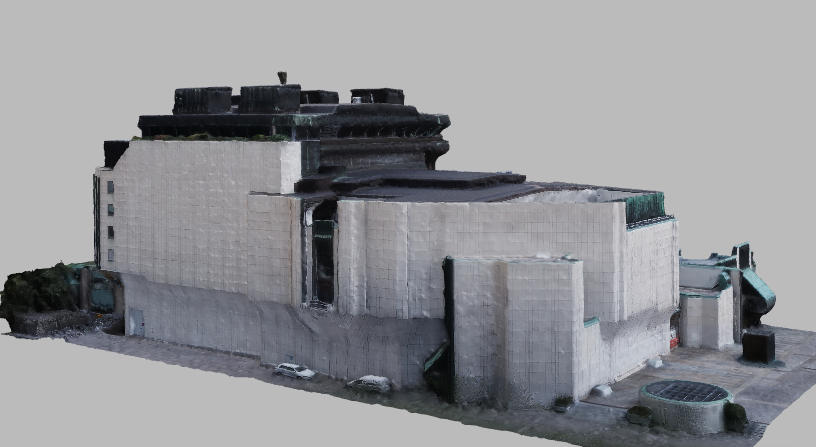
Approaching Republic Square in Ljubljana, visitors encounter a four-story modernist building clad in local Karst marble and green Oplotnica granite. Completed in 1959 by architect Vinko Glanz, a follower of Jože Plečnik's architectural tradition, the building expresses a national identity through materials drawn from Slovenian soil. Twenty-seven life-size bronze figures, sculpted by Karel Putrih and Zdenko Kalin, frame the monumental two-story entrance portal. Representing workers, farmers, and other figures of productive life, they form a sculptural assembly above four heavy oak doors.
Inside, the architecture becomes a showcase of Slovenia's regional stone. Pohorje granite stretches across the floors, while dark Podpeč stone lines the ground-floor walls. Upstairs, red Hotavlje marble and lighter stone surfaces introduce contrasting colours and textures, complemented by stone from Bela Krajina in the foyer. Timber fittings and carefully finished interior details extend this emphasis on local materials throughout the building.
Across the entrance vestibule runs Slavko Pengov's 67.4-metre-long fresco, painted between 1958 and 1959. Its continuous narrative traces the history of the Slovene people, from early settlement through centuries of political and social change to the Second World War. Originally opened as the Palace of the People's Assembly, the building witnessed Slovenia's transition from a Yugoslav republic to an independent state. In 1991, an adjoining building dating from 1879, originally constructed for the Carniolan Savings Bank, was incorporated into the parliamentary complex. The National Assembly subsequently held its inaugural session in December 1992.
At the building's centre lies the Great Hall, a 422-square-metre chamber arranged as an amphitheatre with seating for 150 people. Redesigned in 2000, it features a bronze relief of the Slovenian national emblem created by Marko Pogačnik in 1991. Here, 90 elected deputies conduct parliamentary proceedings, including two representatives of the indigenous Italian and Hungarian national minorities. Each year, approximately 13,000 visitors pass through these halls, where Slovenian stone, historical artworks, and the daily work of democratic government remain closely connected.
Metadata
Significance
Completed in 1959 to the designs of architect Vinko Glanz, the National Assembly Building is a central landmark of Slovenian parliamentary democracy. Located on Ljubljana's Republic Square, the site of Slovenia's 1991 independence declaration, the modernist building expresses national identity through its extensive use of Slovenian stone and timber. Its monumental entrance portal, adorned with 27 bronze figures representing working people, reflects the building's original civic purpose, while its continued use as the seat of the National Assembly connects its architectural heritage with Slovenia's democratic institutions.
@misc{FUNES_national_assembly_of_slovenia_2026,
  author       = {Fengze Cao, Yixuan Xie},
  title        = {{National Assembly of Slovenia (Državni zbor Republike Slovenije) -- 3D Cultural Heritage Record}},
  year         = {2026},
  publisher    = {FUNES.WORLD},
  howpublished = {\url{https://funes.world/entities/national-assembly-of-slovenia}},
  note         = {Technique: Photogrammetry; Format: .glb; License: CC BY-NC 4.0}
}
Academic References & Sources (10)
## Overview
The National Assembly of Slovenia (Slovene: Državni zbor Republike Slovenije) is the supreme representative and legislative institution of the Republic of Slovenia. Located in the national capital of Ljubljana at Republic Square (Trg republike), the National Assembly forms the principal lower house in Slovenia's asymmetric bicameral parliamentary system, operating alongside the upper advisory body, the National Council (Državni svet). The assembly consists of 90 deputies elected for four-year terms: 88 members are elected through an open-list proportional representation voting system across eight electoral constituencies, while two seats are reserved for representatives of the indigenous Italian and Hungarian national minorities.
## Historical Development
The physical seat of the assembly was designed by architect Vinko Glanz and constructed between 1954 and 1959. The structure was formally opened on 19 February 1959 as the Palace of the People's Assembly (Palača Ljudske skupščine), serving as the legislature for the Socialist Republic of Slovenia within Yugoslavia. Following democratic elections in April 1990 and the adoption of the Constitution of the Republic of Slovenia in December 1991, the newly established National Assembly assumed legislative authority, holding its inaugural session in December 1992.
To accommodate the growing functional needs of the independent state's parliament, the building was joined in 1991 to an adjacent 1879 structure originally built for the Carniolan Savings Bank (Kranjska hranilnica), which now houses offices for parliamentary groups and working bodies. The parliamentary complex underwent major interior modernizations in subsequent years, including the comprehensive redesign of the main assembly hall in 2000 and renovations of the Small Hall between 2019 and 2021.
## Architectural Features
Designed in a modernist style influenced by classical antiquity and the Plečnik architectural school, the building is structured as a four-story freestanding block covering a footprint of approximately 2,200 m² and encompassing around 14,000 m² of total usable space. The main exterior facade facing Republic Square is faced with Karst marble slabs, offset by green Oplotnica granite panels beneath the windows. Its defining architectural element is a two-story main portal supported by pilasters and framed by four oak entrance doors. The portal is adorned with 27 life-size bronze figures sculpted by Karel Putrih and Zdenko Kalin, representing allegorical depictions of working people, agriculture, and industry.
The interior design exclusively incorporates domestic Slovenian stone and timber. Pohorje granite is used for flooring, while walls throughout the building feature regional materials such as dark Podpeč stone on the ground floor, red Hotavlje marble on the first floor, light stone along staircases, and Bela Krajina stone in the foyer. A prominent artistic feature is a 67.4-meter-long, 1.4-meter-high fresco by Slavko Pengov, painted between 1958 and 1959 across the entrance vestibule, portraying the history of the Slovene nation from early settlement through World War II. The Great Hall (Velika dvorana), covering 422 m², serves as the primary plenary chamber and is arranged as a 150-seat amphitheater anchored by a bronze relief of the Slovenian national emblem, created in 1991 by Marko Pogačnik.
## Current Status
The building housing the National Assembly is legally designated and protected as a cultural monument of local significance in Ljubljana. It functions continuously as the operational seat of both houses of the Slovenian Parliament, hosting plenary debates, committee proceedings, and international diplomatic receptions. Beyond its official governmental function, the site serves as a civic landmark, offering educational visits, guided tours, and hosting approximately 13,000 visitors annually.
# National Assembly
## The highest representative and legislative authority
The National Assembly is a collegial body composed of 90 deputies, who are citizens of the Republic of Slovenia. Members of the Italian and Hungarian national communities are also represented in the National Assembly, with each of the national community being represented by one deputy, regardless of the number of its members.
## Composition of the National Assembly
Deputies of the National Assembly are elected by direct, secret ballot on the basis of universal and equal suffrage. Any citizen who has attained the age of 18 and has legal capacity and in respect of whom the parental right has not been extended beyond the age of majority may be elected as a deputy.
The term of office of a deputy lasts for four years unless interrupted by the dissolution of the National Assembly and early elections. The term of the National Assembly may be more than four years, but only in the case of war or state of emergency.
The office of deputy is performed on a professional basis, and for that reason, deputies may not hold other offices or carry out other activities which are incompatible with the office of deputy.
The National Assembly is composed of deputies who are citizens of the Republic of Slovenia. The Assembly numbers 90 deputies, who are elected in universal, equal, direct and secret ballots. They are representatives of the people, elected for a term of four years, provided of course that no early or extraordinary elections are called. They are not bound by any kind of instructions in their work.
One deputy each from the Italian and Hungarian ethnic communities in Slovenia are always elected to the National Assembly. With the exception of the deputies from the Italian and Hungarian ethnic communities, deputies are elected through the proportional representation system, with a 4 percent threshold for taking a seat in the National Assembly. Voters have a decisive influence on the allocation of mandates to candidates. The voting system is regulated in detail by the National Assembly Elections Act.
The National Assembly is the highest representative and legislative institution, and in addition to its basic legislative function it also performs the electoral and supervisory function of power. The National Assembly:
- adopts (legislative function):
- the Constitution or amendments thereof,
- acts,
- other general legislative documents,
- rules of procedure,
- consolidated texts of acts and authentic interpretations of acts,
- the national budget, the revised budget and closing account,
- ratifies international treaties,
- calls referendums,
- appoints and dismisses (electoral function):
- the Prime Minister and ministers,
- the President and Deputy President of the National Assembly,
- Constitutional Court judges and other judges,
- the Governor of the central bank,
- members of the Court of Audit,
- the Human Rights Ombudsman and so forth;
- as part of its supervisory function:
- it orders parliamentary enquiries,
- it decides on votes of confidence or no-confidence in the Government,
- it decides on impeachment of the national President, the Prime Minister and ministers in the Constitutional Court.
The National Assembly also decides on the declaration of a state of war or emergency and on the use of defence forces. It confirms the mandates of deputies, and decides on their immunity and the immunity of Constitutional Court judges and other judges. The National Assembly functions at sessions that are regular or extraordinary. Regular sessions are called at times when the Assembly is sitting regularly, that is from 10 January to 15 June, known as the spring sitting, and from 1 September to 20 December, known as the autumn sitting.
Through the elections, voters give Assembly deputies a mandate to decide on their behalf on the most important issues arising in society.
Elections to the National Assembly
The voting system for parliamentary elections is the most comprehensively delineated, so certain fundamental principles apply to other elections in this country. The legal provisions for other elections are formulated separately, but draw and rely on the provisions governing elections to the National Assembly.
The right to vote is universal and equal, meaning that it is the right of every citizen that has reached 18 years of age to vote and be elected regardless of class, ethnic, racial, economic or other affiliation. The principle of equal suffrage is especially emphasised. Equal voting rights relate to the active voting right, and mean that each vote of each voter has the same value, that in elections for the same representative body each voter has just one vote and that their vote takes no precedence over any other. The only exception to this principle of equal voting rights is the voting rights of the Italian and Hungarian ethnic communities, which each send one deputy to the National Assembly, while voters in those communities also vote on other National Assembly deputies. The law may determine under what conditions aliens also have voting rights.
Voting rights are regulated in detail by the National Assembly Elections Act.
The voting rights of members of the Italian and Hungarian ethnic communities is specially regulated for the election of deputies from those ethnic communities, since only members of the communities – and not citizens – have the right to vote and stand for election as deputies of the Italian and Hungarian communities.
The electoral process comprises standing as a candidate, voting and determining the outcome of voting. The process begins at a precisely determined time with the calling of elections, at which point the start time and closing time of the electoral process are determined. General elections to the National Assembly are called by the President of Slovenia.
All deputies are elected at the same time in general elections. Elections are divided into regular (every four years prior to the expiry of the mandate term) and early (held if the National Assembly is dissolved during its four-year term).
Repeat elections are those held at the time of general elections, if there have been irregularities and if the elections already held have been annulled owing to voting irregularities.
Subsequent elections are those held where a ballot was not held in the voting unit or individual polling station on the day assigned for voting.
Where it is necessary to elect one or more deputies, since owing to termination of a deputy mandate during the mandate term one or more seats have become vacant, this is referred to as a replacement election (by-election). Since under Slovenian legislation, elections to the National Assembly use the proportional system, there is a rule that by-elections are not held, since if a deputy’s mandate is terminated, the candidate from the list who would have been elected had the outgoing deputy not been elected then takes the seat.
Under Slovenian electoral legislation, candidates can be proposed either by political parties or voters.
Eight constituencies are formed for the election of deputies to the National Assembly. Each constituency elects 11 deputies. Each constituency is divided into 11 districts. The law has established the principle that one candidate is elected from each electoral district. Two special constituencies are formed, one each in the areas where the Italian and Hungarian ethnic communities live.
In the procedure for allocating mandates, the state election commission first determines which candidate lists across the entire country received at least 4% of votes cast. Mandates are allocated on two levels to those lists that have reached the threshold, as follows:
- in the constituency: deputy mandates are allocated under the Droop quota;
- on the national level: deputy mandates are allocated under the d’Hondt system.
Since the Constitution requires that voters have a certain influence on the allocation of mandates, this is partly provided through the election from the candidate lists (in terms of mandates obtained) of those candidates who received the highest share of votes in the total number of votes in the electoral districts where they stood. Voters may decide only on those candidates on the list that appears in their electoral district.
# Drzavni zbor Republike Slovenije (National Assembly Building), Ljubljana
Državni zbor Republike Slovenije (National Assembly Building) is the seat of Slovenia’s 90-member National Assembly and the centre of the country’s parliamentary life. Designed by Slovenian modernist architect Vinko Glanz, it was constructed between 1954 and 1959. Since Slovenia gained independence in 1991, the building has housed debates, votes, and other key functions of the national legislature.
The building reflects post-war Modernism through its balanced proportions, clean lines, and restrained decoration. Its exterior is clad in local Podpeč limestone and Kopriva marble. The most notable feature is the large bronze entrance portal by sculptors Zdenko Kalin and Karel Putrih. Its reliefs depict farmers, workers, scholars, families, and other figures, presenting an allegorical view of Slovenian society and national development.
The building faces Republic Square, an important civic space used for ceremonies, demonstrations, and public gatherings. The square hosted Slovenia’s 1991 declaration of independence. Visitors can view the sculpted portal and façade, while organised tours may be offered when parliament is not in session.
Want to visit this sight? Check out these Self-Guided Walking Tours in Ljubljana. Alternatively, you can download the mobile app "GPSmyCity: Walks in 1K+ Cities" from Apple App Store or Google Play Store. The app turns your mobile device to a personal tour guide and it works offline, so no data plan is needed when traveling abroad.
## Drzavni zbor Republike Slovenije (National Assembly Building) on Map
Sight Name: Drzavni zbor Republike Slovenije (National Assembly Building)
Sight Location: Ljubljana, Slovenia (See walking tours in Ljubljana)
Sight Type: Attraction/Landmark
Sight Location: Ljubljana, Slovenia (See walking tours in Ljubljana)
Sight Type: Attraction/Landmark
## Nearby Sights
## Walking Tours in Ljubljana, Slovenia
### Create Your Own Walk in Ljubljana
Creating your own self-guided walk in Ljubljana is easy and fun. Choose the city attractions that you want to see and a walk route map will be created just for you. You can even set your hotel as the start point of the walk.
### Explore Ljubljana Old Town on Foot
Ljubljana, Slovenia’s capital and largest city, developed at a natural crossroads between Central Europe, the Adriatic, and the Balkans, beside the navigable Ljubljanica River. People lived in the surrounding marshes in prehistoric times, leaving behind pile-dwelling settlements and a wooden wheel with an axle dating back about 5,200 years. By the early first century AD, the Romans had... view more
Tour Duration: 2 Hours
Travel Distance: 2 Km or 1.2 Miles
Tour Duration: 2 Hours
Travel Distance: 2 Km or 1.2 Miles
### Historic Buildings Walking Tour
The Slovenian capital has no shortage of historical buildings. The architectural wealth of Ljubljana accumulated over the years received a significant boost in the early 20th century thanks to the famous Slovenian architect, Joze Plecnik, a classicist, who tried to model the city on ancient Athens.
Among the notable local landmarks is the Ljubljana Central Pharmacy, a testament to the... view more
Tour Duration: 2 Hours
Travel Distance: 2.8 Km or 1.7 Miles
Among the notable local landmarks is the Ljubljana Central Pharmacy, a testament to the... view more
Tour Duration: 2 Hours
Travel Distance: 2.8 Km or 1.7 Miles
City Walks Overview
# National Assembly Building of Slovenia
National Assembly Building
stavba Državnega zbora
Former names
Palace of the People's Assembly (palača Ljudske skupščine)
Alternative names
Parliament (Parlament)
General information
Location
Republic Square, Ljubljana, Slovenia
Construction started
1954
Completed
1959
Owner
Slovenian Parliament
Technical details
Floor area
2,200 m2 (24,000 sq ft)
Design and construction
Architect
Vinko Glanz
Structural engineer
Alojzij Čigon
Main contractor
Tehnika
Website
www
The National Assembly Building (Slovene: stavba Državnega zbora), officially the Assembly of the Republic of Slovenia (Skupščina Republike Slovenije),[1] also colloquially the Parliament (Parlament) in Ljubljana, the capital of Slovenia, is a modernist palace housing the legislature of Slovenia. Built between 1954 and 1959 upon plans by the architect Vinko Glanz, it is a three-story building with an area of 2,200 m2 (24,000 sq ft). It is located at Republic Square in the center of Ljubljana. Annual visitor numbers are around 13,000.[2]
Despite its name, the building houses both the National Assembly (lower house) and the National Council (upper house) of the legislature. The building is listed in the official records as a cultural monument of local significance.[1] It was opened on 19 February 1959 as the Palace of the People's Assembly (Palača Ljudske skupščine), as it was originally the seat of the Socialist Republic of Slovenia's legislature, the People's Assembly.
## Construction
[edit]
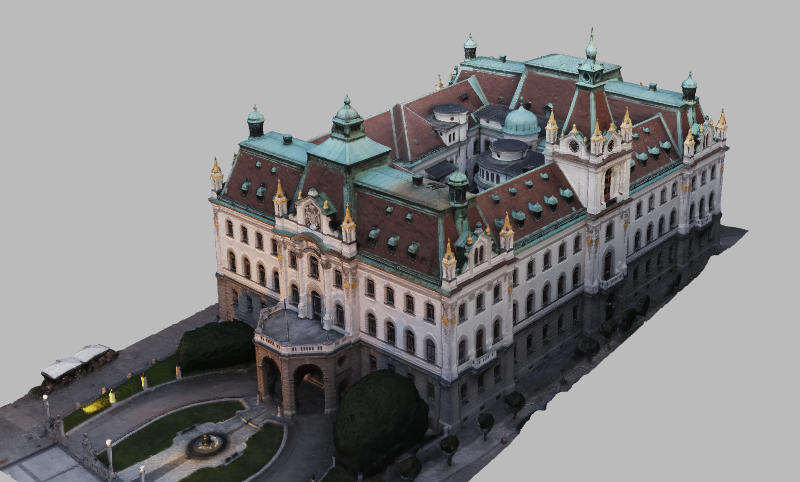
Following the end of World War II, a venue was needed to house the legislature of Slovenia, at the time a federal republic of communist Yugoslavia. Due to the centralizing policies of the pre-1941 Kingdom of Yugoslavia, there had been no sub-national legislatures in the interbellum period; the Austro-Hungarian palace on Congress Square that had housed the pre-1918 Provincial Diet of the Duchy of Carniola did still exist, but had been repurposed as the rectorate of the University of Ljubljana, and additionally had an undesirable association with foreign rule.
In the late 1940s, the Slovenian government began soliciting proposals for a new legislature building. Two designs were submitted by Slovenia's most respected architect, Jože Plečnik; the second of these, known as the "Cathedral of Freedom," featured a tall cone-shaped dome rising to 394 ft (120 m) atop a double colonnade.[3] The authorities rejected Plečnik's designs as too ostentatious, and instead commissioned the architect Vinko Glanz, who had proposed a much more conservative and modest design than either of the Plečnik concepts: an austere modernist palace in the International Style, with no monumental elements or decorations save a large sculptural group of bronze figures framing its main portico.[4]
Work began in 1954 on construction of the building to Glanz's plans, executed by the Ljubljana construction firm Tehnika.[5] Part of Glanz's ethos for the building was that the materials used should be of Slovenian provenance, including local hardwoods, granite, and marble.[4] Twenty-seven master craftsmen worked on the metalwork and joinery.[5]
### Opening
[edit]
The building, then known as the Palace of the People's Assembly, hosted the first session of the People's Assembly of the People's Republic of Slovenia on 19 February 1959.[5]
For its first 32 years, the building held meetings of the tricameral Assembly of the Socialist Republic of Slovenia. Following the independence of Slovenia in 1991, it gave way to use by the Slovenian Parliament: both the National Assembly and the National Council.[4]
## Design
[edit]
### Exterior architecture
[edit]
The four-storey building is externally austere. A freestanding cube,[6] the main façade faces Republic Square and is inlaid with Karst marble, with green Oplotnica granite below each window. The only decorative element is the two storey main portal – four oak doors surrounded by statues by Zdenko Kalin and Karel Putrih which represent working people.[7][4][8]
### Interior
[edit]
Inside, the building is furnished with paintings and frescoes by a selection of Slovenian artists. The largest, a 67.4 by 1.4 metres (221.1 by 4.6 ft)[5] wall painting by the 20th century mural artist Slavko Pengov, extends across the length of the entrance hall and illustrates the history of Slovenians. Created in 1958 and 1959, the mural portrays events including the Revolutions of 1848, the First World War and the 1918 creation of the Kingdom of Serbs, Croats and Slovenes, the Second World War and national liberation, and the creation of socialist Yugoslavia and homeland reconstruction.[9] The walls of the first-floor corridor are furnished with portraits of former Presidents of the National Assembly.[4] Following the 1991 independence of Slovenia, the building's interior has been refurbished several times to suit the desideratum of the new Slovenian Parliament.[7]
The center of the building is occupied by the 422 m2 (4,540 sq ft), 150 seat Great Hall, where the National Assembly convenes. Formerly rectangular, it was renovated into an amphitheater in 2000. Each seat has a microphone, an automatic voting system, plug socket and access to the National Assembly's computer network.[10] The chair facing the doors to the hall is for the President of the National Assembly. Behind it, a bronze relief of the coat of arms of Slovenia is positioned on the marble wall. The sculptor Marko Pogačnik created the work in 1991 to celebrate independence. There is also a 106-seat gallery for the public and guests to view the Great Hall.[10]
The National Council holds its meetings in the Small Hall, on the ground floor. The room is also used for public presentations and conferences.[11]
## Incidents
[edit]
On 18 May 2010, the front façade of the building, made of rare green tonalite, was severely damaged by students who threw granite rocks removed from a nearby pavement at the building's main entrance. The incident happened during a large student protest against the proposed law on the introduction of mini jobs that would curb student work and changes to scholarship policy.[12] Repairs to the building were estimated at 27,000 euros.[13]
## References
[edit]
- 1 2 "Ljubljana – Skupščina Republike Slovenije" [Ljubljana: The Assembly of the Republic of Slovenia] (in Slovenian). Heritage Information and Documentation Centre, Directorate for Cultural Heritage, Ministry of Culture. Retrieved 14 November 2023.
- ↑ "Praznunemo 20 Let Slovenskega Parlamenta [Celebrates 20 Years of Slovenian Parliament]" (in Slovenian). Archived from the original on 20 April 2016. Retrieved 15 February 2016.
- ↑ Wise, Michael Z. (16 October 1993). "The Designs of Slovenia's Joze Plecnik: An Idiosynchratic Architect". The New York Times. Retrieved 16 February 2016.
- 1 2 3 4 5 "About the building". Portal DZ.
- 1 2 3 4 Peršolja, Borut (December 2009). "Slovenska hiša demokracije" [Slovenian House of Democracy]. Adria Airways In-Flight Magazine (in Slovenian) (6): 70–77. ISSN 1318-0789.
- ↑ "Parlament – Državni zbor Republike Slovenije, Upravna stavba, Ljubljana, Vinko Glanz, 1959" [Parliament – the National Assembly of the Republic of Slovenia, Administrative Building, Ljubljana, Vinko Glanz, 1959]. Arhitekturni vodnik [Architectural Guide] (in Slovenian). Zavod Trajekt. Archived from the original on 8 July 2017. Retrieved 10 February 2012.
- 1 2 "National Assembly of the Republic of Slovenia (Slovenian parliament)". Visit Ljubljana. Retrieved 13 February 2016.[permanent dead link]
- ↑ "Obtolčeni kipi sreče, blaginje in miru" (in Slovenian). Retrieved 15 February 2016.
- ↑ "Mural of the history of the Slovene nation since settlement". Portal DZ.
- 1 2 "Great Hall and the lobby". Portal DZ.
- ↑ "Meeting rooms". Portal DZ.
- ↑ "Škoda po vandalizmu – najmanj 27 tisoč evrov" (in Slovenian). Retrieved 15 February 2016.
- ↑ "Demonstracij ni bilo, bilo je zgolj nasilje" (in Slovenian). 20 May 2010. Retrieved 15 February 2016.
## External links
[edit]
- Slovene Parliament building. Virtual panoramas. Burger.si. Accessed 28 February 2011.
- Palače Ljudske skupščine. 60. obletnica zgradbe // Republika Slovenija. Državni zbor
# Slovenian Parliament
Slovenian Parliament
Slovenski parlament
Type
Type
Houses
• National Assembly
• National Council
History
Founded
25 June 1991
Preceded by
Parliament of Yugoslavia
Leadership
President of the National Council
Speaker of the National Assembly
Seats
National Assembly: 90
National Council: 40
Elections
Last National Assembly election
22 March 2026
Meeting place
National Assembly Building, Ljubljana
Website
www
Member of
The Slovenian Parliament (Slovene: Slovenski parlament) is the informal designation of the general representative body of the Slovenian nation and the legislative body of the Republic of Slovenia.
According to the Constitution of Slovenia, the general representative body of the Slovenian nation is the National Assembly. The general public in Slovenia often refer to the National Assembly alone as the Slovenian Parliament.[1] However, the National Council, the representative body of basic social groups, also performs a further, if minor, part of the legislative function.[2]
The opinions of experts and of the general Slovenian public on whether the Slovenian Parliament is bicameral or unicameral differ, although most consider it to be incompletely bicameral.[3][4] In 2008, the Constitutional Court of Slovenia recognized the Slovenian Parliament as incompletely bicameral.[5]
## History
[edit]
The first Slovenian legislature was the Landtag or Diet of the Duchy of Carniola, the most predominantly Slovene-populated (95% in 1910) region of the Austro-Hungarian Empire. Established as part of the reforms that attended the Dual Compromise of 1867, the devolved legislature sat until the end of the empire in 1918. It consisted of a single chamber of thirty-seven delegates, whose competencies extended solely to local matters.
The interwar Kingdom of Yugoslavia was a centralist regime, with a national parliament but no regional assemblies. The legal continuity of the present Slovenian Parliament can therefore be traced to the Constituent Assembly of the People's Republic of Slovenia, a unicameral body with 120 delegates elected on 27 October 1946.
The Assembly had been convened to draft a constitution; having done so, it began functioning as a legislature, and was renamed to the People's Assembly of the People's Republic of Slovenia on 17 January 1947.
In 1953, the Assembly was made bicameral, encompassing two houses ("zbor", usually also translated as "assembly".) The generally-representative Assembly of the Republic was supplemented with an Assembly of Producers, intended for representatives of state-owned industries.
In 1963, a new constitution renamed the polity the Socialist Republic of Slovenia. The new Assembly of the Socialist Republic of Slovenia was made a rare quintocameral legislature, comprising an:
- Assembly of the Republic
- Economic Assembly
- Educational and Cultural Assembly
- Socio-Medical Assembly
- Organisational and Political Assembly
This was found to be unwieldy, and a 1968 amendment combined the middle three zbors into a single Assembly of Labor Associations, and renamed the final one to the Socio-Political Assembly.
A more radical reform followed soon afterward, when the devolutionary 1974 Yugoslav Constitution abolished the Assembly of the Republic altogether and transferred its competencies to the Socio-Political Assembly. Unlike the Assembly of the Republic - which had been de-facto dominated by the League of Communists of Slovenia (ZKS), but was nominally a representative legislature elected by universal suffrage - the Socio-Political Assembly was legally a single-party body. Its fifty seats were formally allocated (ten each) to the ZKS and four of its subsidiary organizations:
- the League of Socialist Youth of Slovenia (ZSMS)
- the Socialist League of the Working People of Slovenia (SZDLS)
- the League of Trade Unions, and
- the Association of Veterans of the Slovenian National Liberation War
Delegates were elected indirectly, in Soviet-style single-candidate approval votes held by similar socio-political assemblies established at the municipal level.
Despite this fundamental change, the 1974 Constitution retained the tricameral structure established in 1968. The Socio-Political Assembly was supplemented with a new Municipalities' Assembly (150 delegates) and an Assembly of United Labor (60-65 delegates). The latter zbor was a continuation of the 1968 Assembly of Labor Associations, and was (like it) geared toward the representation of economic and occupational interests (though it also contained representatives from state agencies, and a single delegate from the federal armed forces.)
Legislative reforms in 1990 saw the word "Socialist" dropped from the republic's name and the ZKS surrendering its privileged status. In the multi-party elections of the same year, the three zbors were retained, though their number of deputies was equalized at 80 each, for a total of 240. The Socio-Political Assembly was converted into a general representative body, while the other two zbors retained their specialized representation, but now on a contested basis. The basic structure of the 1974 constitution therefore endured until the first elections under the 1991 constitution could be held in December of 1992.
The new constitution abolished all three zbors. The Socio-Political Assembly was replaced by the National Assembly, a democratically-elected general representative body with ninety delegates. The functions of the Municipalities' Assembly and Assembly of United Labor were informally combined in the new 40-seat National Council, with 18 seats allotted to local interests and the remaining 22 to basic social groups such as employers, students, and workers.
## Seat
[edit]
The National Assembly and the National Council convene in a modernist palace known as the "Slovenian Parliament" and sited in Republic Square, Ljubljana. It was built between 1954 and 1959 by the architect Vinko Glanz. An unrealized project for a Slovenian Parliament building, designed by the architect Jože Plečnik in the late 1940s, features on the Slovenian euro coins.
## See also
[edit]
## References
[edit]
- ↑ "Državni svet: pogosto jabolko spora" [National Council: A Frequent Apple of Discord] (in Slovenian). MMC RTV Slovenija. 14 January 2009. Retrieved 16 December 2010.
- ↑ Veljković, Božidar; Melita Stiplošek; Natalija Ulaga; Monika Koražija (2006). Državni svet - del slovenskega parlamenta? [National Council - a Part of Slovenian Parliament?] (PDF) (in Slovenian and English). Retrieved 16 December 2010.
- ↑ Lakota, Igor (2006). Sistem nepopolne dvodomnosti v slovenskem parlamentu (diplomska naloga) [The system of incomplete bicameralism in the Slovenian Parliament (diploma thesis)] (PDF) (in Slovenian). Faculty of Social Sciences, University of Ljubljana. p. 62. Retrieved 16 December 2010.
- ↑ Mojmir Mrak; Matija Rojec; Carlos Silva-Jáuregui; World Bank (2004). "The Legislative Branch". Slovenia: From Yugoslavia to the European Union. World Bank Publications. pp. 56–57. ISBN 9780821357187. Retrieved 16 December 2010.
slovenia incomplete bicameral.
- ↑ "U-I-295/07-8" (in Slovenian). Constitutional Court of the Republic of Slovenia. 22 October 2008. Retrieved 16 December 2010.
S tega vidika lahko govorimo o nepopolni dvodomnosti slovenskega parlamenta, kajti po ustavnopravni teoriji se šteje za dvodomno vsaka ureditev, v kateri delujeta na področju zakonodajne funkcije dva organa, ne glede na to, kakšno razmerje je med njima.
## External links
[edit]
46°03′06″N 14°30′04″E / 46.05167°N 14.50111°E
Parliament name
-
Structure of parliament
Bicameral
Chamber name
Drzavni Zbor
Related chamber (for bicameral parliaments)
Drzavni Svet / National Council
POLITICAL SYSTEM
Type of political regime
parliamentary
Notes
The President of the Republic is the Head of State, represents the Republic and is commander-in-chief of its defence forces (Article 102 of the Constitution).
Head of the executive
Prime Minister
Notes
The Government is composed of the Prime Minister and government ministers (Article 110 of the Constitution). The President of the Government as head of the executive branch is responsible for ensuring the unity of the political and administrative direction of Government and coordinates the work of the government ministers.
Method for appointing the executive
The President of the Republic is elected in direct, general elections by secret ballot (Article 103 of the Constitution). After consultation with the leaders of parliamentary groups, the President of the Republic proposes to the National Assembly a candidate for President of the Government (Article 111 of the Constitution). The President of the Government is elected by the National Assembly with a majority vote of all deputies in a secret ballot. If such candidate does not receive the necessary majority of votes, the President of the Republic may, after renewed consultations, propose a new candidate or the same candidate again within 14 days. Candidates may also be proposed by parliamentary groups or at least ten deputies. If several candidates have been proposed, each one is voted on separately, beginning with the candidate proposed by the President of the Republic, and if this candidate is not elected, a vote is taken on the other candidates in the order in which they were proposed (Article 111 of the Constitution). Once a Prime Minister is elected, ministers are appointed and dismissed by the National Assembly on the proposal of the Prime Minister (Article 112 of the Constitution).
Term of office of the executive and coincidence with the term of the legislature
The President of the Republic is elected for a term of five years and may be elected for a maximum of two consecutive terms (Article 103 of the Constitution). The presidency's term of office does not coincide with the term of the legislature.
The National Assembly is elected for four years (Article 81 of the Constitution). The Prime Minister and other ministers cease to hold office when a new National Assembly convenes following elections (Article 115 of the Constitution).
Incompatibility of the functions of member of the executive and member of Parliament
Yes
A parliamentarian elected Prime Minister or appointed Deputy Prime Minister or minister may not perform the office of a member of the National Assembly for the time of the appointment (suspension of office).
Dissolution of Parliament
Yes
If no candidate Prime Minister is elected, the President of the Republic dissolves the National Assembly and calls new elections, unless within 48 hours the National Assembly decides by a majority of votes cast of deputies present to hold new elections for Prime Minister, whereby a majority of votes cast is sufficient for election of the candidate. In such new elections a vote is taken on candidates individually in order of the number of votes received in the earlier voting and then on the new candidates, in which any candidate proposed by the President takes precedence. If in such elections no candidate receives the necessary number of votes, the President dissolves the National Assembly and calls new elections (Article 111 of the Constitution).
If the National Assembly is dissolved, a new Assembly is elected no later than two months after the dissolution of the previous one. The term of the previous National Assembly ends on the first session of the new one, which is called by the President of the Republic no later than 20 days after its election (Article 81 of the Constitution). The National Assembly has not been dissolved in the last 13 years (1992-2005), but its term of office began only in 1992 on the basis of the new Constitution.
ACCOUNTABILITY
Accountability of Government to Parliament
Yes
Within the scope of their powers, Government and individual ministers are independent and accountable to the National Assembly (Article 110 of the Constitution). Ministers are collectively accountable for the work of Government, and each minister is accountable individually for the work of his or her ministry.
Modalities of oversight
- Oral and written questions of parliamentarians
In regular sessions of the National Assembly, a special item is usually allocated on the agenda for questions and initiatives from deputies. Deputies may put questions in writing or orally in the session. They also have the right to offer an initiative to the Government or an individual minister for the settling of specific issues or for the adoption of specific measures. The deputy who posed a question may propose that a debate be held on the Government's response.
Under the Rules of Procedure, a special agenda item for a session of the National Assembly is reserved once a month for parliamentary questions. For each discussion of parliamentary questions, the Bureau determines the date and time of the beginning of discussion of parliamentary questions and the duration of discussion. As a general rule, the afternoon part of the session is reserved for such discussion (Article 241 of the Rules of Procedure).
At the proposal of the deputy who put the question, the National Assembly may decide to hold a debate on the answer provided by the Government or minister or Secretary General of the Government. The National Assembly decides thereon without debate (Article 246 of the Rules of Procedure).
- Government reports to Parliament
Under the Rules of Procedure, together with the draft state budget, the Government also submits the budget memorandum and other documents related to the draft budget, as provided by law (Article 155 of the Rules of Procedure).
The National Assembly and its working bodies inform the Government of their sessions and meetings, their agenda and adopted decisions, and forward to it the necessary material (Article 236 of the Rules of Procedure).
The National Assembly may adopt a decision requesting the Government or an individual minister to report to the National Assembly on the implementation of laws and other regulations adopted by it, as well as on other measures within their competence and on the effects thereof (Article 237 of the Rules of Procedure).
The Government may report to the National Assembly on its work in writing or orally at sessions of the National Assembly. If the Government sends to the National Assembly a written report, the President of the National Assembly immediately informs the deputies thereof. The representative of the Government may explain such written a report at a session of the National Assembly (Article 239 of the Rules of Procedure).
Measures
- Vote of confidence on Government programs and/or legislative proposals
The Prime Minister may require a vote of confidence in the Government. If the Government does not receive the support of a majority of all deputies, the National Assembly must elect within 30 days a new Prime Minister or in a new vote must express its confidence in the incumbent one, or failing this, the President of the Republic dissolves the National Assembly and calls new elections. The Prime Minister may tie the issue of confidence to the adoption of a law or to some other decision in the National Assembly. If such decision is not adopted, it is deemed that a vote of no confidence in the Government has been passed. No less than 48 hours must elapse between the requirement of a vote of confidence and the vote itself (Article 117 of the Constitution).
Motions of censure and votes of no confidence (sub-report)
The National Assembly may pass a vote of no confidence in the Government only by electing a new Prime Minister on the proposal of at least 10 deputies and by a majority vote of all deputies (Article 116 of the Constitution). An interpellation with respect to the work of the Government or an individual minister may be initiated in the National Assembly by at least 10 deputies (Article 118 of the Constitution).
A vote of no confidence in the Government is passed by electing a new Prime Minister on the proposal of at least 10 deputies and by a majority vote of all deputies. No less than 48 hours must elapse between the lodging of a proposal to elect a new Prime Minister and the vote itself, unless the National Assembly decides otherwise by a two-thirds majority of all deputies, or if the country is at war or in a state of emergency. Where a Prime Minister has been elected, a vote of no confidence is expressed in him if on the proposal of at least 10 deputies (Article 116 of the Constitution). An interpellation with respect to the work of Government or an individual minister may be initiated in the National Assembly by at least 10 deputies. If, after the debate following such interpellation, a majority of all deputies carries a vote of no confidence, the national Assembly dismisses the Government or the minister (Article 118 of the Constitution).
Following a successful motion of censure, the incumbent Prime Minister is dismissed, but together with his ministers he must continue to perform his regular duties until the swearing in of a new Government. Ministers cease to hold office whenever the Prime Minister ceases to do so and whenever such ministers are dismissed. They must, however, continue to perform their regular duties until the appointment of new ministers (Article 115 of the Constitution).
Dismissal and/or impeachment of Government and other public officials (sub-report)
- Circumstances and persons concerned
If the President of the Republic violates the Constitution or seriously violates the law in the performance of his duties, he may be impeached by the National Assembly before the Constitutional Court (Article 109 of the Constitution). The National Assembly may also impeach the Prime Minister or ministers before the Constitutional Court on charges of violating the Constitution and laws during the performance of their office (Article 119 of the Constitution).
The impeachment procedure against the President of the Republic may be proposed by at least 30 deputies, and against members of Government by at least 10 deputies. The Constitutional Court decides either that the impeachment charges are justified or it dismisses the charges, and it may further decide on relieving the President of office by a two-thirds majority vote of all judges. Upon receiving a resolution on impeachment from the National Assembly, the Court may decide that pending a decision on impeachment, the President may not perform his office (Article 109 of the Constitution). The Constitutional Court considers the charges against members of Government in such a manner as determined for the President.
In 1995 and 1998, the National Assembly decided on a motion for impeachment of the Prime Minister before the Constitutional Court. In both cases, the impeachment proposal was not passed.
- Have these procedures been applied?
OVERSIGHT OVER THE ACTIONS OF THE GOVERNMENT ADMINISTRATION
Oversight over the actions of the Government administration
Yes
Within the scope of their powers, Government and individual ministers are independent and accountable to the National Assembly (Article 110 of the Constitution). Ministers are collectively accountable for the work of Government, and each minister is accountable for the work of his or her ministry.
Means and modalities of oversight
Under the Rules of Procedure:
(1) Within its scope of work, a working body may ask the Government and other state authorities as well as public institutions, public enterprises and public funds founded by the State to provide explanations and information which it needs to perform its tasks;
(2) Notwithstanding the first paragraph of this rule, at least one third of the members of the Committee for the Oversight of the Work of the Security and Intelligence Services and of the Committee for Budgetary and Other Public Finance Oversight may ask, in writing, the Government, other state authorities, public institutes, public enterprises and public funds founded by the State, to provide information and documents pertaining to the scope of work of such working bodies. The chairman of the working body must immediately forward the request received and bearing the signatures of at least one third of the members to the head of the authority or institute, enterprise or fund;
(3) The Government, other state authorities, public institutes, public enterprises and public funds founded by the State must immediately forward the information and documents requested by the working body referred to in the first paragraph of this Rule, or one third of its members referred to in the second paragraph of this Rule, unless such is contrary to the law;
(4) The exercise of oversight over the application of special forms, methods and measures for data gathering which, in accordance with the law, falls within the competence of the Committee for the Oversight of the Work of the Security and Intelligence Services, may be requested in writing by at least one third of the members of the working body. The chairman of such working body must guarantee the exercise of oversight immediately upon receiving such request (Article 45 of the Rules of Procedure).
In order to gather information, a working body may organize public hearings and invite experts and other persons who might provide useful information. The calling of a public hearing, together with issues on which information needs to be gathered is announced in the media. The working body may ask the persons invited to the public hearing to deliver their opinions in writing as well (Article 46 of the Rules of Procedure).
- Committees of inquiry and missions to Government departments
The National Assembly may order inquiries on matters of public importance, and it must do so when required by a third of the deputies or when required by the National Council. For this purpose, it appoints a Commission that in matters of investigation and examination has powers comparable to those of judicial authorities (Article 93 of the Constitution).
- Oral and written questions of parliamentarians
Under the Rules of Procedure, every deputy has the right to put a question or present an initiative to the Government or a minister or to the Secretary General of the Government, with the purpose of regulating individual issues or adopting certain measures within the scope of work of the Government or a minister or a government office. Parliamentary questions may be put orally or in writing. Parliamentary initiatives may only be presented in writing. A parliamentary question or initiative must be short and concise and formulated in such a manner that its meaning is clear. Parliamentary questions and initiatives and replies thereto are published in the gazette of the National Assembly. The reply must clearly indicate to which question or initiative it relates (Article 240 of the Rules of Procedure).
A special agenda item of the National Assembly session is reserved once a month for parliamentary questions. For each discussion of parliamentary questions, the Bureau determines the date and time of the beginning of discussion of parliamentary questions and the duration of discussion. As a general rule, the afternoon part of the session is reserved for such discussion. During the discussion of parliamentary questions, the President of the Government and ministers as well as Secretaries General of the Government must be present at the session of the National Assembly (Article 241 of the Rules of Procedure).
Oral questions
A deputy may only put two oral questions at each session. The deputy applies to put a parliamentary question to the President of the National Assembly no later than one day before the beginning of the session at which parliamentary questions are discussed by noon.The President of the National Assembly refers the question to the President of the Government or minister or Secretary General of the Government to whom such questions are addressed immediately after receiving the written application (Article 242 of the Rules of Procedure).
If the written application clearly states that the parliamentary question relates to issues of local importance, the President of the National Assembly refers such question to the Government or the competent minister to prepare a written answer (Article 243 of the Rules of Procedure).
In determining the order of applications for parliamentary questions, the person chairing the session of the National Assembly ensures that deputies of different deputy groups are given the floor. The first four questions are put by opposition deputies and a deputy of the governing coalition. If they relate to the formulation or implementation of government policy, the first four questions are answered by the President of the Government (Article 244 of the Rules of Procedure).
Parliamentary questions are answered by the President of the Government or a minister or a Secretary General of the Government at the same session within five minutes. If they are not able to provide an answer at the same session, they explain such orally, and send a written answer within 30 days (Article 245 of the Rules of Procedure).
If the deputy is not satisfied with the answer received at the session, he may request that such an answer be supplemented. The explanation of the deputy's request for the supplementation of the answer may not exceed two minutes, while the supplementation of the answer by the President of the Government, minister or Secretary General of the Government may not exceed three minutes. At the proposal of the deputy who put the question, the National Assembly may decide to hold a debate on the answer provided by the Government or minister or Secretary General of the Government. The National Assembly decides thereon without debate (Article 246 of the Rules of Procedure).
If owing to time constraints or the absence of the President of the Government, minister or Secretary General of the Government, or for any other reason, the President of the Government, the minister or the Secretary General of the Government are not able to answer the parliamentary question, the Government, minister or Secretary General of the Government must send a written answer within 30 days, to be published in the Gazette of the National Assembly. The deputy who put the question may declare he insists on receiving an oral answer. In such case the question is placed on the agenda of the next session of the National Assembly (Article 247 of the Rules of Procedure).
Written questions and initiatives
Deputies present written questions or initiatives to the President of the National Assembly. The President of the National Assembly refers the parliamentary question or initiative to the Government or minister or Secretary General of the Government (Article 248 of the Rules of Procedure).
The Government or minister or Secretary General of the Government answer the written parliamentary question or initiative in writing within 30 days after receiving the question or initiative. The President of the National Assembly immediately informs the deputy who presented a written parliamentary question or initiative of the answer. If the deputy is not satisfied with the answer, he may request that such an answer be supplemented. The Government or minister or Secretary General of the Government send the supplemented answer within 15 days after receiving the request (Article 249 of the Rules of Procedure).
- Role of Parliament in the appointment of senior Government officials
Not applicable. The National Assembly uses decisions to decide on elections, appointments and discharges, to give its consent to acts of public institutes and public enterprises and to appointments and discharges of managers and members of administrative bodies of such institutes and enterprises, in accordance with the law and the Act on Establishment, and to decide on procedural motions and other issues that fall within the scope of its powers (Article 112 of the Rules of Procedure).
- Activity reports of the Government administration and of public services or establishments
The duty to report to the National Assembly is provided for in some sectoral legislation, such as for the the Securities Market Agency and Agency for the Insurance Inspectorate.
- Representation of Parliament in governing bodies of the Government administration
A member of the National Council may not at the same time be a deputy (a member) of the National Assembly.
The Deputies Act determines stipulates that a deputy may not simultaneously be a member of the National Council, nor may he perform other functions or work in state bodies. Furthermore, a deputy may not perform a function in local community bodies on a professional basis (Article 10 of the Deputies Act).
On the day of confirmation of election as deputy, the deputy must cease to hold any office which is not compatible with the office of deputy and to perform any work in a state body (Article 11 of the Deputies Act).
Deputies may not perform profit-making activities which are by law incompatible with the performance of public office. They may not be members of a supervisory board of a commercial enterprise. They must cease to perform activities under the preceding paragraphs not later than three months after the confirmation of election as deputy. If they do not do so, then their term of office is terminated (Article 12 of the Deputies Act).
If a deputy is elected Prime Minister or appointed Deputy Prime Minister or Minister or State Secretary, he or she may not hold the office of deputy while performing such a function.
During this period, the office of deputy shall be held by the candidate from the list of candidates who would have been elected if the candidate from the preceding paragraph had not been elected. If no such candidate exists, the office of deputy shall be held by the candidate from the list of the same name in the constituency in which the list had the greatest remainder of votes in proportion to the quotient in the constituency (Article 14 of the Deputies Act).
Existence of an ombudsman
Yes
- Method for appointing the executive
The Constitution stipulates that in order to protect human rights and fundamental freedoms in relation to the state authorities, local self-government authorities and bearers of public authority, the office of the Ombudsman for the rights of citizens is to be established by a legal act. Special Ombudsmen for the rights of citizens may also be established by law for particular fields (Article 12 of the Constitution). The Human Rights Ombudsman Act stipulates that the Human Rights Ombudsman is to be elected by the parliament upon the nomination of the President of the Republic (Article 2 of the Human Rights Ombudsman Act). The Ombudsman is elected by the parliament with a two thirds majority for a term of six years, and after the expiration of this term of office, he or she may be re-elected only once (Article 12 of the Human Rights Ombudsman Act).
In performing his or her function, the Ombudsman must act according to the provisions of the Constitution and international legal acts on human rights and fundamental freedoms. While intervening, he or she may invoke the principles of equity and good administration (Article 3 of the Human Rights Ombudsman Act).
The Ombudsman must be autonomous and perform his or her functions independently (Article 4 of the Human Rights Ombudsman Act).
The Ombudsman submits to the parliament general annual reports and special reports on his or her work. The funds for the Ombudsman's work are to be allocated by the parliament from the state budget (Article 5 of the Human Rights Ombudsman Act).
The Ombudsman has not less than two but no more than four deputies. Deputies must be appointed by the parliament upon the nomination of the Ombudsman. The Ombudsman submits nomination for his deputies to the parliament not later than six months prior to the expiration of the term of office of the current deputy. The parliament decides on the nomination of the Deputy Ombudsman within 45 days after its submission (Article 15 of the Human Rights Ombudsman Act).
- Relationship to Parliament
The Ombudsman may investigate cases of illegal or irregular activities by state bodies. He or she may invoke the principles of fairness and good management and propose the initiation of disciplinary proceedings against officials. The Ombudsman has the authority to submit a request for an assessment of the constitutionality and legality of regulations and general acts issued for the implementation of public authority, or he or she may, with the consent of the person affected, submit a constitutional appeal against a claimed violation of a human right or basic freedom through an individual act by a state or similar body. The Ombudsman may submit to the National Assembly and the Government petitions to change laws and other regulations. He or she may also submit proposals to any state or other body falling within his or her jurisdiction for them to improve their methods of work and treatment of clients. The Ombudsman reports on his or her work to the National Assembly in regular annual or special reports.
BUDGETARY OVERSIGHT
Consultation of Parliament in the preparation of the national budget
No
With respect to budgetary proposals, the Government submits all relevant documents to the National Assembly. The Government submits the draft state budget for the following year by 1 October of the current year at the latest, together with the budget memorandum and other documents related to the draft budget, as provided by law (Article 155 of the Rules of Procedure).
All revenues and expenditures of the State and local communities for the financing of public spending must be included in their budgets (Article 148 of the Constitution).
Modalities of oversight
- Examination of the budget / finance act by Parliament
The National Assembly passes the budget as a special act and by a special procedure. Within five days from the submission of the proposed budget, the President of the National Assembly forwards it to the deputies and calls a session. The proposed budget and budget memorandum are presented by the Prime Minister and the minister of finance. Amendments to the proposed budget may be submitted by deputies, deputy groups, working bodies with a specific interest and by the central working body, the finance and monetary policy Committee. No later than 30 days from the presentation of the proposed budget, Government sets out its views on all the submitted amendments to which it agrees. Together with a supplemented proposal of the budget, Government must submit to the National Assembly the proposed budget implementation act.
When the voting on parts of the supplemented budget proposal is completed, the presiding officer determines whether the national budget is harmonised in terms of revenue and expenditures. If it is harmonised, the National Assembly votes on it in its entirety. Otherwise, the Assembly requests that Government or the finance and monetary policy Committee propose an amendment for harmonisation of the budget. No later than 15 days after the submission of the new budget proposal, the President of the National Assembly calls a session in which deputies debate and vote on parts of the budget and the amendments, and finally on the budget in its entirety.
The Government submits the draft state budget for the following year by 1 October of the current year at the latest, together with the budget memorandum and other documents related to the draft budget, as provided by law (Article 155 of the Rules of Procedure).
No later than five days following the submission of the draft state budget, the President of the National Assembly forwards to the deputies the draft state budget, the budget memorandum and other documents related to the draft budget, as provided by law, as well as the notification of the convening of the session at which the budget memorandum and the draft state budget will be presented. The session of the National Assembly at which the budget memorandum and the draft state budget will be presented is called by the President of the National Assembly no later than 10 days following the submission of the draft state budget. The budget memorandum and the draft state budget are presented at the session of the National Assembly by the President of the Government and the Minister of Finance. No debate is held on this presentation (Article 156 of the Rules of Procedure).
Amendments to the draft state budget may be tabled by deputies, deputy groups, the working bodies concerned and the working body responsible no later than 10 days following the presentation of the draft state budget at the session of the National Assembly. Amendments are tabled in writing and include a statement of reasons with regard to individual programme parts of the state budget. Anyone who proposes amendments must take into consideration the rule on the balance between budget revenue and expenditure. Amendments should not add charges to the budget reserve or general budget reserves, or incur additional borrowing (Article 157 of the Rules of Procedure).
Within 15 days following the presentation of the budget memorandum and the draft state budget, the working body responsible, at a session of the National Assembly, takes a position on all submitted amendments and adopts its amendments and draws up a report to be sent to the President of the National Assembly (Article 158 of the Rules of Procedure).
Within 30 days following the presentation of the draft state budget, the Government, at a session of the National Assembly, takes a position on all submitted amendments and on the basis of this position, the latest analyses of economic trends and the implementation of the state budget for the previous year, prepares a supplemented draft state budget and submits it to the National Assembly. The supplemented draft state budget is the submitted new integral text of the draft state budget, including the amendments with which the Government agrees and the necessary amendments made by the Government to the draft state budget. In a statement of reasons, the Government explains how it has taken into account the amendments of the qualified parties that made the proposals, and which additional amendments to the draft state budget it has made. The Government may propose to increase the budget or the borrowing (Article 159 of the Rules of Procedure).
Amendments to the supplemented draft state budget may be tabled by the working body responsible, a deputy group or at least one quarter of deputies. Amendments are tabled with regard to individual programme parts of the supplemented draft state budget (Article 160 of the Rules of Procedure).
The session of the National Assembly at which the debate on the supplemented draft state budget will be held is called by the President of the National Assembly within 15 days following the submission of the supplemented draft state budget (Article 161 of the Rules of Procedure).
When the voting on parts of the supplemented draft state budget is completed, the chairperson establishes whether the draft state budget is balanced in terms of revenue and expenditure and of individual parts. If in doubt, the chairperson requests the opinion of the Government and of the working body responsible. If the draft state budget is balanced, the National Assembly votes on it in its entirety (Article 162 of the Rules of Procedure).
If the chairperson establishes that the draft state budget is not balanced, the National Assembly requests the Government to submit, within a certain period of time, an amendment to balance the draft state budget. The amendment to balance the draft state budget may also be submitted by the working body responsible (Article 163 of the Rules of Procedure).
The budget implementation act must be harmonized with the adopted state budget. If the proposed act is not harmonized with the adopted state budget, the Government must propose a harmonizing amendment to the draft budget implementation act. If the harmonizing amendment is not adopted, it is deemed that the state budget has not been adopted (Article 164 of the Rules of Procedure).
If the state budget is not adopted, the National Assembly sets a time limit within which the Government must submit a new draft state budget. The President of the National Assembly convenes a session of the National Assembly within 15 days following the submission of the new draft state budget at the latest (Article 165 of the Rules of Procedure).
- Reports on the budget / finance act by Committees
The finance and monetary policy Committee sets out its views on amendments within 15 days from the presentation of the proposed budget, and drafts a report for the National Assembly.
Fields overseen
Parliament exercises oversight over all public funds.
- Budget of special departments
Parliament exercises oversight over all public funds.
The Court of Audit is the highest body for supervising state accounts, the state budget and all public spending. The organization and powers of the Court of Audit are prescribed by law. The Court of Audit is independent in the performance of its duties and bound by the Constitution and by the law (Article 150 of the Constitution).
Under the Rules of Procedure, the Committee for Budgetary and Other Public Finance Oversight:
- provides oversight of the implementation of the state budget and of the financial plans of the Pension and Disability Insurance Institute, Health Insurance Institute and public institute Radiotelevizija Slovenija in terms of legality, purpose and rationality of use and reliability of their financial statements on the basis of Court of Audit's reports;,
- monitors the implementation of the budgets of local communities which receive financial resources to balance their accounts, and controls the intended use of resources allocated from the state budget;
- controls the implementation of financial plans and the reliability of financial statements of public funds, public enterprises and institutes founded by the Republic of Slovenia;
- discusses draft laws, other acts and issues related to the control over the implementation of the state budget and other public finance as well as to the activities of bodies responsible for such control;
- reports to the National Assembly on the control performed and proposes the necessary measures (Article 39 of the Rules of Procedure).
- Role of Parliament in national development plans
On the proposal of the Government, the National Assembly adopts national programmes in the areas of public activities and economic infrastructure. Through these Assembly defines programmes of activity in individual areas that are financed from the budget or other public funds. The plan of development programmes, which is a constituent part of the budget, shows the planned budget expenditures on investments and State aid in the coming four years. The plan is supplemented each year.
Under the Rules of Procedure, the National Assembly adopts constitutional acts amending the Constitution, laws, authentic interpretations of laws, the state budget, the supplementary state budget, amendments to the state budget and the annual financial statement of the state budget, the Rules of Procedure of the National Assembly, ordinances, resolutions, declarations, recommendations and decisions, and official consolidated texts of laws (Article 107 of the Rules of Procedure).
The National Assembly uses resolutions to evaluate the state of affairs, to determine the policy and to adopt national programmes in individual areas (Article 109 of the Rules of Procedure).
The National Assembly uses declarations to state general positions on home and foreign policy issues and on individual issues of importance for the entire country (Article 110 of the Rules of Procedure).
The National Assembly uses recommendations to propose work measures for state bodies, organizations and individuals performing public service or exercising public authority (Article 111 of the Rules of Procedure).
Parliament's deadline for the examination and adoption of the budget / finance act
The Government must submit the budget together with the budget memorandum to the National Assembly no later than 1 October. The deadline for adoption of the budget by the National Assembly is the end of the calendar year, 31 December (Article 166 of the Rules of Procedure).
Consequences of failure by Parliament to adopt the budget / finance act
If a budget has not been adopted by the first day it is due to come into force, the beneficiaries financed by the Budget are temporarily financed in accordance with the previous budget (Article 148 of the Constitution).
If a budget is not adopted, the National Assembly sets a time limit within which the Government must submit a new draft state budget (Article 165 of the Rules of Procedure).
Budgetary autonomy of Parliament
Yes
The budget of the National Assembly is a constituent part of the national budget. It is drafted by the Secretary General of the Assembly in agreement with the collegium Bureau of the National Assembly President.
OVERSIGHT OF THE IMPLEMENTATION OF THE BUDGET AND OF GOVERNMENT SPENDING
Evaluation of Government spending
Parliament approves Government expenditures annually
Yes
The Government is accountable to the National Assembly for the execution of the budget. The National Assembly passes the closing accounts of the budget together with the report of the Court of Audit (Article 155 of the Rules of Procedure).
Parliamentary oversight of public companies
Yes
The Committee for Budgetary and Other Public Finance Oversight oversees the implementation of financial plans and the correctness of financial presentations by funds set up by law or by public companies and institutes. At least a third of the members of the Committee may request in writing from the Government, state bodies, public companies or funds data and individual documents that fall within the Committee's scope of activities.
The Rules of Procedure stipulate that:
(1) Within its scope of work, a working body may ask the Government and other state authorities as well as public institutes, public enterprises and public funds founded by the state, to provide explanations and information which it needs to perform its tasks;
(2) Notwithstanding the first paragraph of this rule, at least one third of the members of the Committee for Oversight of the Work of the Security and Intelligence Services and of the Committee for Budgetary and Other Public Finance Oversight may ask, in writing, the Government, other state authorities, public institutes, public enterprises and public funds founded by the State, to provide information and documents pertaining to the scope of work of such working body. The chairman of the working body must immediately forward the request received and bearing the signatures of at least one third of the members to the Head of the authority or institute, enterprise or fund;
(3) The Government, other state authorities, public institutes, public enterprises and public funds founded by the State must immediately forward the information and documents requested by the working body referred to in the first paragraph of this Rule or one third of its members referred to in the second paragraph of this Rule, unless such is contrary to the law;
(4) The exercise of oversight over the application of special forms, methods and measures for data collection which, in accordance with the law, falls within the competence of the Committee for Oversight of the Work of the Security and Intelligence Services, may be requested in writing by at least one third of the members of the working body. The chairman of such working body must guarantee the exercise of supervision immediately upon receiving such request (Article 45 of the Rules of Procedure).
Modalities of oversight
- Body for auditing the Government's books and method for appointing
The Court of Audit is the highest body for supervising state accounts, the state budget and all public spending (Article 150 of the Constitution). The organizations and powers of the Court of Audit are set out by law. The Court of Audit is independent in the performance of its duties and bound by the Constitution and laws. Members of the Court of Audit are appointed by the National Assembly.
- Reports of the public auditor's office
The Court of Audit submits its annual report to the National Assembly.
For parliamentary oversight over the budget through an established standing committee for budgetary and other public finance oversight.
Under the Rules of Procedure, the Committee on Finance and Monetary Policy deals with draft laws, other acts and problems concerning the sphere of the Ministry of Finance, and investigates problems concerning the implementation of monetary policy, in cooperation with the representatives of the Bank of Slovenia (Article 2 of the Decree on the Establishment of the Committee on Finance and Monetary Policy.
OVERSIGHT OVER FOREIGN POLICY
Foreign Relations Committee (sub-report)
- Functions of the Committee
Parliament exercises oversight over foreign policy through the Committee on foreign policy, the Committee on EU Affairs and the Commission for relations with Slovenes abroad.
The Committees and the Commission analyse and deliberate over issues concerning foreign and European affairs, adopt and communicate their views on matters in their competence to the National Assembly, draw up proposals and deliberate over reports, maintain bilateral and multilateral contact with foreign States and monitor the implementation of relevant policies.
- Composition of the Committee
The composition of the Committee on foreign affairs (19 members), Committee on EU Affairs (18 members) and Commission for relations with Slovenes abroad (9 members)
reflects the numerical representation of each party in Parliament.
- Bilateral visits of Parliament, inter-parliamentary conferences and information missions abroad
Parliament exercises oversight over foreign policy through bilateral visits, participation in inter-parliamentary conferences and information missions abroad.
- Plenary debates on foreign policy issues
Plenary debates on international relations and foreign policy are usually held on the adoption of ratification laws of international treaties. There have also been several extraordinary sessions that have dealt exclusively with foreign policy issues.
Involvement of Parliament
- Participation of Parliament in inter-governmental meetings
Parliamentarians may sometimes participate in intergovernmental meetings at the request of Government.
- Modalities and procedures for ratifying international treaties and agreements (sub-report)
Ratification of Treaties
(1) The National Assembly ratifies treaties by adopting a law;
(2) The draft law on ratification of a treaty is submitted by the Government;
(3) The ratification of a treaty is subject to the provisions of the Rules of Procedure that apply to urgent procedure;
(4) In the procedure for the ratification of a treaty, no amendments are possible to the text of the treaty.
(Article 169 of the Rules of Procedure).
- Other mechanisms for participation in foreign policy by Parliament
Apart from bilateral and multilateral activities, a significant role in the conduct of EU policy is played also by the Committee on EU Affairs. An important role in international cooperation is also attributed to friendship groups or quadrilateral meetings and permanent delegations of National Assembly in international organizations (such as NATO, OSCE, CEI, PACE, EURO-MED, IPU, and Quadrilateral meetings (Slovenia, Hungary, Italy, Austria)).
OVERSIGHT OVER NATIONAL DEFENCE POLICY
National Defence Committee (sub-report)
- Functions of the Committee
Parliament exercises oversight over defence policy through the Committee on Defence (Article 2 of the Decree on Establishment of the Committee on Defence).
The Committee deliberates over proposed laws, other acts and issues relating to the working area of the Ministry of Defence (Article 2 of the Rules of Procedure).
- Composition of the Committee
The composition of the Committee on Defence (10 members) reflects the numerical representation of each party in parliament.
Parliamentary oversight of public arms manufacturing companies
The Committee on Defence deliberates over special purpose production, the state of affairs and the capacities of manufacturing companies, and gives its opinion and position on the implementation of policy.
Circumstances and involvement
- Modalities and procedures in case of war, an armed attack or a state of emergency
A state of emergency should be declared whenever a great and general danger threatens the existence of the State (Article 92 of the Constitution). The declaration of war or state of emergency, urgent measures as well as their repeal, are decided by the National Assembly, on the proposal of the Government. The National Assembly decides on the use of the defence forces. In the event that the National Assembly is unable to convene, the President of the Republic decides on said matters. Such decisions must be submitted for confirmation to the National Assembly immediately upon its next convening.
- Role of Parliament in sending troops abroad
The National Assembly does not have any special competence in connection with sending troops abroad. The Government decides on the cooperation of the army in fulfilling obligations assumed in international organizations (General long-term plan on development and equipment of the Slovenian army; National Gazette, 97/2001).
- Other mechanisms for participation in national defence policy by Parliament
The form, extent and organisation of the defence of the inviolability and integrity of the national territory are regulated by a law adopted by the National Assembly with a two-thirds majority of deputies present (Article 124 of the Constitution). The conduct of defence policy is supervised by the National Assembly.
STATE OF EMERGENCY
Circumstances
A state of emergency is declared whenever a great and general danger threatens the existence of the State (Article 92 of the Constitution). A state of emergency may be declared if there is an imminent threat of attack on the State, or if a direct threat of war arises. A state of war is declared upon a direct attack on the State. A military attack on any part of the country and with any military means and methods whatever is deemed to be an attack on the entire country. Natural disaster covers disasters caused by natural forces, while other disasters are those caused by man through activities and actions, as well as war, state of emergency and other forms of mass violence.
The declaration of war or state of emergency, urgent measures as well as their repeal, are decided by the National Assembly, on the proposal of Government. The National Assembly determines the basic guidelines for organising and implementing safety from disasters, adopts and oversees the national programme of safety from disasters, and decides on the provisions of funds and other issues. In the event that the National Assembly is unable to convene, the President decides on said matters. Such decisions must be submitted for confirmation to the National Assembly immediately upon it next convening.
Can parliament take the initiative to declare a state of emergency
No
Consequences of a state of emergency for Parliament
In the event that the National Assembly is unable to convene due to a state of emergency or war, the President may, on the proposal of Government, issue decrees with the force of law (Article 108 of the Constitution). Such decrees may, in exception, restrict individual rights and fundamental freedoms. The President of the Republic must submit decrees with the force of law to the National Assembly for confirmation immediately upon it next convening. If his or her term of office expires during a war or state of emergency, the President's term expires six months after the cessation of such war or state of emergency (Article 103 of the Constitution). If the term of the National Assembly expires during a war or state of emergency, its term also expires six months after the end of the war or state of emergency, or earlier if the National Assembly so decides (Article 81 of the Constitution)
VERIFICATION OF THE CONSTITUTIONALITY AND THE APPLICATION OF LAWS
Modalities of oversight
- Body ruling on the constitutionality of laws
A specialised body / constitutional Court
The Constitutional Court is composed of nine Judges, elected on the proposal of the President of the Republic by the National Assembly (Article 163 of the Constitution). The judges are elected from among legal experts. The President of the Constitutional Court is elected among the judges for a term of three years. Judges are elected for a term of nine years, and may not be re-elected (Article 165 of the Constitution).
The Constitutional Court decides (i) on the conformity of laws with the Constitution, (ii) the conformity of laws and other regulations with ratified treaties and with general principles of international law, (iii) on the conformity of regulations with the Constitution and with laws, (iv) on the conformity of local community regulations with the Constitution and with laws, (v) on the conformity of general acts issued for the exercise of public authority with the Constitution, laws and regulations, (vi) on constitutional complaints stemming from the violation of human rights and fundamental freedoms by individual acts, (vii) on jurisdictional disputes between the State and local communities and among local communities themselves, (viii) on jurisdictional disputes between courts and other State authorities, (ix) on jurisdictional disputes between the National Assembly, the President o f the Republic and the Government, (x) on the unconstitutionality of the acts and activities of political parties, and (xi) on other matters vested in the Constitutional Court by the Constitution or laws (Article 160 of the Constitution).
In the process of ratifying a treaty, the Constitutional Court, on the proposal of the President of the Republic, the Government or a third of the deputies of the National Assembly, issues an opinion on the conformity of such treaty with the Constitution. The National Assembly is bound by the opinion of the Constitutional Court. Unless otherwise provided by law, the Constitutional Court decides on a constitutional complaint only if legal remedies have been exhausted. The Constitutional Court decides whether to accept a constitutional complaint for adjudication on the basis of criteria and procedures provided by law (Article 160 of the Constitution).
If the Constitutional Court establishes that a law is unconstitutional, it abrogates such law in whole or in part. Such abrogation takes effect immediately or within a period of time determined by the Constitutional Court. This period of time may not exceed one year. The Constitutional Court annuls or abrogates other regulations or general acts that are unconstitutional or contrary to law. It may, up until a final decision, suspend in whole or in part the implementation of an act whose constitutionality or legality is being reviewed. If in deciding on a constitutional complaint the Constitutional Court establishes the unconstitutionality of a regulation or an act, it may annul or abrogate such regulation or act (Article 161 of the Constitution).
The Constitutional Court decides by a majority vote of all Judges unless otherwise provided for individual cases (Article 162 of the Constitution).
Evaluation of laws
No
Not applicable
Measures
### The (Un)Realized Parliament
22. 12. 2017—6. 5. 2018
### The (Un)Realized Parliament
22. 12. 2017—6. 5. 2018
In the newly formed country after the end of World War II, the Federalist People’s Republic of Yugoslavia, some of Slovenia’s public and administrative offices were housed in existing buildings in Ljubljana’s city centre. Parliament sessions took place in Kazina building, which clearly expressed the need for a new People’s Assembly building. On 23 January 1947, Ferdo Kozak, the president of the assembly, met with the architect Jože Plečnik to talk on the subject of »building the Slovenian parliament.«* The event was followed by an extensive correspondence, held today by the Manuscript Collection of the National and University Library and the Plečnik Collection.
Plečnik originally proposed the location on top of the Castle Hill, where he intended to place a large octagonal structure and connect it by way of a monumental stairway with the entrance to the Magistrat building. Meanwhile however, the government set a new location in park Tivoli, at the location of the then fairground area. On 1 May 1974, it launched an invitation for the submission of ideas for the construction of People’s Assembly building, and received 18 proposals. Some of the most important Slovenian and Yugoslav architects took part in the competition, among them I. Spinčič, T. Bokal, P. Göstl, F. Bitenc, B. Kocmut, O. Gaspari, M. Zupančič, D. Derkovič, E. Ravnikar, N. Bežek, V. Antolić, R. Masarović, J. Neidhardt, and others.
The council of experts in charge of assessment and evaluation of drafts proposals, which included the architect Vinko Glanz, the author of the later realized proposal for the parliament building, did not award the first prize. Two equivalent second prizes were awarded to Edvard Ravnikar and associates and Jurij Neidhardt, and the third prize went to Vlado Antolić.* The majority of proposals dealt solely with the architectural solution of the building itself and with its immediate surroundings. Of all the architects taking part in the competition, it was only Ravnikar who saw in it the opportunity to tackle the wider problem of country’s new administrative centre in which the People’s Assembly building would form a coherent whole with People’s Assembly Presidium building, a culture park in the so-called nunnery garden or next to the Cekin Castle, Government Presidency building, Central Committee of Communist Party of Slovenia palace along Ljubljana’s main thoroughfare and the cultural institutions in this area of the city.*
Criticizing the proposals for new People’s Assembly building, Dušan Grabrijan, the rapporteur for the council of experts, warned that in such an important assignment, one should not imitate foreign role models (Pantheon, Washington Capital, etc.) or resort to provincial or classicist solutions inspired by small German states (Weimar, Hannover, etc.), but that instead, a creative solution adapted to local circumstances should be sought.*
A few months later, the Presidency of the People’s Assembly decided to assign the task to five selected architects: Jože Plečnik, Edvard Ravnikar, Vinko Glanz, Nikolaj Bežek and Marko Zupančič. In his reply letter to Kozak, Plečnik is full of gratitude: »If taken seriously, this task would be far beyond the powers of my old age! The young generation is maturing – let them mature all the way up! I think the time chosen to produce new, final designs for the new parliament, is a very good time.«* And yet, urged by Ferdo Kozak »…’hors concours’, or outside of competition*«, he sent in a draft design for a monumental Slovenian parliament which was a derivation of some of his religious ideas from the pre-war time and which he symbolically named the Cathedral of Freedom. Later on, he also had a wooden 1 : 100 scale model made.
The results of this competition remain a mystery; what happened on the subject of People’s Assembly between 1947 and 1954 is not known. Was Glanz engaged for this issue because he was, as an architect, a member of the executive committee and was also in charge of renovation of many other projects concerning state protocol buildings, or was it the result of his taking part in the 1947 competition?*
As Plečnik’s student, the functionalist-oriented architect Vinko Glanz maintained a living bond with his teacher’s creative credo, hence his sense for the monumentality of architectural address and pathos reflected in the outer appearance of the Palace of the People’s Assembly and its sculpture-adorned entrance portal (Zdenko Kalin and Karel Putrih), in the classical design of its interior and in each of its individual architectural elements.*
Built in 1958, the representative and monumental Palace of the People’s Assembly symbolized the power of political authorities of the time, while at the same time reflecting the modernist spirit present in the architectural language of its exterior. It was in this building that in 1991, following the nation’s decision at the all-Slovenian referendum, the first independent Slovenian state was voted through. Since then, the state has built no further building that would symbolize individual aspects of state activities or its highest representatives.
Perhaps this is why the question whether Plečnik’s »Cathedral of Freedom«, despite the fascination and different artistic re-interpretations and questionings of state symbols, belongs to the realm of utopia, remains just as relevant today.
MAO collection holds some of Glanz’s drawings for assembly hall seats and benches, several drawings of the portal, a few unfinished floor plan designs made as ozalid prints and a design for the southern facade of the assembly building drawn on a transparent paper. Also presented at the exhibition are photographs of the assembly building by Janez Kališnik and Marko Turk’s microphone, all held by MAO, a club chair and table (National Museum of Slovenia), archival footage by RTV Slovenia (Slovenia’s national broadcasting organization), correspondence between Ferdo Kozak and Jože Plečnik (National University Library) and the documents concerning Jože Plečnik’s unrealized design for the Slovenian parliament.
We would hereby like to thank institutions and individuals for loaned material, to Mr. Lojze Gostiša for allowing the use of portrait photographs of Jože Plečnik and Vinko Glanz taken on Brioni islands, as well as to Milan Kambič for his color photographs of parliament interior showing the architect’s symbolic use of stone cladding, flooring and other details made of materials from Slovene quarries.
Curated by Natalija Lapajne
____
*Official invitation by the People’s Assembly of the People’s Republic of Slovenia, 23. January 1947, held in Plečnik Collection, Museums and Galleries of Ljubljana.
*Report by the council of experts in charge of assessment and evaluation of draft proposals for the construction of the People’s Assembla of the People’s Republic of Slovenia building, Ljubljana, dated 7. Sept. 1947, held by MAO. Selected members of the council were the following architects: A. Ulrich, M. Sever, S. Rohrman, V. Glanz, D. Smrekar and D. Grabrijan.
*Breda Mihelič, Urbanistični razvoj Ljubljane, Partizanska knjiga, Ljubljana, 1983, pp. 36–38.
*Dušan GRABRIJAN, Natečaj za ljudsko skupščino Ljudske republike Slovenije v Ljubljani, Arhitektura 2, 7 (Feb. 1948), pp. 3–14.
*Letter by Jože Plečnik to Ferdo Kozak, 3 Oct 1947, Manuscripts collection at National University Library, estate of F. Kozak MS1875.
*Letter by Jože Plečnik to Ferdo Kozak, 11 Dec 1947, Manuscripts collection at National University Library, estate of F. Kozak MS1875.
*Nika Grabar, Kaja Širok, Martina Vovk, Parlament – Tri zgodbe, Muzej novejše zgodovine Slovenije, Ljubljana, 2012, p. 19.
*Stane Bernik, Slovenska arhitektura dvajsetega stoletja, Ljubljana 2004, pp. 322–323.
Location
MAO
Pot na Fužine 2
Ljubljana
Admission
free admission
Info
infobio(at)mao.si
+386 1 54842 74
Organization
MAO
# Vinko Glanz
## Architect of the Nova Gorica municipal building
After completing high school in Šibenik, he studied naval engineering in Zagreb, and then architecture in Ljubljana under Jože Plečnik, graduating in 1927. He worked with Plečnik until 1929 on plans for Ljubljana, Rab, and Šibenik, after which, on Plečnik’s recommendation, he moved to Dubrovnik to work in the heritage protection service. Following his military service in Sarajevo, he returned to Ljubljana in 1930 and, as an architect for the Drava Banovina, participated in the project of the Jugoslovanski kralj (Slovenski dom) hotel in Rogaška Slatina.
After the Second World War, he was involved in assessing war damage and post-war reconstruction, and was employed at the Design Institute of the Republic of Slovenia and later at the company Slovenija projekt. From 1953 to 1977, he served as a construction advisor to the Executive Council of the Socialist Republic of Slovenia. As a student of Plečnik, drawing was central to his architectural process, and his teacher’s influence is evident in works such as the tomb of Gregor Žerjav and the Trubar monument in Rašica.
After the war, he designed numerous buildings and monuments, including representative structures on the Brioni Islands, the Gramozna jama memorial complex, and various projects across Slovenia and Istria, while also participating in architectural competitions. Among his notable works are also the municipal building in Nova Gorica, Villa Bled, Podrožnik, and the renovation of the Brdo estate near Kranj.
His most important work is the building of the People’s Assembly (today the National Assembly of the Republic of Slovenia), completed in 1959, for which he used predominantly local materials.
Avtor: Manuela Dajnko
Vir:
Excerpt from the article: https://www.novagoricaart.si/osebnost/vinko-glanz/
"Come enter the Chambers"
" COME ENTER THE CHAMBERS
Europe is rich in Parliaments, in their history, in their heritage and in their influence.
Celebrating the European Year of Citizens 2013, the French Assemblée nationale would like to take you to an unprecedented tour through Parliamentary Europe. Through their committees
on European union affairs, national parliaments are
actively involved in European integration.
From Tallinn to Lisbon, from Stockholm to Athens, from Brussels to Bucharest, open the doors and enter the Chambers. You will discover European democracy landmarks as you have never seen them ! "
Parliamentary assemblies are presented in alphabetical order of their names in their original language.
"Assemblée nationale
Paris - France"
The Palais Bourbon colonnade
Opening of the 14th legislature of the French National Assembly, June 2012
The Palais Bourbon together with the hotel de Lassay - which is the official residence of the Speaker of the National Assembly - were built between 1722 and 1728 to a design by architect Giardini, who got his inspiration from the Grand Trianon.
The Palace was built for the Duchess of Bourbon - legitimized daughter of Louis XIV - and has been the seat of the Assembly since 1798, when the “Council of the Five Hundred” became the first Chamber holding session there.
Under the Napoleonic Empire, architect Bernard Poyet built a thirty-step pedimented portico of twelve columns: the colonnade soon became the very symbol of the National Assembly.
www.assemblee-nationale.fr
The Palais Bourbon Cour d'Honneur
Plenary hall of the French National Assembly
The National Assembly library
Palais Bourbon, 'round midnight
"Assembleia da Republica
Lisbon - Portugal"
Palace of São Bento – the façade of the Assembly of the Republic of Portugal
Formal opening of the 12th legislature - 21 June 2011
Plenary hall of the Assembly ot the Republic of Portugal
The lobby
The Assembleia da Republica is the unicameral parliament of Portugal.
It sits currently in the Palace of Sao Bento - in which building work started in 1598 and lasted 340 years - til 1938.
Designed by architect Afonso Àlvares, the Palace of Sao Bento was originally a Benedictine monastery; its ownership was transferred to the Portuguese State upon dissolution of religious orders.
The palace became the seat of the Portuguese parliament in 1834 under the liberal regime. It was declared a national monument in 2002.
www.parlamento.pt
The former Senate plenary hall
"Bundesrat
Berlin - Germany "
German Bundesrat plenary
Preussisches Herrenhaus – the façade of the German Bundesrat
The Bundesrat is the German parliament upper chamber; it is also known as the Federal Council.
The three-winged building was designed in 1904 under the supervision of architect Friedrich Schulze-Kolbitz as the upper chamber of the Prussian parliament. It was partially destroyed during world war two.
In between the end of world war two and German reunification, it was used by various GDR institutions. Major renovation was undertaken in 1997 by architectural firm Schweger & Partner, so that the Bundesrat may convenes its sessions there - which is the case since August 2000.
www.bundesrat.de
Plenary hall of the German Bundesrat
"Bundesrat
Vienna - Austria"
Nationalrat and Bundesrat – National Council and Federal Council of Austria
The Bundesrat is the federal chamber of the Austrian Parliament. It is known as the Federal Council The Federal Council is the chamber which represents the interests of the nine Federal Provinces (Länder) in the legislative process.
The Austrian Parliamen was built between 1874 and 1883 designed by the Danish-born architect Theophil Hansen, who got his inspiration from Greek architecture.
In Austria the construction of a building for the Reichsrat, the Council of the Realm, had been debated since the end of the Revolution of 1848, but the constitutional preconditions were only created with the “October Diploma” of 1860 and the February Patent" of 1861. The Parliament building was the home of the House of Deputies (Abgeordentenhaus) and the House of Lords (Herrenhaus). After the fall of the Austro-Hungarian Empire the Parliament building became the home of the National Council (Nationalrat) and of the Federal Council (Bundesrat).
The Parliament building was largely destroyed in the Second World War, but rebuildt and refurbished.
www.parlament.gv.at
Austrian Bundesrat plenary
The Austrian Parliamentary Library serves both chambers
"Bundestag
Berlin - Germany"
The façade of the Bundestag
Bundestag plenary
Bas-relief on the Bundestag façade
On June 20th 1991, the Bundestag passed a bill to transfer to Berlin both parliament and government. The Council of Elders decided that the former Reichstag building, dating from the late 19th century, would be the seat of parliament.
Following various international architectural competitions, a new parliamentary district was created, with the transformed former Reichstag building - and its glass dome accessible to visitors - becoming its very symbol.
British architect Sir Norman Foster managed to retain the historic facade of the former Reichstag while creating spaces for a modern and open parliament.
www.bundestag.de
The Bundestag Dome
"Camera dei Deputati
Rome - Italy"
Montecitorio Palace
Italian Chamber of deputies plenary
The Italian Camera dei deputati sits in Montecitorio palace, which was built in the 17th century by Gian lorenzo Bernini for Pope Gregory XV's nephew, young Cardinal Ludovico Ludovisi.
With the death of the Pope in 1655, work stopped and was not restarted until 30 years later when Pope Innocent XII decided to install the Apostolic Curia (papal court) there.
After the unification of Italy and the annexation of the Papal States in 1870, the transfer of the capital to Rome imposed to choose seats tailored to the needs of the institutions of the Kingdom.
Montecitorio was attributed to the Chamber of Deputies and renovation work was undertaken speedily to adapt the old palace to its new parliamentary requirements.
The inauguration took place in July 1871, but the new chamber soon proved itself inadequate. In 1900 the Questors of the Chamber decided to undertake work. Until 1918, the assembly thus had to meet in a small temporary hall.
www.camera.it
Plenary hall of the Italian Chamber of deputies
Stained glass and iron ceiling above the plenary hall of the Italian Chamber of deputies
"Camera Deputatilor
Bucharest - Romania"
Palace of the Parliament
The Camera Deputatilor is the lower chamber of the Romanian parliament. It is located in the emblematic building of the Palace of Parliament, in the heart of the historic center of Bucharest.
With its 365 000 sqm, and according to the administrative buildings section in the Guinness book of records, it is the second largest administrative building and the third largest one in volume in the world.
Its dimensions are spectacular: 84 m high, 275 m long and 235 m wide.
Construction began on June 25th 1984. Initially named “the House of the Republic”, it became “The People's House” before acquiring its present name of “Palace of the Parliament”.
600 architects and no less than 20 000 workers worked on the site day and night.
The palace combines in an eclectic fashion elements of traditional Romanian architecture (where Brancovenesc style predominates), of Romanian popular ornamental art (such as the rosette, symbol of the sun or typical wooden sculptures), as well as Renaissance, Baroque and Germanic influences.
The architectural ensemble uses impressive amounts of marble, steel, concrete as well as many types of wood. Materials of all the provinces of Romania were used so that the entire country has contributed to the construction and decoration of its halls.
The building - which is divided into 21 parts - alternates monumental spaces, auditoriums, generously proportioned halls and richly ornate lobbies.
Since 1989, the building has become the symbol of Romanian democracy. It houses the Chamber of Deputies since 1996 and the Senate since 2004, as well as the Constitutional court and the Legislative Council.
www.cdep.ro
Romanian Chamber of deputies plenary Committee room Cupola of the plenary hall
"Chambre des Députés
Luxembourg - Grand Duchy of Luxembourg"
Main entrance of the Chamber of deputies
Luxembourg Chamber of deputies plenary
Plenary hall of the Luxembourg Chamber of deputies
The Chambre des Députés is the unicameral parliament of Luxembourg.
After independence in 1839, the Assembly of States, which later was renamed Chamber of Deputies used to sit in Government Hall, the current Grand Ducal Palace. Later, as Government Hall became the residence of the Grand Duke, Parliament used to sit in the City Hall of Luxembourg city.
In 1858, Wirtgen House, Baustert House, Hernandez House and Heynen House, located on the Krautmaart, were demolished to give way to building a new Chamber of Deputies. It was built to the design of engineer Antoine Hartmann. It is detached from Government Hall; 4 facades are examples of the “historicist style”, together with Gothic, Renaissance and classical elements.
The current building - called Hall of the Chamber - was built between 1858 and 1860. The Chamber of Deputies moved in in October 1860.
In 1881, it was enlarged and transformed and more spacious galleries were created.
More recently - in the 1980s and 1990s, the Hall of the Chamber has been enlarged and renovated.
www.chd.lu
Hall of the Luxembourg Chamber of deputies
"Chambre des Représentants
Brussels - Belgium"
Aerial view of the Palace of the Nation - Belgian Federal Parliament
Palace of the Nation - Belgian Federal Parliament
House of the representatives of Belgium plenary
Plenary hall of the House of Representatives of Belgium
Speakers' portrait gallery
The House of Representatives of Belgium, also known as “La Chambre” is one of the two Chambers of the Belgian federal parliament.
Since 1831 the Chambre sits in the Palace of the Nation, a building of neo-classical style built between 1778 and 1783 at the time of the Austrian Netherlands to a design by architect Barnabé Guimard.
The building first housed the States General of the Netherlands before becoming in 1831, after the Belgian independence, the seat of the Chamber of Representatives.
The Palace of the Nation building is itself the result of the integration of the Palace of the Chancellery with the palace of the Court of Auditors.
In 1883, the building was destroyed by fire, and it took three years to architect Henri Beyaert to rebuild it.
www.lachambre.be
"Congreso de los Diputados
Madrid - Spain"
Palace of the Congress of deputies
The Congreso de los diputados is the lower chamber of the Cortes generales, which is the parliament of the Kingdom of Spain, established by the 1978 Constitution.
It is located in a nineteenth-century palace built by architect Narciso Pascual Colomer, and inaugurated in 1850. This building was originally a convent before becoming the seat of the assembly.
www.congreso.es
Congress of deputies plenary
Plenary hall of the Congress of Deputies
The Congress of deputies library
"Dáil
Éireann
Dublin - Ireland"
Leinster House - Oireachtas (Parliament)
Dáil Éireann is the lower Chamber of the Irish parliament that sits in “Leinster House” in Dublin.
The building, built between 1745 and 1748, was originally the residence of the Duke of Leinster, and the headquarters of the Royal Dublin Society. It was not until 1922 - the year of the creation of the Irish Free State- that it became the seat of both chambers of the Irish parliament.
By metonymy, the term “Leinster House” also refers to Irish political life.
www.oireachtas.ie
Dáil Éireann plenary
Plenary hall of Dáil Éireann
"Drzavni Svet
Ljubljana - Slovenia
"
Slovenian Parliament building
"Drzavni Zbor
Ljubljana - Slovenia"
Drzavni zbor (National Assembly) is located in the postmodern parliament building which construction began in 1954 to a design by architect Vinko Glanz and was completed in 1959. It hosted the first session of the People's Assembly of the People's Republic of Slovenia on 19 February 1959.
Using national materials was the guideline for the building. Thus, the entire building was tiled with karst marble, while areas under the windows were filled with green granite. The main façade accent is on portal. Academy sculptors Putrih and Kalin mounted the symbolic sculptural compositions on five pillars, suporting the portal.
Indoors, local materials such as marble, stone and wood have been exclusively used. Mosaics and paintings that adorn the interior of the Parliament are the work of Slovenian artists. The area in front of the Large Hall contains a mural by academy painter Slavko Pengov depicting the history of the Slovenian nation from the Slav colonisation to the start of post-war renewal.
To meet the requirements of parliamentary work, the building has been extensively renovated. In 1991, parlament building was joined with the adjacent building, constructed in 1879 for the Kranjska hranilnica saving bank, which now houses offices for deputy groups and working bodies. The Large Hall, where the National Assembly meets, was renovated at the end of year 2000.
The parliament building houses Drzavni zbor (National Assembly) and Drzavni svet (National Council), both established in 1992 make up the bicameral Parliament of Slovenia.
www.dz-rs.si
www.ds-rs.si
Drzavni Zbor (Nationa Assembly) plenary
Drzavni Sveet (National Council) plenary
Plenary hall of Drzavni Zbor
Bas-relief on the façade of the Slovenian Parliament
"EDUSKUNTA
Helsinki - Finland"
Finnish Parliament building reflecting in water
Eduskunta plenary
Plenary hall of the Eduskunta
The Eduskunta is the unicameral parliament of Finland.
The construction of the Palace of the National Diet, designed by Johan Sigfrid Siren, began in 1926 and ended in 1931.
The parliament building is part of the national landscape and identity of Finland since 1931. It is the prime symbol of Finnish independence and democracy.
www.parliament.fi
The cafeteria of the Finnish parliament
"Eerste Kamer der Staten-Generaal
The Hague - The Netherlands"
Eerste Kamer (Senate) is the upper Chamber of the Dutch parliament. Both chambers of Parliament sit in the Binnenhof, a set of buildings in the center of The Hague, which also houses the office of the Minister-President.
The oldest remains of Binnenhof are said to date back to 1230, at the time of Count of Holland Florent IV.
The Senate, established in 1815, sits there since 1849.
www.eerstekamer.nl
Dutch Senate building viewed from the Hofvijver
Eerste Kamer den Staten generaal plenary
Plenary hall of Eerste Kamer des Staten-Generaal
"Folketing
Copenhagen - Denmark"
Christiansborg Palace, building of the Folketing
Folketinget plenary
Plenary hall of the Folketing
The Folketing is the unicameral parliament of Denmark that sits since 1849 in Christiansborg Palace, in the heart of Copenhagen.
Christiansborg Palace was originally built for the King of Denmark between 1733 and 1740.
Over time, the Palace has undergone very significant changes and the current location of the Folketing is in what is commonly called the “third Christiansborg” whose construction was initiated by Frederick VIII in 1907 in a neo-baroque style.
The Folketing held its first meeting there on May 28th, 1918.
www.ft.dk
Christiansborg Palace - View from the river
"House of Commons
London - United Kingdom"
Palace of Westminster
House of Commons plenary
The Chapel of St Mary undercroft (The Crypt)
The House of Commons is the lower Chamber of the Parliament of the United Kingdom. It is located within the Palace of Westminster.
The building originally served as a royal residence, but no English or British monarch has lived there since the sixteenth century.
If the older section of the palace - Westminster Hall - dates back to 1097, most of the building dates from the nineteenth century when the building was rebuilt after the devastating fire that ravaged it on October 16th, 1834.
The Palace of Westminster was indeed rebuilt in 1840 and British parliamentarians have sat there ever since that date.
The hall where the Commons sit is located in the northern part of the building. The benches, as well as other furniture throughout the part of the building used by the House of Commons are green. We find this color code in other parliaments, in Commonwealth countries but also elsewhere, as in Belgium.
In 1642, Charles I wanted to seize five members of Parliament who were accused of high treason. When he asked William Lenthall – then Speaker of the House of Commons – whether he would have information on these members, Lenthall uttered a now famous reply : “May it please your Majesty, I have neither eyes to see nor tongue to speak in this place but as the House is pleased to direct me, whose servant I am here”.
Since this episode, tradition has it, no British Sovereign enters the House of Commons.
www.parliament.uk
House of Commons plenary hall
Palace of Westminster, viewed from above
"House of Lords
London - United Kingdom
"
The Prince's Chamber
Like the House of Commons, the House of Lords - the upper Chamber of the British parliament - is located within the Palace of Westminster.
The hall where the Lords sit is located in the southern part of the palace. The benches as well as other furniture throughout the part of the building used by the Lords are red. Stained glass windows and six allegorical frescoes representing religion, chivalry and law decorate the upper tier of the hall..
Members sit on three sides of the room. Benches located to the right of Woolsack – as is the name given to the Lord Chancellor bench - form the Spiritual Side and those left of it form the Temporal Side.
Where the Lords sit follow very specific rules:
The Lords Spiritual (archbishops and bishops of the Church of England) are placed on the spiritual side.
The Lords Temporal (members of the nobility) are seated according to their political affiliation, those of the majority by the spiritual side, while the opposition sits by the temporal side. Peers without political affiliation sit on the benches across the hall opposite the Woolsack. They are therefore nicknamed crossbenchers.
www.parliament.uk
Victoria Tower, Palace of Westminster
The Royal Gallery
House of Lords plenary
The façade of the Croatian Parliament building
"Hrvatski Sabor
Zagreb - Croatia"
Hrvatski Sabor is the unicameral Parliament of the Republic of Croatia. Built from 1731 to 1737 the Hrvatski Sabor building is house to the Croatian Parliament since May 6, 1737.
It appears to be -with the Icelandic Althing, built around 930- among the oldest parliaments in Europe.
www.sabor.hr
Croatian parliament plenary
Plenary hall of the Croatian parliament
Busts of notable Croats from the 19th and 20th century who, as members of parliament, made a plea for the independence of Croatia : Josip Jelacic, Ivan Mazuranic and Josip Juraj Strossmaer (from left to right)
"Il-Kamra Tad-Deputati
Valletta - Malta
"
The façade of the Parliament of Malta
Malta Chamber of deputies plenary
Plenary hall of the Parliament of Malta
Tapesry chamber
Entrance of the maltese parliament
The House of Representatives of Malta (Il-Kamra Tad-Deputati) forms the unicameral parliament of the Republic of Malta. The historic site is located in the Grand Master's Palace in Valletta, which was built from 1572 that was commissioned by Jean l’Evesque de la Cassiere after the Great Siege of Malta by the Ottomans.
The palace also serves as home to the President of the Republic of Malta
A new building designed by architect Renzo Piano and located on Freedom Square, is nearing completion.
www.parlament.mt
"Národná
rada
Bratislava - Slovak Republic
"
The façade of the building of the National Council of the Slovak Republic
The Národná rada (National Council) is the unicameral parliament of the Republic of Slovakia.
It sits in a new building built in Bratislava between 1986 and 1994.
Located close to the castle on the heights of Bratislava, the building overlooks the Danube.
www.nrsr.sk
National Council of the Slovak Republic plenary
Plenary hall of the National Council of the Slovak Republic
"Narodno Sabranie
Sofia - Bulgaria"
General view of the Bulgarian National Assembly
Narodno Sabranie is the name of the unicameral Parliament of Bulgaria. Built by architect Konstantin Yovanovic between 1884 and 1886, the building is neo-Renaissance style. The interior has been renovated many times, but its exterior has been preserved.
www.parliament.bg
Bulgarian National Assembly plenary
The façade of the National Assembly of Bulgaria
Interior of the National Assembly of Bulgaria
"Nationalrat
Vienna - Austria"
Nationalrat and Bundesrat – National Council and Federal Council of Austria
Plenary hall of the former House of deputies of Austria
Plenary hall of the National Council
The Columned hall
The National Council (Nationalrat) is the upper Chamber of Austrian Parliament.
The National Council has 183 Members elected for a legislative period of five years. Jointly with the Federal Council it represents the legislative power at federal level. The National Council is responsible for proposing, deliberating and passing laws. As an institution directly elected by the people it has important control functions too.
The Austrian Parliament was built between 1874 and 1883 designed by the Danish-born architect Theophil Hansen, who got his inspiration from Greek architecture.
In Austria the construction of a building for the Reichsrat, the Council of the Realm, had been debated since the end of the Revolution of 1848, but the constitutional preconditions were only created with the “October Diploma” of 1860 and the February Patent" of 1861. The Parliament building was the home of the House of Deputies (Abgeordentenhaus) and the House of Lords (Herrenhaus). After the fall of the Austro-Hungarian Empire the Parliament building became the home of the National Council (Nationalrat) and of the Federal Council (Bundesrat).
The Parliament building was largely destroyed in the Second World War, but rebuildt and refurbished. The plenary hall of the Nationalrat was rebuildt in a modern style and completed in 1956 designed by the architects Max Fellerer and Eugen Wörle. The steel heraldic Austrian eagle placed on the wall behind the Speaker’s seat was designed by the sculpturer Rudolf Hoflehner.
www.parlament.gv.at
"Orszaggyules
Budapest - Hungary"
The Hungarian National Assembly Grand stairway
The Palace of the Nation (Országház)
Orszaggyules (Hungarian Diet or National Assembly of Hungary) is the unicameral parliament of Hungary.
It sits in a large building situated on the eastern bank of the Danube in Budapest. Its construction began in 1895 and the building was inaugurated in 1896 to mark the millennium of Hungary.
The building, whose volumes are organized around the 96 meters high central dome has a neo-Gothic façade but a floor plan that follows the baroque conventions. It is to date the largest building in Hungary and one of the two highest in Budapest with St. Stephen's Basilica in Pest.
As the Palace of Westminster in London, the Hungarian parliament has a symmetrical facade of neo-gothic style. Its dimensions are impressive: 268 meters long, 123 meters wide, 10 courtyards, 13 elevators, 27 gates, 29 staircases and no less than 691 rooms.
The façade is adorned with statues of former kings of Hungary and of Transylvania and of military heroes of the country.
www.parlament.hu
Hungarian National Assembly plenary
Plenary hall of the former upper house of the Hungarian parliament
Dome Hall - Hungarian National Assembly
"European Parliament
Strasbourg - European Union"
The Louise Weiss building in Strasbourg, seat of the European Parliament, viewed from the river
Seat of the European Parliament in Strasbourg
European Parliament plenary
Plenary hall of the European Parliament (Strasbourg)
Located in Strasbourg, in the heart of the Orangerie, the building of the European Parliament, also known as Louise Weiss building was completed in 1998. His chamber, with a capacity of 750 seats, is the largest in Europe; it hosts the monthly plenary sessions of European Parliament.
The European Parliament also has buildings in Brussels for meetings that take place outside the plenary sessions.
The seat of the European Parliament in Strasbourg has been designed by Architecture Studio Europe. It is composed of an arc, of a dome and of a 60 meter high tower. All three elements encircle an elliptical agora that symbolizes democracy.
The top of the building voluntarily seems unfinished, as if to suggest an ongoing European project.
As for the glass front of 13,000 sqm, it stands as a symbol of the democratic transparency of the European Union.
www.europarl.europa.eu
European Parliament building in Brussels European Parliament in Brussels plenary Plenary hall of the European Parliament in Brussels
"Poslanecká sněmovna
Prague - Czech Republic
"
The façade of the Czech Chamber of Deputies
Plenary hall of the Czech Chamber of deputies
The Chamber of Deputies of the Czech Republic is the lower Chamber of the Czech parliament. Between the two world wars it used to sit in the Rudolfinum ; it now sits in the Auersperg Palace in Prague.
The Auersperg Palace was built in the late 18th century and connects several old buildings, which dates back to medieval times. Under the basement floor, archaeological works have revealed the remains of a medieval trade store and of a tomb from the cemetery near the Romanesque church of Saint Ondřej now destroyed.
The palace belonged to the aristocratic family of Clary-Aldringens before being bought by Prince Karel Vilém Auersperg in the 19th century.
www.psp.cz
The parliamentary library - Czech Chamber of deputies
"Riigikogu
Tallinn - Estonia
"
Plenary hall of the Riigikogu
The National Assembly of Estonia (Riigikogu) is the unicameral parliament of the Republic of Estonia.
It sits in a building built between 1920 and 1922 by architects Eugen Habermann and Herbert Johanson on the site of a medieval monastery.
The Riigikogu has held its first meeting on September 12th, 1922.
www.riigikogu.ee
The façade of the Riigikogu building
Riigikogu plenary
"Riksdag
Stockholm - Sweden
"
The Grand Stairway in the East wing of the Riksdag
The East and West wings of the Riksdag and the bridge Riksbron, viewed from Strömgatan
Riksdag plenary
Plenary hall of the Riksdag
The Riksdag building in the winter: the façade of the East wing. Both Swedish flag and European flags are flown upmast
The Riksdag (Royal Diet) is the unicameral parliament of the Kingdom of Sweden.
Built to a design of architect Aron Johansson, the original building was built between 1895 and 1905 on Helgeandsholmen Island in the historic center of Stockholm.
The headquarters of the Swedish parliament is composed of two separate buildings. Initially, only the building located east of Riksgatan was used by Parliament, while the building west of Riksgatan was the headquarters of the Swedish central bank. When, in 1971, Sweden abandoned bicameralism, the central bank building got refurbished to house the new chamber.
Over the last twenty years, the Riksdag has expanded to meet the needs of a modern Parliament by acquiring additional buildings in the old town.
www.riksdagen.se
The Riksdag library
"Saeima
Riga - Latvia"
Winter wiew of the Saeima buidling
Saeima plenary
Plenary hall of the Saeima
The Saeima is the unicameral parliament of Latvia. Its building took place between 1863 and 1867, for the Order of the Knights of Vidzeme to a design by two architects, Robert Pflug and Jānis Baumanis.
Its architecture is a mix of Florentine style and Louis XVI style.
The building has had various uses in history : it was the former seat of the Supreme Soviet of the Socialist Republic of Latvia. The Saeima held its first parliamentary session on Nov. 7th, 1922.
www.saeima.lv
The Saeima plenary hall ceiling
"Seanad
Éireann
Dublin - Republic of Ireland
"
Irish Senate Plenary hall
Seanad Éireann is the upper Chamber of the Irish parliament that sits in “Leinster House” in Dublin.
The building, built between 1745 and 1748, was originally the residence of the Duke of Leinster, and the headquarters of the Royal Dublin Society. It was not until 1922 - the year of the creation of the Irish Free State -that it became the seat of both chambers of the Irish parliament.
By metonymy, the term “Leinster House” also refers to Irish political life.
www.oireachtas.ie
Leinster House
"Seimas
Vilnius - Lithuania"
The Seimas building
Seimas is the unicameral parliament of the Republic of Lithuania.
It consists of three buildings ; the oldest, built in 1980, was dedicated to the Supreme Soviet.
In 1990, the Reform Movement of Lithuania won the first free parliamentary elections and Lithuanian parliamentary history interrupted in 1940 by the Soviet occupation, resumed. In 2007, major renovations were undertaken with the construction of a new chamber.
www.lrs.lt
Main entrance of the Seimas
Lithuanian parliament plenary - May, 7th 2013
The new plenary hall built in 2007
Hall of the Act of march 11th - Former plenary hall until 2007
"Sejm
Warsaw - Poland"
Sejm plenary
The Sejm is the Diet of Poland, which is the lower Chamber of the Polish parliament. Until the 19th century, the Diet was the name that brought together both MPs and senators. But since the Second Republic (1918-1939), the term refers only to the lower Chamber, the other being called the Polish Senate.
The main building was built in 1928.
In 1946, the Senate was abolished by referendum until reinstated in 1989.
www.sejm.gov.pl
General view of the Sejm building
Plenary hall of the Sejm
"Senado
Madrid - Spain"
Pasos perdidos Hall
The Palace of the Senate is the building of the Spanish Senate. Built in the late sixteenth century by architect Francisco de Montalbán, it was first used as an Augustinian convent, at the request of Doña María de Aragón.
The first parliamentary use of the building dates back to 1814 when it received the Assembly of Cortes.
The Senate held its first meeting there on November 17th, 1835.
Extensive modernization work took place in the late 80s.
www.senado.es
The spanish Senate Library
The spanish Senate building
Former plenary hall of the spanish Senate
Spanish Senate plenary
Plenary hall of the Spanish Senate
"Sénat
Brussels - Belgium"
The façade of the Belgian Senate
The Belgian Senate is the upper Chamber of the Federal Parliament of Belgium. Like the Chambre des Députés, it sits in the Palace of the Nation, a building of neo-classical style built between 1778 and 1783 at the time of the Austrian Netherlands to a design by architect Barnabé Guimard.
The building first housed the States General of the Netherlands before becoming in 1831, after the Belgian independence, the seat of the Chambre des Députés.
The Palace of the Nation building is itself the result of the integration of the Palace of the Chancellery with the palace of the Court of Auditors.
In 1883, the building was destroyed by fire, and it took three years to architect Henri Beyaert to rebuild it.
The main stairway –decorated in red- leads to the Senate Hall and to senatorial meeting rooms. The coats of arms of all Belgian provinces decorate the dome of the chamber, which was built in 1849.
The monumental paintings that adorn the chamber depict historical heroes symbolizing the greatness and strength of the Belgian people.
www.senat.be
Plenary hall of the Belgian Senate
Belgian Senate plenary
"Sénat
Paris - France"
The Grand stairway and the Republican Guard
The Luxembourg Palace
French Senate plenary
Plenary hall of the french Senate
The Luxembourg Palace is the seat of the French Senate. Its building was commissioned in 1615 by Marie de’ Medici to architect Salomon de la Brosse and was completed in 1631. The Queen moved in the right wing of the palace in 1625, the left wing being reserved for his son, the future King Louis XIII.
Later, Louis XVI gave the palace to his brother, the Count of Provence, - who later became king Louis XVIII. The French Revolution expelled him out of the Palace.
The palace then was used as prison, before being assigned in 1795 to the Directoire and, by the end of 1799, to the “conservative Senate.” From that date on, the Palais du Luxembourg acquired its parliamentary vocation that it never lost but for some short periods.
Over time, the building has undergone architectural changes that have gradually adapted it to the needs of a modern political assembly while scrupulously respecting the treasure of Parisian architecture, and its exceptional artistic heritage.
www.senat.fr
The Annex of the Library - French Senate
The "Petit Luxembourg" Chapel
"Senat
Warsaw - Poland"
General view of the Polish Senate building
The Senate is the upper Chamber of the Polish parliament. It was originally the Chamber of Councillors of Polish kings.
The current building dates from 1952 but has undergone major improvements under the direction of architect Andrzej Barbara Kaliszewski and Bohdan Napieralski.
Senators moved there in 1991. Indeed, after the first free elections in June 1989, the newly elected Polish senators had no place to meet. They settled down in one wing of the National Assembly (Sejm) ; as there was no hall large enough to host all the senators, the Senate met alternately with the National Assembly in the meeting hall of the latter and then for over a year and a half, they sat in the Hall of Columns.
www.senat.gov.pl
Polish Senate plenary
Plenary hall of the polish Senate
"Senat
Prague - Czech Republic"
Wallenstein Palace - Sala terrena
Wallenstein Palace - Main hall
The Senate is the upper chamber of the Czech Parliament ; since 1992, it sits in the Wallenstein Palace, in the heart of Malá Strana.
The seventeenth-century Baroque palace was built for Albrecht von Wallenstein, general of the imperial armies in 1623, who was one of the most powerful and richest noblemen in Bohemia in the troubled years following the Thirty Years’ war.
The dimensions of the palace are impressive : it is 340 meters long and 170 meter wide at its widest point.
In 2000, the European Union awarded the Czech Senate an Europa Nostra award for its exemplary restoration of the building.
www.senat.cz
Czech Senate plenary
Plenary hall of the Czech Senate
"Senato della Repubblica
Rome - Italy"
Italy triumphant, centrepiece of the ceiling frescoes in the Maccari room
Plenary hall of the italian Senate
The Senate of the Republic is the upper Chamber of the Italian parliament. It sits in the Palazzo Madama, which was completed in 1505.
The building remained a property of the Medici and of the Grand Dukes of Tuscany until the eighteenth century. In 1755, Palazzo Madama was bought by Pope Benedict XIV and became a government building of the Papal States.
But in September 1870, Italian troops invaded Rome ; with the end of the Papal States. Rome became the capital of Italy, and in February 1871, the Palazzo Madama was chosen as the seat of the Senate of the Italian Kingdom.
www.senato.it
Palazzo Madama - Italian Senate building
"Senatul
Bucharest - Romania
"
Plenary hall of the romanian Senate
The Palace of the Parliament
Plenary hall lobby of the Romanian Senate
The Romanian Senate is the upper Chamber of the bicameral Parliament of Romania.
It is located since 2004 in the emblematic building of the Palace of Parliament, where is also the Chamber of Deputies.
With its 365,000 sqm, and according to the administrative buildings section in the Guinness book of records, it is the second largest administrative building and the third largest one in volume in the world
Its dimensions are spectacular: 84 m high, 275 m long and 235 m wide.
Construction began on June 25th 1984. Initially named “the House of the Republic,” it became “The People's House” before acquiring its present name of “Palace of the Parliament.”
600 architects and no less than 20 000 workers worked on the site day and night.
The palace combines in an eclectic fashion elements of traditional Romanian architecture (where Brâncovenesc style predominates), of Romanian popular ornamental art (such as the rosette, symbol of the sun or typical wooden sculptures), as well as Renaissance, Baroque and Germanic influences.
The architectural ensemble uses impressive amounts of marble, steel, concrete as well as many types of wood. Materials of all the provinces of Romania were used so that the entire country has contributed to the construction and decoration of its halls.
The building –which is divided into 21 parts, alternates monumental spaces - auditoriums, generously proportioned halls and richly ornate lobbies.
Since 1989, the building has become the symbol of Romanian democracy. It houses the Chamber of Deputies since 1996 and the Senate since 2004, as well as the Constitutional Court and the Legislative Council.
www.senat.ro
The Dome of the Plenary hall of the Romanian Senate
"Tweede Kamer der Staten-Generaal
The Hague - The Netherlands"
Main entrance of the House of Representatives of the dutch Parliament
Oude Zaal - Former plenary hall until 1992
Tweede Kamer der Staten-Generaal plenary
Tweede Kamer der Staten-Generaal is the lower Chamber of the parliament of the Netherlands. Its current building was built in 1992.
Its architect Pi de Bruijn got its inspiration from the Dutch landscape for the lay out of the Hall.
MPs’ seats are tulip-shaped and the carpet is as green as a Dutch field, while the ceiling was painted in a blue-grey color.
www.tweedekamer.nl
Plenary hall of the Tweede Kamer der Staten-Generaal
"Vouli Antiprosopon
Nicosia - Cyprus"
The building of the House of representatives of Cyprus
House of representatives of Cyprus plenary
Plenary hall of the House of Representatives of Cyprus
Wall mosaic - House of representatives of Cyprus
Vouli Antiprosopon is the Chamber of Representatives of the unicameral parliament of Cyprus.
Its building, completed in 1955, has become the Parliamentary hall since the independence of Cyprus on 16 August 1960.
www.parliament.cy
"Vouli Ton Ellinon
Athens - Greece"
The hellenic Parliament buidling
Hellenic parliament plenary
Vouli Ton Ellinon is the unicameral Parliament of Greece.
The construction of the building, designed by the German architect Friedrich von Gärtner, began in 1836 ; at the time it was meant to become a royal residence.
Decades later, in 1930, architect Andreas Kriezis converted the building – which was largely destroyed by a fire in 1909 - to make it the seat of parliament that moved in in 1934.
The interior of the old palace was almost completely demolished to meet the functional needs of a parliament. With the exception of the main loadbearing walls, only the grand staircase, the hall of trophies and the Aides’ room have been preserved.
What remains today of the old palace is, essentially, its facade.
www.hellenicparliament.gr
Plenary hall of the hellenic parliament
—Nos remerciements s'adressent en premier lieu à l'ensemble des assemblées parlementaires de l'Union européenne pour leur contribution à la réalisation de cette exposition collective.
You are all set!
Your first Culture Weekly will arrive this week.
The monumental Parliament building is designed as a freestanding cube. With its representative facade is turning to the Revolution Square. The building is an expression of the modernist interpretations of classic design that suggests the influence of Joze Plecnik. The two story portal produced by the sculptor Zdenko Kalin and Karel Putrih represents an allegory of the working people.
The inside of the building reflects the attitude of Vinko Glanz to design space that has its roots in Plecnik school: perfection in the processing of building elements and details and material selection. Mosaics and frescoes are the work of Joze Ciuha, Marij Pregelj and Ivan Seljak - Copic. The frieze before the big hall was painted by Slavko Pengov and…
The monumental Parliament building is designed as a freestanding cube. With its representative facade is turning to the Revolution Square. The building is an expression of the modernist interpretations of classic design that suggests the influence of Joze Plecnik. The two story portal produced by the sculptor Zdenko Kalin and Karel Putrih represents an allegory of the working people.
The inside of the building reflects the attitude of Vinko Glanz to design space that has its roots in Plecnik school: perfection in the processing of building elements and details and material selection. Mosaics and frescoes are the work of Joze Ciuha, Marij Pregelj and Ivan Seljak - Copic. The frieze before the big hall was painted by Slavko Pengov and illustrates the history of Slovenes. The big hall was renovated in 2000 by Sonja Miculinic, Darja Valic and Albina Kindlhofer.