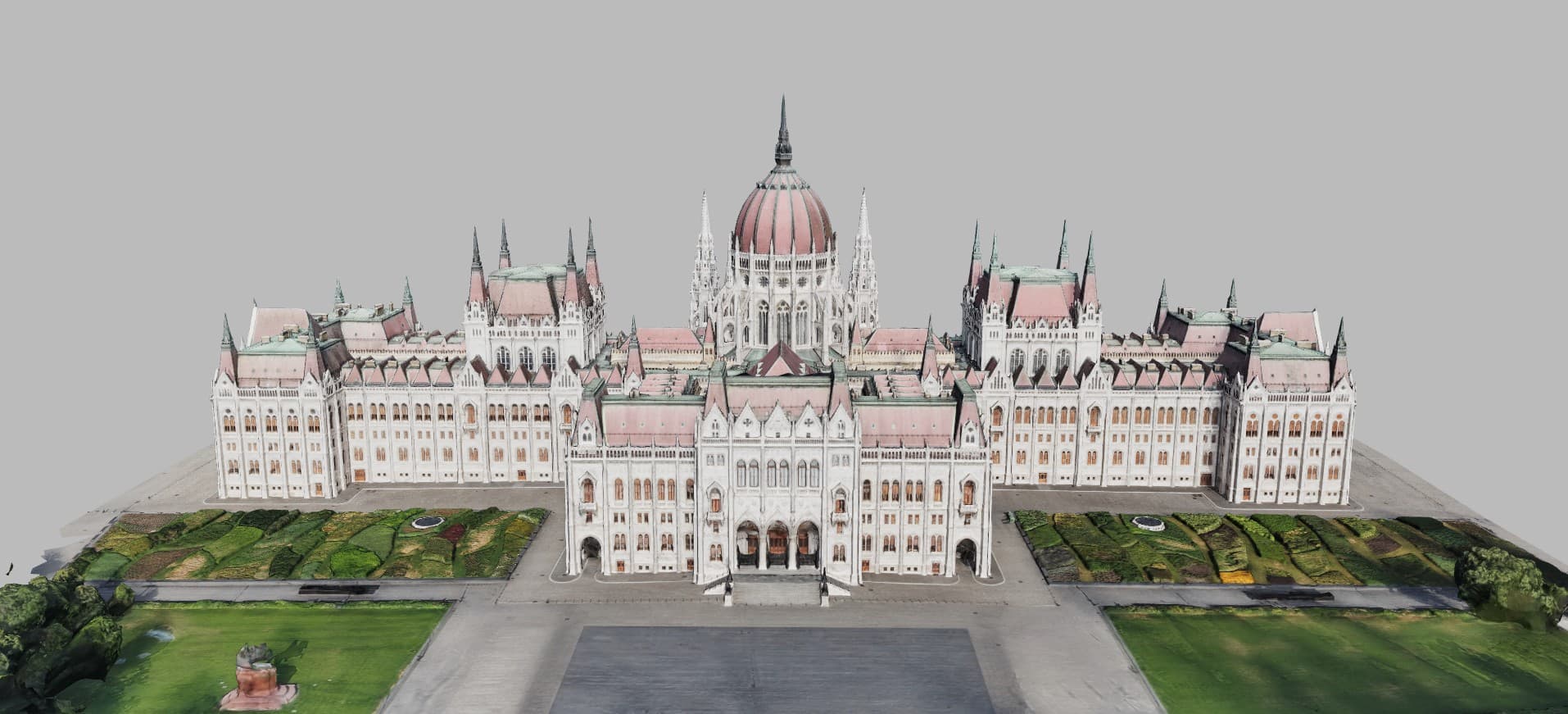
On the Buda bank of the Danube, overlooking Batthyány Square and facing the Hungarian Parliament Building across the river, the Church of Saint Anne stands as one of Budapest’s finest expressions of Baroque ecclesiastical architecture. Its twin towers rise above the historic neighbourhood of Víziváros, framing an elegantly proportioned façade adorned with saints, allegorical figures and the historic coat of arms of Buda. Within, the seemingly conventional exterior gives way to an unexpected spatial harmony: an elongated octagonal nave beneath an oval cupola, where curved surfaces and sculptural ornament create a sense of movement and grandeur.
The interior reveals the expressive richness of Hungarian Baroque art. At the high altar, completed in 1773, sculptor Károly Bebó transforms the Presentation of Mary in the Temple into a sacred drama, bringing biblical figures together in a composition of remarkable vitality. The delicate wrought-iron screen of the Loreto Chapel, crafted by Ignác Pügl in 1752, offers a more intimate expression of eighteenth-century craftsmanship. Together, sculpture, painting and architecture create an atmosphere in which artistic splendour and religious devotion become inseparable.
The church’s history reaches back to a medieval parish established in 1390. Its original place of worship, dedicated to Saint Peter Martyr, was lost during the centuries of Ottoman rule and the struggles to reclaim Buda. Following the liberation of the city in 1686, the parish was re-established the following year and entrusted to the Jesuits. The construction of the present church began in 1740 under master builder Kristóf Hamon. After his death in 1748, Máté Nöpauer continued the project, and the nave’s cupola was completed in 1762. An earthquake the following year damaged the structure, prolonging its completion. Although the interior continued to be embellished throughout the eighteenth century, the church was not formally consecrated until 4 August 1805, following restoration under Christoph Hickisch.
The ensuing centuries brought repeated trials. Floodwaters from the Danube inundated the surrounding neighbourhood, artillery fire damaged the church during the siege of Buda in 1849, and the devastation of the Second World War inflicted further losses. Even in peacetime, its survival was not assured: demolition was contemplated in connection with underground railway construction in the early 1950s. The proposal was eventually abandoned, and successive restoration campaigns returned the church to its former splendour.
Today, Saint Anne’s remains both a living place of worship and a cherished landmark of Budapest, where sacred music continues to resonate through spaces conceived nearly three centuries ago. Its history is inseparable from that of Buda itself, bearing witness to destruction, recovery and the determination to preserve beauty amid adversity. As the Danube flows past and the city continues to reinvent itself, the church offers a quiet sense of permanence in a landscape continually reshaped by history.