At the exact intersection of Zhoucheng's four historic streets stands Bell And Drum Tower, a twenty-three-meter-tall building of timber and stone. Completed in the spring of 1924 under the direction of county magistrate Yang Chunlin, this four-story tower remains the tallest traditional timber-frame structure in Binchuan County. It serves as a pass-through gateway, its square first floor anchored by four massive wooden corner columns and pierced by four stone arched portals that allow the town's daily traffic to flow directly through its base.
Ascending the structure reveals a transition in geometry and time. The second floor, still square, houses a six-hundred-kilogram brass bell cast during the Jiajing reign of the Ming Dynasty. This bell, measuring one and a half meters tall with a base diameter of zero point six meters, once regulated the town's daily life through the morning and evening hours. Above this level, the architecture shifts into a hexagonal shape on the third and fourth floors, capped by a triple-eaved spire roof where wind bells catch the mountain breezes.
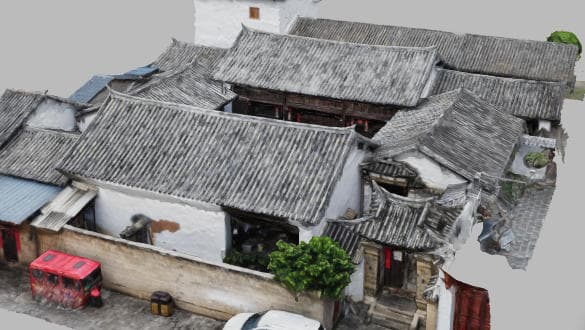
The tower has witnessed intense human struggles. In April 1936, Red Army commanders He Long and Ren Bishi led their forces through these very streets, engaging in a fierce ten-hour battle to capture the town. Bullet marks and memories of that conflict linger in the surrounding stone. When the county seat relocated to Niujing in 1956, the bustling political center quieted, leaving the tower as a silent sentinel over a preserved grid of grey-black tiled roofs.
Today, visitors standing beneath the heavy timber beams can hear the rustle of nesting swifts startled by footsteps. The cool touch of the ancient stone portals and the distant chime of the upper wind bells connect modern observers to the generations of artisans, soldiers, and citizens who walked this crossroads.