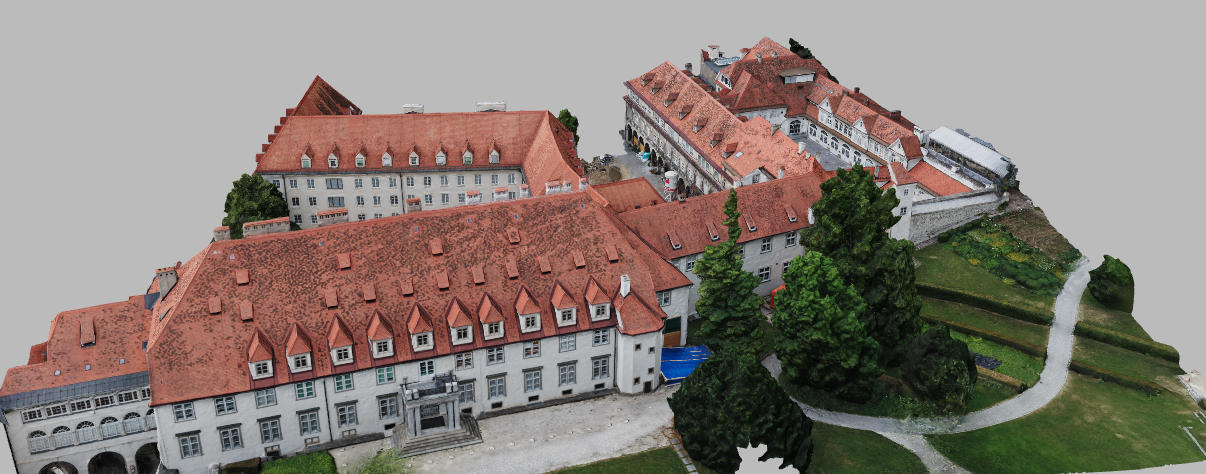
Step onto the flagstones of Herrengasse into a centuries-old complex of political institutions, Renaissance stonework, and military history. In 1557, Italian architect Domenico dell'Allio began expanding the Landhaus as a seat for the Styrian Estates. Its three-story inner courtyard features arcaded loggias, stone columns, sixteenth-century copper roof gargoyles, and a Mannerist bronze fountain. Beside the entrances, marble plaques installed in 1588, known as the Rumortafeln, prohibit drawing weapons, fighting, and causing disturbances on the premises. Inside, the parliamentary rooms preserve Baroque stucco decoration, while the Knight's Hall features ceiling paintings depicting the signs of the zodiac.
Directly adjoining this Renaissance palace stands the Landeszeughaus, constructed between 1642 and 1645 under architect Antonio Solar. Built as a regional military depot for Inner Austria, the four-story stone and timber building stored weapons and equipment for forces defending the region against Ottoman incursions. Today, it remains the world's largest surviving historic arsenal, preserving approximately 32,000 weapons, suits of armour, and pieces of military equipment.
Inside, unadorned wooden ceilings, floors, and storage racks extend across approximately 2,000 square metres. The historic timber construction and carefully maintained interior conditions help protect the metal collections from corrosion. Visitors pass densely arranged rows of breastplates, helmets, swords, halberds, muskets, and pistols, displayed on original shelving systems dating from the seventeenth century. Heavy artillery occupies the ground floor, while the upper levels retain the organized arrangement of the historic armoury.
When Empress Maria Theresa ordered the centralization of imperial armouries in 1749, the Styrian Estates successfully petitioned to preserve the Graz arsenal as a historical memorial. The collection was subsequently opened to the public as a museum in 1882 and became part of the Joanneum in 1892. Awarded the European Heritage Label in 2025, the Landeszeughaus continues to preserve its historic military collections beside the Landhaus, which remains the seat of the Styrian Provincial Parliament.
Metadata
Significance
Located on Herrengasse in Graz's UNESCO-listed historic centre, the Styrian Landhaus and Armoury complex combines Renaissance civic architecture with a seventeenth-century military depot. Expanded between 1557 and 1565 under Domenico dell'Allio, the Landhaus features a three-story arcaded courtyard and remains the seat of the Styrian Provincial Parliament. Directly adjacent, the Armoury was built between 1642 and 1645 and preserves approximately 32,000 weapons, suits of armour, and military objects in its historic storage arrangement. The two buildings retain their respective legislative and museum functions.
@misc{FUNES_styrian_landhaus_styrian_armoury_2026,
  author       = {Fengze Cao, Yixuan Xie},
  title        = {{Styrian Landhaus & Styrian Armoury (Landhaus Steiermark & Landeszeughaus Graz) -- 3D Cultural Heritage Record}},
  year         = {2026},
  publisher    = {FUNES.WORLD},
  howpublished = {\url{https://funes.world/entities/styrian-landhaus-styrian-armoury}},
  note         = {Technique: Photogrammetry; Format: .glb; License: CC BY-NC 4.0}
}
Academic References & Sources (11)
## Overview
The Styrian Landhaus and Styrian Armoury (Landhaus Steiermark and Landeszeughaus Graz) form an architectural complex located on Herrengasse in the Old Town of Graz, Austria. The Landhaus is a Renaissance palace that serves as the seat of the Styrian Provincial Parliament (Landtag Steiermark). Situated directly adjacent, the Styrian Armoury is the world's largest surviving historic arsenal, preserving a collection of approximately 32,000 weapons, suits of armor, and military equipment.
## Historical Development
The Styrian Estates acquired the original site on Herrengasse in 1494 to establish a permanent assembly hall. Initial construction took place between 1527 and 1531, followed by a major expansion from 1557 to 1565 directed by Northern Italian architect Domenico dell'Allio, who designed the main Renaissance wing and the arcaded courtyard. In 1630–1631, a chapel was added to the complex following the expulsion of Protestant nobles during the Counter-Reformation.
The Landeszeughaus was constructed between 1642 and 1645 under the direction of Swiss architect Antonio Solar. Built as a regional military depot for Inner Austria, it stored arms to equip forces defending against Ottoman incursions. When Empress Maria Theresa ordered the centralization of imperial armories in 1749, the Styrian Estates successfully petitioned to preserve the Graz arsenal intact as a historical memorial. The armoury opened to the public as a museum in 1882 and was integrated into the Joanneum (now Universalmuseum Joanneum) in 1892.
## Architectural Features
The Landhaus is built in the Northern Italian Renaissance style. Its exterior features arched windows, an ornate central balcony, and copper gargoyles. The three-story arcaded inner courtyard (Landhaushof) contains loggias supported by columns, sgraffito artwork, 16th-century copper roof gargoyles, a grand staircase by Bartolomeo di Bosio, and a central Mannerist bronze fountain. Inside, the Landstube (parliamentary chamber) contains Baroque stucco work, while the Rittersaal (Knight's Hall) features ceiling artwork depicting zodiac signs. Historic marble plaques known as Rumortafeln, mounted at the entrances in 1588, strictly forbid brawling, shouting, and drawing weapons on the premises.
The Landeszeughaus is a four-story, functional stone and timber structure covering an area of 2,000 square meters. The interior features unadorned wooden ceilings, beam racks, and original shelving systems designed to maximize storage space while maintaining an internal microclimate that prevents metal corrosion. Heavy artillery and cannons are housed on the ground floor, while the three upper floors contain organized rows of full suits of armor, breastplates, helmets, swords, halberds, muskets, and pistols.
## Current Status
The Landhaus and Styrian Armoury form a key component of the Historic Centre of Graz, which was designated a UNESCO World Heritage Site in 1999. The Landhaus continues to serve as the active legislative seat of the Styrian Provincial Parliament, while its courtyard hosts concerts, theatrical performances, and an annual ice nativity scene during Advent. The Landeszeughaus functions as a department of the Universalmuseum Joanneum, maintaining its original 17th-century equipment arrangement. In 2025, the Landeszeughaus was awarded the European Heritage Label.
# Landeszeughaus
Das Landeszeughaus in Graz wurde in den Jahren 1642 bis 1647 errichtet und war einst das zentrale Waffendepot der Steiermark. Die darin gelagerten Waffen samt Zubehör dienten der Ausrüstung des steirischen Landesaufgebots und der Versorgung der zur Abwehr des Osmanischen Reiches im 16. Jahrhundert eingerichteten Militärgrenze in den heutigen Staaten Kroatien und Ungarn. Mit seinen 32.000 Exponaten aller Art ist das Landeszeughaus die größte Rüstkammer der Welt, die noch dazu weitgehend im Originalzustand erhalten ist. Das Haus ist heute ein Teil des Universalmuseums Joanneum und zieht jährlich tausende Touristen und Liebhaber historischer Waffen aus aller Welt an.
## Geschichte
[Bearbeiten | Quelltext bearbeiten]
1551 wurde erstmals urkundlich die Bezeichnung Zeughaus für jene Räumlichkeiten verwendet, in denen die Landschaft ihre Waffen deponierte. Diese befanden sich im alten Landhaus und an den Grazer Stadttoren. Mit der Neuerrichtung des Landhauses ab 1565 lagerten die Waffen in den geräumigen Dachböden. Die zunehmende militärische Bedrohung führte zu einer Hochblüte der Waffenproduktion und zur Errichtung des heutigen Zeughauses von 1642 bis 1644 nach Plänen von Antonio Solari in den Formen des deutschen Frühbarock. Mit seinen fünf übereinanderliegenden Geschoßen von 11,5 m Breite und 52,5 m Länge bot es den nötigen Raum, um die verschiedenartigen Kriegsgerätschaften und -materialien in übersichtlicher Form zu lagern.[1] Ausrüstung für 16.000 Mann wurden hier gelagert und instand gehalten. Das Landeszeughaus selbst verlor jedoch nach der Errichtung immer mehr an Bedeutung, und da nach dem Frieden von Karlowitz im Jahre 1699 eine relativ stabile Grenze zum Osmanischen Reich hergestellt werden konnte, war die Hauptaufgabe des Zeughauses, nämlich die Bewaffnung der Söldner an der Militärgrenze in Kroatien/Ungarn, nicht mehr in diesem Maße vonnöten. Wiewohl das Zeughaus weiter genutzt wurde, kam es 1749 zur Schließung des Hauses, und der gesamte Bestand sollte aufgelöst und nach Wien gebracht werden. Diese Initiative ging von Maria Theresia aus, welche im Zuge ihrer Reformen auch das Heerwesen in den Erblanden reformierte und zentralisierte.
Die Stände konnten die Kaiserin vom ideellen Wert des Zeughauses überzeugen, und so blieb das Zeughaus mit seiner Ausstattung als Gesamtensemble und eigentlich ältestes Museum der Steiermark erhalten. 1892 wurde es in das Universalmuseum Joanneum eingegliedert.
Während des Zweiten Weltkrieges wurde das Museum evakuiert und alle Waffen in drei abgelegene steirische Schlösser gebracht. Mit Hilfe der britischen Besatzungsmacht erfolgte der Rücktransport, ohne dass Verluste zu verzeichnen waren. Bereits im April 1946 konnte das Landeszeughaus wieder geöffnet werden.[2]
Am 22. März 2013 wurde der größte Umbau seit der Errichtung des Zeughauses abgeschlossen. Der Eingangsbereich wurde umgestaltet[3] und das Zeughaus barrierefrei gemacht.[4]
## Heutiger Bestand
[Bearbeiten | Quelltext bearbeiten]
Heute beherbergt das Zeughaus in Graz mit etwa 32.000 Exponaten die weltweit größte historisch gewachsene Sammlung an Schutzwaffen (rund 3.840 Harnische, Helme, Ringelpanzer und Schilde),[5] Blankwaffen (2.414 Stück),[6] Stangenwaffen (5.395 Stück),[6] Gewehren (3.867 Stück),[7] Pistolen (4.259 Stück)[7] und Waffenzubehör aller Art (davon allein 3.449 Pulver- und Zündkrautflaschen sowie Patronenköcher)[7]. Mit diesem Bestand wäre es immer noch möglich, rund 5.000 Mann auszurüsten. Den Schwerpunkt bilden Rüstungsstücke und Waffen für den einfachen Fuß- und Reitersoldaten aus dem 16. und 17. Jahrhundert. Aber auch Offizierswaffen finden sich in der Sammlung, die – häufig reich verziert – aus Werkstätten in Innsbruck, Augsburg oder Nürnberg stammen. Prunkstücke sind unter anderem:
- der Küriss von Erzherzog Karl II. von Innerösterreich; hergestellt von Conrad Richter, Augsburg um 1565
- der Rossharnisch, zuletzt im Besitz von Karl Graf von Stubenberg; hergestellt von Konrad Seusenhofer, Innsbruck (Plattner) und Daniel Hopfer, Augsburg (Ätzmaler) um 1510
- der Prunkharnisch von Michael Witz d. J., Innsbruck um 1550
## Literatur
[Bearbeiten | Quelltext bearbeiten]
- Peter Krenn: Das Landeszeughaus in Graz. Verlage Bonechi und Styria, Florenz–Graz–Lahn in Limburg/Lahn 1991, ISBN 3-222-11719-5.
- Peter Krenn: Ein Zeughaus der Stände. Das Steiermärkische Landezeughaus in Graz. PDF In: Friedrich Langer: Österreichs Museen stellen sich vor S. 47–53
- Josef Wastler: Bau des landschaftlichen Zeughauses. In: Das Landhaus in Graz. Gerold, Wien 1890, S. 26–31 (PDF).
## Weblinks
[Bearbeiten | Quelltext bearbeiten]
## Einzelnachweise
[Bearbeiten | Quelltext bearbeiten]
- ↑ Peter Krenn: Ein Zeughaus der Stände S. 48
- ↑ Zur Geschichte des Landeszeughauses
- ↑ Grazer Zeughaus nach 22 Jahren barrierefrei
- ↑ Landeszeughaus Graz erhielt nun einen Lift
- ↑ Peter Krenn: Harnisch und Helm. Landeszeughaus Graz am Steiermärkischen Landesmuseum Joanneum. Deutsch–Englisch. Kunstverlag Hofstetter, Ried im Innkreis 1987, S. 4.
- 1 2 Peter Krenn: Schwert und Spieß. Landeszeughaus Graz am Steiermärkischen Landesmuseum Joanneum. Deutsch–Englisch. Kunstverlag Hofstetter, Ried im Innkreis 1997, S. 4.
- 1 2 3 Peter Krenn: Gewehr und Pistole. Rifles and Pistols. Landeszeughaus Graz am Steiermärkischen Landesmuseum Joanneum. Kunstverlag Hofstetter, Ried im Innkreis 1990, S. 4.
Koordinaten: 47° 4′ 10,7″ N, 15° 26′ 22,9″ O
# Zeughaus Armoury Graz
## Four floors of history
At the heart of Graz’s old town stands the Zeughaus Armoury — the world’s largest surviving historic armoury, preserved almost in its entirety since the 17th century.
What once served the purpose of defence is now a singular document of its time. Suits of armour, helmets, swords and firearms speak of an era in which Graz was the strategic centre of Inner Austria.
### Arsenal of a border region
In the 17th century, Styria lay at a military crossroads of Europe. As the capital of Inner Austria, Graz functioned as the organisational centre of regional defence. In 1642, the armoury was constructed to plans by Antonio Solar — functional in design, clearly structured and built for times of emergency. The collection has been preserved in remarkable completeness.
## Collection and atmosphere
### A spatial structure of wood and iron
Four storeys, densely arranged weapon racks, wooden shelves rising to the ceiling. The Landeszeughaus feels less like a museum than a moment of history held in suspension.
Four floors of Styrian history.
## Facts and figures
### At a glance
- Over 32,000 historic weapons and suits of armour
- Established: 1642
- Four exhibition levels
- Original holdings preserved since the 17th century
- Part of the Universalmuseum Joanneum
## Planning your visit
### Guided tours and information
Due to heritage protection regulations, the objects are not individually labelled. Guided tours provide historical context and interpret the collection within its broader framework. Alternatively, audio guides and printed leaflets are available.
Current opening hours and admission prices can be found on the website of the Universalmuseum Joanneum.
## Zeughaus Armoury: FAQs
The Zeughaus Armoury is the world’s largest surviving historic armoury. Since the 17th century, the collection has remained almost entirely preserved within its original building, conveying a cohesive picture of early modern regional defence.
For a tour, allow around one and a half to two hours. A guided tour provides additional historical context and adds depth to the visit.
Yes. Guided tours are offered regularly, providing insight into the history, collection and function of the armoury. Audio guides and printed leaflets are also available.
Due to the historic structure of the building, access is only partially barrier-free. Current information on accessibility is available on the museum’s website.
Das Landeszeughaus gehört zu den meist besuchten Sehenswürdigkeiten in Graz. Die größte historische Waffenkammer der Welt mit seiner einzigartigen Atmosphäre zieht gleichermaßen Einheimische und Touristen in ihren Bann. Auf vier Stockwerken folgt die dicht gedrängte Aufstellung der rund 32.000 Kriegsgeräte (z. B. Harnische, Panzerhemden, Helme, div. Waffen) aus drei Jahrhunderten (15. bis 18. Jhdt). Sie zeigt sich im Wesentlichen im ursprünglichen Erscheinungsbild eines Rüsthauses.
Erbaut zwischen 1642 und 1645 von den steirischen Landständen war das heutzutage international berühmte Landeszeughaus einst das wichtigste Rüsthaus im Südosten des Habsburger-Reiches. Im 17. Jahrhundert wurden zum Schutz des Landes in erster Linie Rüststücke für einfache Fuß- und Reitsoldaten eingelagert. Bereits Mitte des 18. Jahrhunderts ist das Landeszeughaus militärisch bedeutungslos geworden, blieb aber als Museum erhalten.
Die im ursprünglichen Umfeld gelagerten Waffen und Kriegsgeräte stellen noch heute eine historische Besonderheit dar. Denn die meisten anderen Zeughäuser Europas wurden im Gegensatz zum Grazer Landeszeughaus aufgelöst. Seit 1892 ist es dem Landesmuseum Joanneum eingegliedert, jedoch wurde nie der Versuch unternommen, dieses Denkmal zu musealisieren. Aus diesem Grund kann man gerade hier die Aufbewahrungsart und Atmosphäre eines authentischen Zeughauses studieren und erleben.
## Landeszeughaus Öffnungszeiten & Erreichbarkeit
- April bis Oktober – von Dienstag bis Sonntag & an Feiertagen von 10 – 17 Uhr geöffnet
- November bis März – von Dienstag bis Sonntag & an Feiertagen nur im Rahmen von Führungen geöffnet
Führungen finden jeweils um 11 und um 14 Uhr auf Deutsch und um 12:30 Uhr auf Englisch statt.
Weitere Termine & das aktuelle Programm (Führungen, Workshops, Kinderführungen): www.museum-joanneum.at/landeszeughaus/ihr-besuch/programm
## Landeszeughaus Eintrittspreise
- Erwachsene 10,50 €
- Gruppen ab 12 Personen, Seniorinnen/Senioren, Menschen mit Behinderung(en) 9 €
- Schüler, Lehrlinge, Studierende unter 26 Jahren, Präsenz- und Zivildiener 4 €
- Familienkarte (2 Erwachsene und Kinder unter 14 Jahren) 21 €
- Kinder unter 6 Jahren frei
- Führung 2,50 €
Zusätzlich gibt es das Joanneums-24h- und -48h-Ticket. Dies berechtigt zum Eintritt in alle 19 Museen des Joanneums in Graz und der Steiermark.
Fotos: Universalmuseum Joanneum / N. Lackner
# Armoury
Universalmuseum Joanneum | Most important historical weapon collection in the world | warded the European Heritage Label
A knight’s tale of passion? Certainly fitting for some of the warriors in shining armour. At the Landeszeughaus armoury of Graz, standing in rank and file are the armour and weapons of valiant warriors of the Middle Ages. The special historical setting and sheer number of collector’s items make a visit to the Graz armoury a treat not to be missed. Marvel at an unbelievable 32,000 exhibits arranged on four floors, where many a visitor, large or small, drifts into dreams of heroic sagas of times past.
In April 2026, the Armoury was awarded the European Heritage Label – a recognition of its special significance for Europe’s shared cultural heritage.
Summer opening hours 2026
1st April - 31st Oktober, Tue-Sun, public holidays, 10 am - 6 pm
Winter opening hours 2026
1st November - 31st December, Tue-Sun, public holidays, Admission during the winter months is only possible with a guided tour.
The Landeszeughaus is also accessible without a guided tour on the following days:
Sat, Sun in November and December, 11 am - 3 pm
December 8, December 29 to December 31, 2026, 11 am - 3 pm
Guided Tours:
Tue-Sun: 12.30 pm english., 11 am, 2 pm german
Additionally open: 05/25/2026, 10/26/2026
Exceptionally closed: 09/20/2026, 12/24/2026, 12/25/2026
- Entrance fees & opening hours in detail
- Free entry with Graz Card and Graz Card Light
## Good to know
The Armoury in Graz is the largest preserved historic armory in the world. Among the countless pieces of equipment for ordinary foot soldiers, there are also special treasures, such as one of only seven completely preserved horse armors worldwide.
Allow around 45 minutes for a visit to the Armoury in Graz. A guided tour takes approximately 1 hour. If you would like to explore the historic weapons and armour in more detail, plan around 90 minutes.
In the past, up to 190,000 weapons were stored in the Armoury in Graz. Today, around 32,000 items have been preserved. These include suits of armor, firearms and cannons, polearms, cutting and thrusting weapons, bullet molds, powder flasks, and more, all displayed across four floors and about 2,000 m² of exhibition space.
The Armoury in Graz can be reached by tram lines 1, 3, 4, 5, 6, and 7 (stop: Hauptplatz/Graz Congress), followed by a short walk towards Herrengasse.
The Armoury was awarded the European Heritage Label in April 2026 due to its outstanding importance for Europe’s shared cultural heritage. As the world’s largest preserved historic armoury, it provides a unique insight into European history and vividly illustrates the cultural and historical connections across Europe.
The Styrian Armoury brings history to life in a fascinating way. Its densely packed armoury rooms provide an authentic impression of past centuries and captivate both adults and children. For anyone interested in history, castles or knights, it is one of the highlights of a visit to Graz.
The Styrian Armoury (Landeszeughaus) houses the world’s largest preserved historic armoury. Spread across four floors, around 32,000 original weapons, suits of armour and pieces of military equipment are on display. The museum offers a unique insight into the history of Styria and is one of the most impressive cultural attractions in the UNESCO World Heritage city of Graz.
Unlike many other weapon collections, the Styrian Armoury was not assembled retrospectively as a museum collection. The historic equipment has remained largely unchanged for centuries. As a result, the museum offers a rare and authentic glimpse into an early modern armoury and is considered unique worldwide.
## Details
Due to its geographical position south of the Alps, and as the capital of Inner Austria, Graz developed as an important centre of defence against intruding peoples from the east. It was especially the advances of the Ottoman Turks, which from the end of the 15th century forced the Styrian estates to organize defence and to build up their weapons stockpiles. Both native gunsmiths and armourers, and masters from Nuremberg, Augsburg and Innsbruck were commissioned. Starting in 1642, Antonio Solar erected a "Zeughaus" (armoury) adjacent to the Landhaus for the increasing store of arms.
The narrow building is five storeys high and about 50m long. The façade is embellished by two impressively vulptuous Baroque statues by Giovanni Mamolo representing Mars (war god) and Minerva (goddess of war and the arts).
In the course of reforming military administration, Empress Maria Theresa intended to give up the armoury. But the Styrian estates succeeded in preventing the liquidation and in saving the armoury as a testimony for the braveness of the Styrians in fighting the "age-old enemy of Christendom".
So today the only originally preserved armoury in the world contains about 32,000 exhibits. Historical arms and military equipment dating from the late 15th to the early 19th centuries. More than 3,300 armours and helmets, over 7,800 small arms, c. 5,400 staff weapons, 2,400 swords, sabres and the like - whatever was needed for warfare in former times, you will find it in the armoury.
Besides the mass of weapons for simple soldiers, the gorgeous armours for the nobility and the entirely preserved horse armour from the early 16th century are especially impressive. The c. 50 heavy guns from the ground floor of the armoury, however, were removed when Napoleon's troops were approaching and later on sold to a bell-founder.
Today the tourist information of Graz has found a new home on the ground floor of the armoury.
By the way: When you see such a mass of old iron, you will wonder why all these arms do not get rusty. Apart from professional care, the wooden ceilings, floors and wall panels are responsible for it - wood absorbs moisture.
# Landhaus Graz
Das Landhaus entstand durch den Beschluss, die Landtage der steirischen Landstände in einem eigenen Landhaus einzurichten. Das Landhaus wurde von Domenico dell‘ Aglio errichtet. Der Landhaushof verfügt mit Arkadengängen über 3 Etagen und der Brunnenlaube über eine wunderbare Kulisse für Feste, Konzerte und Filmvorführungen, das Landhaus ist nicht nur Grazern als Location bekannt.
## Wo finde ich das Landhaus Graz?
## Das Landhaus und der Landhaushof Graz
Als Landhaus wurde ab dem Hochmittelalter der Regierungssitz der adeligen Landstände in einer Stadt bezeichnet. Es ersetzte die frühmittelalterliche Burg einer Siedlung als Versammlungs- und Verwaltungssitz.
Das heute sichtbare, repräsentative Gebäude wurde aber erst durch den damals in Österreich sehr beliebten Baumeister und Architekten, dem Mailänder Domenico dell’Allio, neu gestaltet und erweitert – es zählt dadurch heute zu den schönsten Renaissancebauten der Steiermark.
Domenico dell’Allio war es auch, der den Schlossberg und die Stadtmauern von Graz zu einer wehrhaften Bastion ausgebaut und das Renaissance-Tor der Grazer Burg angefertigt hat. Da man sich in ganz Österreich gegen die drohende Gefahr aus dem Osmanischen Reich schützen wollte, erhielt er außerdem den Auftrag für den Ausbau der Festungsmauern in Klagenfurt, Wien, Fürstenfeld, Maribor, Radkersburg und Ptuj.
Das Landhaus in Graz wurde ständig erweitert und durch verschiedene Architekten verändert, weshalb dort heute mehrere Stilrichtungen vertreten sind und das Gebäude einen unregelmäßigen Grundriss aufweist. Während in der barocken Landstube die 48 Abgeordneten der steirischen Landesregierung tagen, wird der malerische Arkadenhof regelmäßig für Veranstaltungen genutzt.
## Eine politische Geschichte
Bereits ab 1494 ist ein Bürgerhaus in der einstigen Bürgergasse, die später in Herrengasse umbenannt wurde, belegt, das von den steirischen Landständen als Treffpunkt genutzt wurde. Die Landstände als politische Vertreter gegenüber dem Landesherren waren zu dieser Zeit hauptsächlich adelige Familien, später auch Bürger.
In Österreich standen sich häufig die protestantischen und katholischen Landstände gegenüber. Da der Bau bald zu wenig Platz bot, wurde der erste Renaissancebau in Graz in der Schmiedgasse zu diesem Zweck erbaut. Auch dieser war nicht ausreichend und so kam es zum Bau des heutigen Landhauses in der Herrengasse.
Direkt im Nebengebäude wurde 1642 das Grazer Zeughaus errichtet, das heute mehr als 30.000 Waffen, Rüstungen und militärische Ausrüstung beherbergt und 1890 fügte man den Landhauskeller als gastronomische Einrichtung hinzu.
So entstand über die Jahrhunderte ein einheitlich erscheinender Bau mit drei Innenhöfen. Der älteste Gebäudekomplex ist drei Stockwerke hoch, liegt an der Schmiedgasse 5 und besitzt eine Halle mit einem eindrucksvollen Gewölbe. Als nächstes entstand der sogenannte Rittersaaltrakt mit dem ältesten Renaissance-Tor in Graz, der im 17. Jahrhundert mit einem vierten Geschoss versehen wurde.
Der namensgebender Rittersaal war einst mit Wappenmalereien ausgeschmückt – heute sind nur mehr die Sandsteinwappen einiger Städte, in denen Domenico dell’Allio gewirkt hat, am Rundbogen-Steinportal der Nordfront erhalten. Die Fassade des Traktes wurde 1890 im Stil der Neorenaissance neu gestaltet. Wie bereits oben erwähnt, entstand dann noch ab 1557 der Haupttrakt des Landhauses unter der Federführung von Domenico dell’Allio an der Ecke Herrengasse/Landhausgasse.
## Was es alles an Besonderheiten zu entdecken gibt
Auch damals ging es sicher bei vielen politischen Diskussionen heiß her, wie die sogenannte „Rumortafel“ aus Kupferblech beweist, die neben dem Haupteingang hängt und gegen „Rumoren und sich Schlagen“ schwere Strafen androht.
Immer wieder entdeckt man im Landhaus Graz den steirischen Panther – sei es in Fries-Verzierungen, als Schlussstein oder in Form einer Windfahne.
Zahlreiche Elemente des Gebäudes sind noch aus der jeweiligen Bauzeit erhalten, darunter zum Beispiel die Glocke des Dachreiters aus 1586, die alle Befehle zum Einschmelzen für Kriegskanonen überstanden hat, im Gegensatz zu vielen anderen Glocken der Stadt. Auch einige Torflügel, schmiedeeisernen Beschläge und der schöne Landhausbrunnen, der mit 1590 datiert ist und als eines der bedeutendsten Bronzegusswerke des Manierismus außerhalb Italiens zählt, sind nach wie vor erhalten.
Als um 1630 das radikale Programm der Gegenreformation in der Steiermark abgeschlossen war, wurde in der Nordwestecke des Arkadenhofes die Landhauskapelle errichtet und der Mariä Himmelfahrt geweiht. Vor allem der barocke Landstubentrakt, wo heute die politischen Abgeordneten tagen, ist reich ausgestattet und dekoriert. Der Saalraum hat eine Spiegeldecke und ist mit kriegerischen Darstellungen gegen die Franzosen und Türken sowie mit Waffentrophäen und Wappen geschmückt.
In den Ecken stehen vergoldete Kachelöfen und es gibt noch weitere allegorische Gemälde. Wer das Landhaus in Graz im Winter besucht, hat die Gelegenheit, die jährlich im Arkadenhof aufgestellte Eiskrippe, die nach einer Idee des 2017 in Villach verstorbenen Eis- und Sandkünstlers Gert J. Hödl erstmals 1996 entstanden ist. Und sogar auf eine Briefmarke im Wert von sechs Schilling hat es das Landhaus Graz bereits gebracht, als die Österreichische Post 1960 die Briefmarkenserie Österreichische Baudenkmäler herausgegeben hat.
# Das Landhaus
Das Landhaus der Steiermark zählt zu den bedeutendsten Gebäuden der Renaissance in Österreich. Dem Bedürfnis nach einem Versammlungsort der Landstände entsprechend bildete sich der Komplex des Landhauses, der von Herren-, Landhaus- und Schmiedgasse sowie dem Landeszeughaus begrenzt wird, in einem Zeitraum von rund 150 Jahren.
Die Anfänge liegen in einem Bürgerhaus in der Herrengasse, das die Stände 1494 zur Abhaltung ihrer Versammlungen erwarben. 1534 erfolgte der Zukauf eines Hauses in der Herrengasse, wo es schon die Kanzlei der Landstände gab, womit erstmalig das gesamte Areal zwischen Herren-, Landhaus-, und Schmiedgasse den Steirischen Ständen gehörte.
Der Platz für ein stattliches Palais, das zur Repräsentation der Landstände diente, war damit geschaffen. 1555 beschloss der Landtag, den aus Scaria gebürtigen Festungsarchitekten Domenico dell'Aglio (auch dell‘Allio, de Lalio, De Lallio, u. a., um 1515 - 1563) mit dem Neubau des Landhauses in der Herrengasse zu beauftragen.
Seine eigentliche Schönheit entfaltet sich erst im Hof, den Dell'Aglio an Nord- und Ostseite mit Arkaden toskanischer Ordnung in allen drei Geschossen gestaltete. Schon 1581 - 1584 waren die Brüder Antonio und Francesco Marmoro, (eingedeutscht Marbl), die der Werkstatt Dell'Aglios entstammten, damit beschäftigt, das Gebäude in der Herrengasse im Süden um vier Achsen zu verlängern.
1645 wurde noch eine Achse mit einem zweiten Tor von Antonio Solar hinzugefügt, der auch das anschließende Landeszeughaus 1643/44 errichtete. Hinter der beeindruckenden frühbarocken Fassade mit den Nischenfiguren von Mars und Minerva von Giovanni Marmoro (eingedeutscht: Hans Marbl) liegt eines der wenigen erhaltenen und am besten bestückten Zeughäuser Europas.
Für den Hof des Landhauses selbst ergab sich jedoch 1888/90 eine grundlegende Änderung, als nach Plänen Hermann Scanzonis ein frei stehender Arkadengang zum Abschluss des Hofes errichtet wurde. Die Vollendung der dreiflügeligen Arkadenanlage ist also dem 19. Jahrhundert zuzuschreiben.
Bemerkenswert ist der Ziehbrunnen aus Röthelsteiner Marmor von Antonio Marmoro (Anton Marbl) mit einer spätmanieristischen Brunnenlaube aus Bronzeguss von den Rotgießern Marx Wening und Thomas Auer, deren Signatur sich mit der Datierung 1590 an den Plinthen finden lässt. Die Brunnenlaube, die sich über eindrucksvollen Satyrdocken mittels fünf Kandelabersäulen erhebt, wird aus Nereiden, Delfinen mit Putten und Akanthus sowie Weinlaub in einem komplizierten Geflecht gebildet. Der bekrönende Krieger trägt eine Fahne mit dem Steirischen Panther (dieser aus dem 19. Jh.).
Dr.in Christine Rabensteiner
Kuratorin für Kunst der Neuzeit
Universalmuseum Joanneum, Alte Galerie
aus "LANDTAG STEIERMARK"
# Zeughaus Armoury Graz
## Four floors of history
At the heart of Graz’s old town stands the Zeughaus Armoury — the world’s largest surviving historic armoury, preserved almost in its entirety since the 17th century.
What once served the purpose of defence is now a singular document of its time. Suits of armour, helmets, swords and firearms speak of an era in which Graz was the strategic centre of Inner Austria.
### Arsenal of a border region
In the 17th century, Styria lay at a military crossroads of Europe. As the capital of Inner Austria, Graz functioned as the organisational centre of regional defence. In 1642, the armoury was constructed to plans by Antonio Solar — functional in design, clearly structured and built for times of emergency. The collection has been preserved in remarkable completeness.
## Collection and atmosphere
### A spatial structure of wood and iron
Four storeys, densely arranged weapon racks, wooden shelves rising to the ceiling. The Landeszeughaus feels less like a museum than a moment of history held in suspension.
Four floors of Styrian history.
## Facts and figures
### At a glance
- Over 32,000 historic weapons and suits of armour
- Established: 1642
- Four exhibition levels
- Original holdings preserved since the 17th century
- Part of the Universalmuseum Joanneum
## Planning your visit
### Guided tours and information
Due to heritage protection regulations, the objects are not individually labelled. Guided tours provide historical context and interpret the collection within its broader framework. Alternatively, audio guides and printed leaflets are available.
Current opening hours and admission prices can be found on the website of the Universalmuseum Joanneum.
## Zeughaus Armoury: FAQs
The Zeughaus Armoury is the world’s largest surviving historic armoury. Since the 17th century, the collection has remained almost entirely preserved within its original building, conveying a cohesive picture of early modern regional defence.
For a tour, allow around one and a half to two hours. A guided tour provides additional historical context and adds depth to the visit.
Yes. Guided tours are offered regularly, providing insight into the history, collection and function of the armoury. Audio guides and printed leaflets are also available.
Due to the historic structure of the building, access is only partially barrier-free. Current information on accessibility is available on the museum’s website.
# Landeszeughaus, Universalmuseum Joanneum
Die Zeit vom 15. bis zum 18. Jahrhundert war für das Herzogtum Steiermark durch bewaffnete Auseinandersetzungen mit ungarischen Rebellen sowie dem Osmanischen Reich geprägt. Daher ließen die steirischen Landstände ab 1642 das „landschaftliche Zeughaus“ als Depot für Waffen und Rüstungen erbauen.
Als das Zeughaus im 18. Jahrhundert seine Bedeutung verlor und Maria Theresia beschloss, es zu schließen, erbaten die Landstände seine Erhaltung. 1882 wurde die Rüstkammer erstmals öffentlich zugänglich und schließlich in das von Erzherzog Johann gegründete Joanneum eingegliedert.
Heute gilt das Landeszeughaus als die größte erhaltene historische Waffenkammer der Welt. Die Sammlung umfasst 32.000 Rüstungen und Waffen, die auf vier Etagen mit rund 2.000 Quadratmetern Fläche lagern.
## Sehenswürdigkeiten in der Umgebung
Grazer Landhaus Altstadt Stadtpfarrkirche Hl. Blut Bemaltes Haus
## Museen im Bezirk
Museen im Bezirk Graz-Stadt
Kontakt und Information
Herrengasse 16, 8010 Graz
T: +43 316 8017 9810
E: zeughaus@museum-joanneum.at
zur Wegbeschreibung
Öffnungszeiten
Di-So/Fei 10 - 18 Uhr
01.04.2026-31.12.2026 Di-So/Fei 11und 14 Uhr (deutsch), 12:30 Uhr (englisch)
01.11.2026.-06.01.2027 im Rahmen einer Führung zugänglich:
Service
Zuordnungen
Ort: Graz
Bezirk: Graz-Stadt
Kategorie: Historisches und archäologisches Museum
Themen: Geschichte, Kulturkundliche Sammlung, Spezialsammlung oder Gedenkstätte, Landesgeschichte, Orts- bzw. Stadtgeschichte, Militärgeschichte, Kriegswesen, Waffen, Militaria, Zeughaus
Die Zeit vom 15. bis zum 18. Jahrhundert war für das Herzogtum Steiermark durch bewaffnete Auseinandersetzungen mit ungarischen Rebellen sowie dem Osmanischen Reich geprägt. Daher ließen die steirischen Landstände ab 1642 das „landschaftliche Zeughaus“ als Depot für Waffen und Rüstungen erbauen.
Als das Zeughaus im 18. Jahrhundert seine Bedeutung verlor und Maria Theresia beschloss, es zu schließen, erbaten die Landstände seine Erhaltung. 1882 wurde die Rüstkammer erstmals öffentlich zugänglich und schließlich in das von Erzherzog Johann gegründete Joanneum eingegliedert.
Heute gilt das Landeszeughaus als die größte erhaltene historische Waffenkammer der Welt. Die Sammlung umfasst 32.000 Rüstungen und Waffen, die auf vier Etagen mit rund 2.000 Quadratmetern Fläche lagern.
## Sehenswürdigkeiten in der Umgebung
Grazer Landhaus Altstadt Stadtpfarrkirche Hl. Blut Bemaltes Haus
## Museen im Bezirk
Museen im Bezirk Graz-Stadt
# Grazer Landhaus: A Renaissance Gem in Graz, Austria
The Grazer Landhaus in Graz, Austria, is a magnificent Renaissance palace and a landmark of historical and architectural significance. Its elegant facade, distinctive arched windows, and a stunning arcaded courtyard visible from the entrance make it one of the city's most important structures. Since the 16th century, it has served as the political heart of the Styria region.
## A Masterpiece of Renaissance Architecture
The building's journey began in 1494 when the Styrian Estates, the regional representative body, acquired a house on Herrengasse. The first Renaissance construction phase occurred between 1527 and 1531. However, the building's most celebrated features were created between 1557 and 1565 under the direction of Italian architect Domenico dell'Allio. He introduced a Northern Italian Renaissance style, often compared to Venetian palazzos, which transformed the city's architectural landscape.
The most iconic element is the grand arcaded courtyard. Its three-story arcades and elegant design established the Landhaus as a premier example of Renaissance architecture north of the Alps and a clear statement of the Estates' power and influence.
Graz: a self-guided walking tour of the UNESCO old town and Schlossberg, with audio, quizzes & free eSIM
2 hours10 stopsAudio guideStart any day, at your own paceTicket on your phone · 30-day refund
## A Center of Styrian History
For centuries, the Landhaus has been the seat of the Styrian provincial parliament. The building was commissioned by the Styrian Estates to create a permanent and representative headquarters, often in deliberate architectural competition with the ruling Habsburgs. During the 16th century, it was a focal point for the predominantly Protestant Estates as they asserted their influence against Catholic rulers. After the expulsion of Protestant nobility in 1629, a chapel was added in 1630-31, symbolizing the re-establishment of Catholicism.
A curious historical feature is the presence of "Rumortafeln" or "rumbling boards" at the entrances. These plaques, dating from 1588, prohibit shouting, fighting, drawing weapons, and general scuffling within the building. These rules demanding modest behavior are still formally observed to this day.
## Notable Interior and Courtyard Features
The Landhaus holds several artistic treasures. The courtyard features the Landhausbrunnen, a Mannerist bronze fountain from 1590. Designed by Jeremias Franck, it is adorned with intricate figures of satyrs and Nereids, topped by a warrior holding the Styrian Panther emblem.
Inside, the Rittersaal (Knight's Hall) on the first floor contains an ornate stucco ceiling created in the mid-17th century by Alessandro Sereni. This unique ceiling is decorated with signs of the zodiac and various natural motifs.
## The Landhaus Today
The Grazer Landhaus continues its historic role as the seat of the Styrian provincial parliament (Landtag Steiermark). Its beautiful courtyard is accessible to the public 24/7 and serves as a vibrant venue for cultural events, concerts, film screenings, and the famous annual Ice Nativity Scene during Advent. The building also houses the Graz Region tourist information office, and guided tours of the interior are available.
## FAQ
### What is the Grazer Landhaus used for today?
The Grazer Landhaus continues to serve as the seat of the Styrian provincial parliament (Landtag Steiermark). Its courtyard is also a public space used for cultural events, concerts, and the annual Advent Ice Nativity Scene.
### Can you visit the Grazer Landhaus?
Yes, the arcaded courtyard of the Grazer Landhaus is open to the public 24/7 for architectural appreciation. Guided tours of the building's interior are also offered.
### What are the 'Rumortafeln' at the Grazer Landhaus?
The 'Rumortafeln' (rumbling boards) are plaques from 1588 at the entrances that prohibit quarrels, shouting, violence, and drawing weapons. These rules demanding modest behavior are formally observed to this day.
### Who was the architect of the Grazer Landhaus?
The main Renaissance wing and the iconic arcaded courtyard were designed by the Italian architect Domenico dell'Allio between 1557 and 1565.
# Landhaus Courtyard
## Graz
The arcaded inner courtyard of the Landhaus Graz is a masterpiece of the Italian Renaissance and one of the top 10 sights.
What a perfect place for a celebration! This thought comes to mind when entering the Landhaushof in Graz. In the Renaissance world of this inviting locale, colorful images of celebrating people immediately spring to life in the mind's eye. During the warm season, flowers adorn the magnificent arcades, and in Advent, the famous ice nativity scene finds a fitting setting here. In between, concerts, theater performances, and indeed festivities of all kinds take place in the splendid atmosphere of the courtyard in the Landhaus.
Our tip: Stroll "Old Town Tour through the World Heritage Site Graz"
A piece of Northern Italy right in Graz's Herrengasse? The Landhaus resembles a Venetian palazzo. Starting in 1557, the Italian master builder Domenico dell' Allio erected a representative building for the estates of Styria. Even today, the representatives of the Styrian state parliament convene here.
Not only is the facade of the building impressive; especially the arcade courtyard in the Renaissance style leaves visitors in awe. At the end of the 15th century, the Styrian estates decided to hold their regional parliaments not in various castles and monasteries but in a specially built Landhaus in the capital Graz.
The original small "chancellery" was expanded in the 16th century by "Welsche" (Italian) builders into the largest building complex of the old town. Domenico dell' Allio, who came to Graz as a fortress builder from Northern Italy and was also responsible for the expansion of the Schlossberg fortress, erected the main wing on Herrengasse and the magnificent inner courtyard starting in 1557.
Admiration and wonder seize those who enter the spacious Landhaushof for the first time. Arcaded walkways spanning three stories, copper roof gargoyles from the 16th century, the bronze-cast gazebo – a masterpiece of Mannerism. It is now well known not only to the residents of Graz that celebrations, concerts, film screenings, and the Advent ice nativity scene offer a special experience in this setting. Inside the Landhaus, the baroque styled rooms impress.
The Landstube features a stucco ceiling adorned with figures and coats of arms by Johann Angelo Formentini, topped with two stoves featuring coat-of-arms animals - the Austrian eagle and the Styrian panther. The knight's hall, whose stucco ceiling also showcases the zodiac signs with great attention to detail. And then there is the Landhaus chapel, built in 1630/31. After the expulsion of the Protestant nobility in 1629, it symbolizes the return of Catholicism to the Landhaus with its black-and-gold framed altar in the style of Jesuit Baroque, the altar painting "The Assumption of Mary," and the two statues of Saints Catherine and Barbara.
By the way: Since 1588, "rumor boards" at the two entrances to the Landhaus prohibit making noise in the building, drawing swords, daggers, or bread knives, wrestling, and fighting. Instead, one should behave modestly here in words and deeds; otherwise, punishment is meted out to body and life. The rules of conduct still hang here to this day. Thus, those representatives convening in this building surely adhere to them...
## Photos & videos
## Contact
8010 Graz
# Landhaus Courtyard
The arcaded inner courtyard of the Landhaus Graz is a masterpiece of the Italian Renaissance and one of the top 10 sights.
What a perfect place for a party! The inevitable thought if you step into the Landhaushof in Graz. Taking in the Renaissance surroundings of this inviting location immediately conjures up colourful images of people enjoying festivities. At Advent, the celebrated ice nativity scene finds a perfect setting in the Landhaus Courtyard. Throughout the year, concerts, theatre performances and celebrations of all kinds take place in the splendid atmosphere of the courtyard at the Landhaus.
Adjacent to the Landhaus is the Landeszeughaus, once the most important armoury in Inner Austria and now one of the largest historical weapon collections in the world with over 30,000 exhibits. (Entrance: Herrengasse)
## Good to know
You should allow around 20 minutes for a visit to the Landhaushof in Graz. This gives you enough time to admire the Renaissance courtyard with its arcades and take a few photos. The Landhaushof can easily be included in a walk through Graz’s historic centre.
The Landhaushof Graz, the former seat of the provincial estates, is one of the most important Renaissance buildings in Central Europe. Its defining features include ornate arched windows and arcades, a three-story courtyard in Renaissance style, and a magnificent bronze fountain arbor.
Behind the arched windows, the Styrian regional parliament meets in its assembly hall. During Advent, the famous ice nativity scene finds its perfect setting here. Throughout the year, concerts, theater performances, and various celebrations take place in the elegant atmosphere of the courtyard. Located in the heart of the UNESCO World Heritage city centre of Graz, it offers visitors a remarkable example of Italian Renaissance architecture.
The Landhaushof Graz can be accessed via Herrengasse as well as Schmiedgasse. Right next to the Landhaus is the Armoury, once the most important armoury of Inner Austria and today one of the largest historic weapons collections in the world with over 30,000 exhibits (entrance: Herrengasse 16). The Graz Region tourist information office is also located here.
The Armoury Graz is located directly next to the Landhaus. Once the most important armoury of Inner Austria, it is now one of the largest historic weapons collections in the world, with over 30,000 exhibits. The entrance is on Herrengasse.
The former seat of the Styrian provincial estates is one of the most significant Renaissance buildings in Central Europe. Designed by Domenico dell’Allio, the arcaded courtyard impresses with its harmonious architecture and is often compared to a Venetian palazzo. For architecture lovers, the Landhaushof is one of the most beautiful places to visit in the UNESCO City of Design Graz.
Yes, the Landhaushof is one of the top attractions in Graz. The historic courtyard combines impressive architecture, history and culture in one location. Thanks to its central position, it can easily be combined with a visit to the nearby Styrian Armoury or a walk through Graz’s Old Town.
## Details
A touch of Northern Italy in Herrengasse, right in the centre of Graz? In fact, the Landhaus is reminiscent of some Venice palazzo. In 1557, the Italian architect Domenico dell’Allio started to construct a prestigious building for the Styrian estates. It still is the provincial parliament of Styria.
Not only the main façade of the building is outstanding. People are especially amazed by the Renaissance-style arcaded courtyard.
In the late 15th century the Styrian estates gave up holding their diets at different castles and monasteries, and decided to erect a Landhaus in the capital of Graz. The first little "office" was extended in the 16th century by "welschen" (Italian) master builders to form the largest building complex in the historic centre of Graz. The main wing in Herrengasse and the splendid courtyard were erected in 1557 by Domenico dell'Aglio. He had come to Graz from Northern Italy as a fortress architect also supervising the reconstruction of the fortress on Schlossberg.
People often just stand and gape after entering the spacious courtyard of Landhaus for the first time. Arcades on all three floors, copper gargoyles dating from the 16th century, the bronze fountain - a Mannerist masterpiece. Not only locals know that such an ambience makes feasts, concerts, film shows, the Christmas ice crib a tremendous experience.
The interior of Landhaus is adorned by Baroque furnishings. Landstube (the session hall) is notable for its stucco ceiling by Johann Angelo Formentini with plastic figures and coats of arms, and by the porcelain stoves crowned by heraldic animals - the Austrian eagle, and the Styrian panther. In Rittersaal, the elaborate stucco ceiling shows the signs of the zodiac. Not forgetting Landhaus chapel, built in 1630/31. After the expulsion of the Protestant estates in 1629, its black and gold Jesuit-style altar, the altarpiece showing the Assumption of the Virgin, and the two statues of St. Catherine and St. Barbara symbolize the restoration of Catholicism in Landhaus.
By the way: Since 1588, so-called "Rumortafeln" (rumbling panels) fixed next to the Landhaus gateways have prohibited people in the building from rumbling, pulling out a sword, a dagger or a knife, from scuffling and fighting. They should rather be humble in their words and deeds, otherwise they will be severely punished. As these rules can be read there even today, the members of the provincial parliament holding their sessions in the building surely behave according to them...