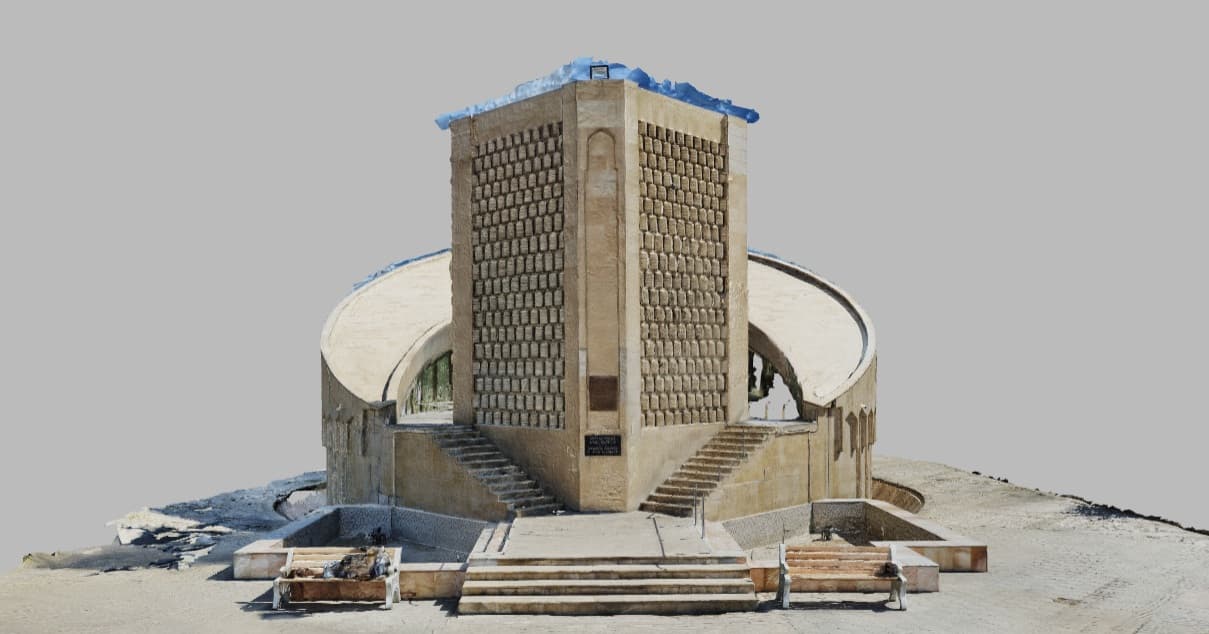
In the quiet surroundings of Bukhara’s Samanid Park stands the Ismail Samani Mausoleum, a compact monument of golden-brown brick that achieves remarkable grandeur through modest proportions. Rising from a square plan approximately ten meters on each side, the building is crowned by a hemispherical dome and four smaller corner domes. Its four nearly identical façades feature recessed pointed arches, engaged corner columns, and a delicate arcade of forty small arched openings beneath the roofline. Rather than relying on glazed tiles or elaborate painted ornamentation, the architects transformed fired brick into an intricate decorative language. Carefully arranged bricks evoke woven basketry, geometric rosettes, and interlocking patterns. As sunlight moves across these textured surfaces, the monument acquires a changing character, its ornament continually redrawn by light and shadow.
Within the mausoleum, four elaborately decorated squinches mediate the transition from the square burial chamber to the circular dome above. This sophisticated structural solution reflects the convergence of early Islamic architecture with older Sogdian and Sasanian building traditions. The geometric composition also recalls the four-arched sanctuaries of pre-Islamic Persia. In adapting these inherited forms to an Islamic funerary monument, the builders created an architectural expression that would become an important precedent for subsequent mausoleums across Central Asia.
Dating from the late ninth or early tenth century, the mausoleum emerged during the ascendancy of the Samanid dynasty, when Bukhara flourished as a center of Persian literature, Islamic scholarship, and artistic innovation. Traditionally associated with Amir Ismail Samani, who ruled from 892 to 907 CE, the building is believed to have been conceived as a family tomb. Historical evidence suggests that it may originally have been commissioned for his father, Ahmad ibn Asad. Although the monument contains three burials, only that of Ismail’s grandson, Nasr II, who died in 943, has been securely identified through inscriptional evidence.
Over the centuries, the mausoleum became surrounded by an extensive cemetery, with accumulated earth partially concealing its lower walls. This circumstance is often credited with helping the monument survive the Mongol conquest of Bukhara in 1220, although the precise circumstances of its preservation remain uncertain. Between 1937 and 1939, the Russian architectural conservator Boris Zasypkin, working alongside the Bukharan master craftsman Shirin Muradov, undertook a meticulous restoration. In 1993, the mausoleum was incorporated into the UNESCO World Heritage Site of the Historic Centre of Bukhara.
More than eleven centuries after its construction, the Ismail Samani Mausoleum remains an extraordinary testament to the creative vitality of medieval Central Asia. The dynasty it commemorates has long vanished, yet the monument preserves something more enduring than political sovereignty: the imagination of a civilization capable of transforming the humblest material into an expression of permanence. Amid the successive empires that have shaped Bukhara, this quiet sanctuary stands as a reminder that architectural greatness need not be measured in scale or splendor, but in the ability to give lasting form to the aspirations of its age.