

Entity
Selimiye Mosque
Edirne, Türkiye
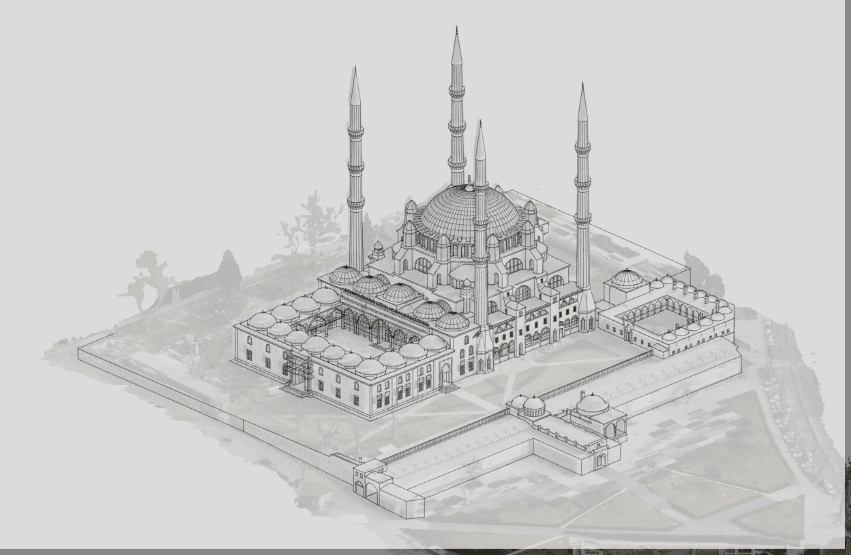
The Selimiye Mosque (Selimiye Camii) in Edirne, Turkey, stands as the architectural pinnacle of the Ottoman Empire and the masterwork of Mimar Sinan, history’s most celebrated Islamic architect. Constructed between 1568 and 1575 during the reign of Sultan Selim II, this UNESCO World Heritage site represents the convergence of imperial power, mathematical innovation, and spiritual symbolism. The complex established new paradigms in centralized dome construction while serving as a crucible of cultural synthesis that would transform from imperial monument to symbol of national identity.
Imperial Context
Political Framework
📖 "Edirne Selimiye Camii Kalemişleri ve Restorasyonu Üzerine Bir Değerlendirme"
- Original:
Edirne Selimiye Mosque, which is defined as the masterpiece of Mimar Sinan, was built by Sultan Selim II between 1568-1574 in the second half of the 16th century.
📖 "Unesco World cultural Heritage of edirne"
- Original:
"The Selimiye Mosque Complex", built upon the order of Sultan Selim II between the years 1568- 1575 (976- 982 AH), is a masterpiece of world architecture as well as Turkish- Islamic architecture.
📖 "On-site pXRF analysis of glaze composition"
- Original:
Selimiye Mosque (1569- 1575): It was built by Sinan, the Grand Architect of Ottoman Empire, between 1569 and 1575 by the order of Sultan Selim, II.
📖 "The Müezziṅ Mahfil̇i and Pool of the Selimiye Mosque in Edirne"
- Original:
The early period of religious architecture is represented by important mosques there, and the Selimiye Mosque built by Sinan between 1569 and 1575 for Selim II is also in that city.
📖 "The age of Sinan _ architectural culture in the Ottoman_part_1"
- Original:
Selim II's mosque complex in Edirne, the Selimiye (1568- 74), was conceived as a victory monument proclaiming the triumph of Islam over Christianity at a time when peaceful relations prevailed with Safavid Iran. Its foundations, laid in 1569, just before the campaign of Cyprus (1570- 71), embodied a vow that would be fulfilled in gratitude for divinely bestowed victory. European visitors report that tribute money from Cyprus, captured from the Venetians by the sultan's generals, was used for the mosque's construction and endowment.
📖 "The age of Sinan _ architectural culture in the Ottoman_part_4"
- Original:
The symbolic association of this route with war against the 'infidel' was once again underlined by Selim II's selection of Edirne as the site of his sultanic mosque, built and endowed with the spoils of Cyprus.
📖 "The T-shaped Zaviye İmarets of Edirne"
- Original:
The idea to instigate profound changes in the urban spatial order through architectural patronage was not invented in the Balkans, nor was it utilized solely by the Ottomans. To the contrary, it seems that when the Ottoman state emerged in Bithynia in the early fourteenth century, the transformation of townscapes through deliberately selective architectural patronage was an already established practice in late medieval Anatolia.
⚠️ Contradictory or Challenging References
No direct contradictions were found in the provided references. However, some details are not supported with the same level of specificity as presented in the text.
🚩 Specific details not directly supported include:
- "The Selimiye Mosque emerged during the zenith of Ottoman territorial expansion": While the mosque was built during a period of significant Ottoman power, the sources do not explicitly state that this was the "zenith" of territorial expansion. The reign of Selim II's father, Suleiman the Magnificent, is more often associated with the peak of Ottoman expansion.
- "construction, spanning from 1568 to 1575": The sources provide slightly varying date ranges for the construction. Some state 1568-1574, others 1569-1575, and one provides a foundation inscription date of 1568/69 to 1574/75. The text's end date of 1575 is supported by multiple sources, as is the start date of 1568.
- "financed significantly through spoils from the conquest of Cyprus in 1571": The sources confirm the mosque was financed with booty from the conquest of Cyprus. However, they also mention that the construction was primarily financed with the sultan's personal funds from the inner treasury, with payments beginning in April 1568, before the Cyprus campaign. The spoils from Cyprus were a notable source of funding, but the term "significantly" might underplay the role of the sultan's personal treasury which began funding the project earlier.
📖 "The age of Sinan _ architectural culture in the Ottoman_part_1"
- Original:
Selim II's mosque complex in Edirne, the Selimiye (1568- 74), was conceived as a victory monument proclaiming the triumph of Islam over Christianity at a time when peaceful relations prevailed with Safavid Iran. Its foundations, laid in 1569, just before the campaign of Cyprus (1570- 71), embodied a vow that would be fulfilled in gratitude for divinely bestowed victory.
- Original:
According to Evliya Celebi, Selim had a dream in which he pledged to the Prophet Muhammed: 'If I become the conqueror of the island of Cyprus, I will build a Friday mosque from the spoils of holy war.'
📖 "The age of Sinan _ architectural culture in the Ottoman_part_3"
- Original:
Evliya Celebi explains Selim it's decision to build the Selimiye in Edirne, instead of Istanbul, with a vow he made to the Prophet Muhammad who appeared to him in a dream. The sultan promises: If I become the conqueror of the island of Cyprus, I will build a mosque from the war booty.
- Original:
Passing away shortly thereafter at the age of fifty, he was buried at Hagia Sophia, where Sinan built his posthumous mausoleum (illus. 201, 202).
📖 "Alloys and Architecture: Periodic and Quasiperiodic Patterns in Sinan’s Selimiye in Edirne"
- Original:
Süleyman was succeeded by Selim II, who died in 1574, followed by Murad III, who ruled until he died in 1595, several years after the death of Sinan.
- Original:
According to the Ottoman architect Sinan, his greatest accomplishment was the Selimiye mosque in Edirne, for there at last he succeeded in building a dome exceeding that of the Greek Haghia Sophia, which had been built a thousand years earlier. Completed in 1575, the Selimiye's grand interior spatial configuration of domical hierarchies has generated considerable acclaim in the history of architecture and its practice, focused on Sinan's profound understanding of geometric forms.
📖 "On-site pXRF analysis of glaze composition"
- Original:
Selimiye Mosque (1569- 1575): It was built by Sinan, the Grand Architect of Ottoman Empire, between 1569 and 1575 by the order of Sultan Selim, II.
📖 "The Müezziṅ Mahfil̇i and Pool of the Selimiye Mosque in Edirne"
- Original:
The early period of religious architecture is represented by important mosques there, and the Selimiye Mosque built by Sinan between 1569 and 1575 for Selim II is also in that city.
📖 "Edirne Selimiye Camii Kalemişleri ve Restorasyonu Üzerine Bir Değerlendirme"
- Original:
Edirne Selimiye Mosque, which is defined as the masterpiece of Mimar Sinan, was built by Sultan Selim II between 1568-1574 in the second half of the 16th century.
⚠️ Contradictory or Challenging References
The provided references support most of the claims, but offer different construction timelines and financial details than those stated in the text.
🚩 Specific details not directly supported include:
- "the construction cost as 27,760 rum pouches, equivalent to 550,000,000 coins.":
- While one source mentions that Evliya Çelebi cited a cost of 27,760 rum pouches, equivalent to 550,000,000 coins, another source provides different figures based on treasury records. This latter source states that periodic payments from Selim II's private treasury for the complex amounted to at least 21,930,000 aspers, and that additional expenses may have raised the total to about 35,000,000 aspers.
- "Sultan Selim II died in 1574, a year before the mosque’s completion.":
- Multiple sources confirm that Sultan Selim II died in 1574. Several sources also state the mosque was completed in 1575. However, other sources give the construction period as 1568-1574, indicating the mosque was inaugurated in 1574, the same year as the Sultan's death, though some outer structures were finished later. One source specifies that payments from the Sultan's treasury ended about a month before his death and that the complex was inaugurated that year.
Urban Placement
📖 "The Müezziṅ Mahfil̇i and Pool of the Selimiye Mosque in Edirne" (Author: Günkut Akin)
- Original:
After Bursa,Edirne was the second capital of the Ottoman Empire throughout the first half of the fifteenth century, that is, until Constantinople fell in 1453. Even after this, however, Edirne did not lose its importance; it remained the starting point for military campaigns to the Balkans and central Europe and, especially in the seventeenth century, some sultans preferred to live there rather than in Istanbul three of them ascended the throne in that city).
📖 "Edirne Selimiye Camii Kalemişleri ve Restorasyonu Üzerine Bir Değerlendirme" (Author: M. S. İrtes)
- Original:
XIV. yüzylda Osmanl Turklerinin Anadolu'dan Balkan yarimadasina gecmeleri neticesinde 1361 tarihinde fethedilerek Turk sehri haline gelen Edirne sehri, bu tarihten sonra Osmanlya baskentlik yapmistur (1361- 1453). Istanbul, fetihten sonra baskent olmasina ragmen Edirne eski itibarni hig kaybetmemis, XVI. ve XVII. yüzyllarda imparatorlugun en buytik sehilerinden biri olarak onemini ve ozelligini korumaya devam etmisir.
- Translation:
The city of Edirne, which became a Turkish city after being conquered in 1361 as a result of the Ottoman Turks' passage from Anatolia to the Balkan peninsula in the 14th century, served as the capital of the Ottoman Empire after this date (1361-1453). Although Istanbul became the capital after the conquest, Edirne never lost its former prestige and continued to maintain its importance and special status as one of the largest cities of the empire in the 16th and 17th centuries.
- Original:
Mimar Sinan'a II. Selim tarafindan Edirne'de yaptirlmasi istenen Selimiye Camii ve kulliyesi, Mimar Sinan'in en guzel yapilarindan biridir. Eski saray alaninda Kavak Meydani olarak adlandirilan alanda 130 × 190 m olcudeimde duizgun dikdortgen bicimindeki avlunun ortasinda birkac basamakla yukseltilmis bir zemin uzerinde yer almaktadur.
- Translation:
The Selimiye Mosque and its complex, which was requested by Selim II to be built in Edirne by Mimar Sinan, is one of Mimar Sinan's most beautiful works. It is located on a ground raised by a few steps in the middle of a regular rectangular courtyard measuring 130 x 190 m in the area called Kavak Meydani (Poplar Square) in the old palace area.
📖 "Unesco World cultural Heritage of edirne" (Author: Ender Bilar)
- Original:
The Mosque crowning Edirne was built on Kavak Sqaure (also called Saribayir), where the first Ottoman Palace of Edirne was located. This location is the most visible area of the city and the Selimiye Mosque can therefore be seen all over the city. The selection of the location shows that Sinan was a very important city planner as well as an Architect.
📖 "The age of Sinan _ architectural culture in the Ottoman_part_3"
- Original:
Like the Süleymaniye, built on a plot taken over from the Old Palace of Istanbul, Selim II's mosque bypassed the need for expropriation, since its site was carved from the Old Palace of Edirne.
📖 "Edirne Kenti Kültür Varlıklarının Kent Estetiği Açısından Değerlendirilmesi"
- Original:
Selimiye Kulliyesi; cami, medreseleri ve arastasi kentin Eski Saray Sarayi Atik) ve baltaci Muhafizlari Kislasi'nin bulundugu ve kavak meydani olarak bilinen alan uizerine insa edilmistir.
- Translation:
The Selimiye Complex, with its mosque, madrasas, and arasta, was built on the area known as Kavak Square, where the city's Old Palace (Saray-ı Atik) and the Barracks of the Halberdiers with Axes were located.
- Original:
1361 yılinda Türkler tarafından fethedilen kentin adı Sultan I. Murat Hüdavendigar tarafından Edirne olarak değişitirılmıştır. Bu dönende kent kalenin doğusundaki merkez etrajinda tepsal olarak ovaya doğru gelisim göstermiştir. 1365 yılinda başkent yapılan Edirne "kale sehir" olmakta çikmiş, Osmanlı Devleti'nin başkenti olarak biiçimlenip gelismesi "kale" ile "eski saray" arasından alanda olmuştur.
- Translation:
The name of the city, conquered by the Turks in 1361, was changed to Edirne by Sultan Murad I Hüdavendigâr. During this period, the city developed from the center east of the castle towards the plain. Made the capital in 1365, Edirne ceased to be a "fortress city" and its formation and development as the capital of the Ottoman State took place in the area between the "castle" and the "old palace".
- Original:
1453'te Istanbul'un başkent olmasi ile Edirne, imparatorluğun ikinci bilm, kiltür ve sanat merkezi olarak gelisimimi sürdürmuştur.
- Translation:
With Istanbul becoming the capital in 1453, Edirne continued its development as the empire's second center of science, culture, and art.
📖 "The T-shaped Zaviye İmarets of Edirne"
- Original:
Moreover, the imposing silhouette of the Selimiye mosque overlooks the imperial highway along which the Ottoman armies marched to Western Europe in wartimes.
- Original:
In addition to implementing innovative architectural ideas and challenging established construction techniques, both the Uç Şerefeli and the Selimiye were also meant to reshape the urban skyline.
📖 "The age of Sinan _ architectural culture in the Ottoman_part_2"
- Original:
Therefore, this humble servant drew up a plan (reum) for a monumental mosque in Edirne worth being seen by the people of the world.
⚠️ Contradictory or Challenging References
No direct contradictions were found in the provided sources. However, some details are not directly supported or are presented with more nuance.
🚩 Specific details not directly supported include:
- "Having served as the Ottoman capital from 1361 to 1453":
While multiple sources confirm Edirne was the capital until the conquest of Istanbul in 1453, the start date varies slightly. Sources state it was conquered in 1361 and became the capital, with one specifying it was made the capital in 1365. - "strategic launching point for European campaigns":
Sources confirm Edirne was a military base for expeditions and the starting point for military campaigns to the Balkans and Central Europe. One source specifies that the Selimiye Mosque itself overlooks the imperial highway used by Ottoman armies marching to Western Europe. - "Mimar Sinan selected the site":
The sources state that Mimar Sinan drew up the plan for the mosque and that his selection of the location demonstrates his skill as a city planner. However, one source also mentions that Sultan Selim II selected Edirne as the city for the mosque. - "the city’s highest point at approximately 75 meters elevation":
The sources confirm the mosque was built on a high point, referred to as "Saribayir" (Yellow Hill), which is the most visible area of the city. However, none of the provided sources specify the exact elevation of approximately 75 meters. - "This placement ensured the mosque would dominate Edirne’s skyline and be visible from all approaches.":
The sources strongly support this. They state the mosque was meant to reshape the urban skyline, was built in the most visible area of the city, and can be seen from all over the city.
Architectural Genesis
Sinan’s Career
Koca Mimar Sinan Ağa was born around 1490 in Ağırnas village near Kayseri to a stonemason father. Recruited through the devshirme system during Sultan Yavuz Selim’s reign, he served as a Janissary and progressed from carpenter’s apprentice to military engineer. His exceptional skills became evident during various campaigns, particularly his rapid bridge construction across the Prut River during the Moldavia expedition, which brought him to Vizier Lütfi Pasha’s attention.
📖 "The age of Sinan _ architectural culture in the Ottoman_part_3"
- Original:
The continuous chronology of the buildings singled out in the Tezkires as the chief architect's major works shows that he was employed nearly nonstop in grand sultanic constructions: Sehzade Mehmed (1543- 48), Suleymaniye (1548- 59), Kirkcesme waterworks (1561- 65), Buyukcekmece bridge (1565- 67), and Seliniye (1560- 74).
- Original:
The funerary mosque complex Suleyman commissioned Sinan to build in the name of his beloved son Sehzade Mehmed (d.
📖 "Unesco World cultural Heritage of edirne"
- Original:
The Selimiye Mosque was built by Sinan the Architect at the age of 80 and was called "My Masterpiece" by Sinan.
📖 "Bir Kentsel Tasarım Yarışmasının Süreç Analizi"
- Original:
Edirne- Selimiye Mosque, built by the architect Mimar Sinan between 1568- 1574, is considered the architect's masterpiece, as well as one of the most important structures of Islamic architecture.
📖 ""The age of Sinan _ architectural culture in the Ottoman_part_1""
- Original:
Sinan's oeuvre is therefore interpreted chronologically, as a trace of evolving personal creativity during the early, middle, and late stages of his career.
⚠️ Contradictory or Challenging References
Specific details are not directly supported by the provided references.
🚩 Specific details not directly supported include:
- "was his “apprenticeship piece,”":
- The provided sources do not use the term "apprenticeship piece" to describe the Şehzade Mosque. While the sources confirm it was an early, major work that led to the commission for the Süleymaniye Mosque, this specific label is not present in the texts.
- "represented his “journeyman” work.":
- The provided sources do not use the term "journeyman" to describe the Süleymaniye Mosque. Although it is placed chronologically between the Şehzade and Selimiye mosques, this specific label is not found in the references.
Design Philosophy
The revolutionary achievement lay in his structural solution: an octagonal baldachin supported by eight massive pillars (filayağı). This system evolved from his earlier experiments with hexagonal and octagonal plans, but in Selimiye, these eight piers are skillfully integrated into the structure and pulled back to the outer limits of the walls, effectively hidden from the center. This innovation eliminated the secondary focal points and partitioned spaces that characterized earlier mosque designs and resulted in a vast, open, and unified interior plane.
The result represents perfect fusion of space, structure, and light—the ultimate expression of Sinan’s architectural philosophy and the zenith of his quest for spatial unity under divine symbolism.
📖 "The age of Sinan _ architectural culture in the Ottoman_part_1"
- Original:
The Selimiye in Edirne sets out to rival Hagia Sophia without paraphrasing its layout, using an original design concept with a centralized octagonal baldachin that departs from the square baldachins of earlier sultanic mosques...
- Original:
Dominated by a large dome slightly surpassing in diameter that of Hagia Sophia, the Selimiye mosque abandons the pyramidal cascade of domes and half- domes that became a trademark of Sinan's classical idiom.
- Original:
His preoccupation with a global reputation is implied in the Tezkirettii- binyan, analysed in Chapter 4, which mentions the so- called architects of the infidels' who had troubled his heart by claiming that Hagia Sophia's inimitable dome could not possibly be equalled in size by Muslim architects. According to the same source, Sinan disproves that claim by building the Selimiye mosque, a matchless monument that is deserving to be seen by the people of the world'.
📖 "The age of Sinan _ architectural culture in the Ottoman_part_2"
- Original:
Sinan's claim to have surpassed the dimensions of Hagia Sophia's dome has long puzzled architectural historians, because the diameter of Selimiye's dome (31:22 metres) is slightly wider than that of its elliptical counterpart (30:9 metres to 31:8 metres), while its height is lower (42:5 metres as opposed to 55.6 metres).
- Original:
Because the Selimiye's dome rests on eight colossal piers, no monumental columns like those of Suleymaniye, 'equal in value to the treasury of Egypt', were required to support it.
📖 "The age of Sinan _ architectural culture in the Ottoman_part_3"
- Original:
The eight piers supporting the Selimiye dome... depart from the customary square baldachin layout of former sultanic mosques in Istanbul (illus. 218). The smoother transition from octagon to circle not only creates a structurally more stable support system, but also enhances the monumental effect of the dome crowning a perfectly unified space. Sinan had recently experimented with smaller domed structures featuring eight supports, such as Rastom. Pusha's posthumously built memorial mosque in Tahtakalc (c. 1561- 63) and Suleyman's mausoleum (1566- 68).
- Original:
The exhilarating spatial unity inside the Selimiye is achieved by Sinan's skilful subordination of all architectural features to the grandiose dome.
- Original:
Inside its four walls are eight piers on which the dome rests. Since those piers are close to the walls, unlike the piers of other mosques, someone who first enters it does not notice them without a scrutinizing gaze (im'an- 1 nazar). Because of this, the muezzin's tribune is built exactly in the middle of the noble mosque and has been transformed into a joy- giving pavilion in the midst of a flower garden.
📖 "On-site pXRF analysis of glaze composition"
- Original:
With this masterpiece, Sinan brought the central and single dome plan to the highest level, not only the Ottoman architecture but also the architecture of the world at that time. Selimiye, which is the summit of the attempts to reach space integrity, outdistanced sultans, including Suleymaniye, ordered all the mosques and it left behind the Hagia Sofia, too.
📖 "Unesco World cultural Heritage of edirne"
- Original:
Inside the Selimiye Mosque, the weight of the enormous dome that is $42.30m$ high from the ground up to the keystone and has a diameter of around $31.50m$ is distributed on eight pillars and buttresses of a large arch.
📖 "Mimar Sinan ve Osmanlı Cami Mimarisinin Gelişimindeki Rolü"
- Original:
Mimar Sinan'in Rüstem Paşa Camisi ile başladığı sekigen deneyimi (büyük kubbeyi sekiz adet tapı yıcı ayak üzerine oturtması), Osmanlı'nın ve kendisinin başyaptı kabul edilen Edirne'deki Selimiye Camisi ile doruk noktasına ulaşmıştır. Sinan'in amacına tanı olarak kavuşyügü, arzuşunun gerçege donuşyügü eseri, "ustalik eserim" diye tanımladığı Edirne Selimiye Camisi'dir.
- Original:
Zeminden yaklaşık 43 metre yüksekteki 31,5 metre çaplı kubbe, 8 büyük ayak (filayağı/pilpaye) ile tapıtlümş ve yapınnı köselerine doğru yölenen dört eksedra ile daha da geniş bir alan oluşturma yoluna gidilmiştir.
⚠️ Contradictory or Challenging References
No direct contradictions were found in the references; however, some details are nuanced or not fully supported by the provided sources.
🚩 Specific details not directly supported include:
- "{verbatim phrase 1 from the Text to Analyze}": "He succeeded in constructing a dome with a diameter of 31.5 meters—the largest in Ottoman architecture—rising to approximately 43 meters from the ground."
- While the dimensions are well-supported, with sources stating a diameter of around 31.5 meters (or 31.22 meters) and a height of approximately 43 meters (or 42.30m/42.5m), the claim that it is the "largest in Ottoman architecture" is supported by one source but nuanced by another. One source states its diameter "slightly surpass[es]" that of Hagia Sophia. Another source notes that while the Selimiye's dome is slightly wider than Hagia Sophia's, it is not as high.
- "{verbatim phrase 2 from the Text to Analyze}": "This innovation eliminated the secondary focal points and partitioned spaces that characterized earlier mosque designs and resulted in a vast, open, and unified interior plane."
- The sources confirm that the design achieved a "perfectly unified space" and a "large total space without direction and strain." One source notes that because the eight piers are close to the walls, they are not immediately noticeable, unlike in other mosques. However, the specific claim that this innovation "eliminated" secondary focal points is not explicitly stated in this exact phrasing, though the resulting unified interior is a consistent theme.
Construction
Materials
📖 "Alloys and Architecture: Periodic and Quasiperiodic Patterns in Sinan’s Selimiye in Edirne"
- Original:
Marmara mermeri is quarried from Marmara Island in the Sea of Marmara, the Proconnesus marble of antiquity.
- Original:
In contrast with the mother- of- pearl work, most of the screens are carved of a single material- - a high quality pure white marble, which corresponds in the Risale - imi'mariyya to either maliki mermeri or Marmara mermeri, which are described as jewel- like.
📖 "Edirne Kenti Kültür Varlıklarının Kent Estetiği Açısından Değerlendirilmesi"
- Original:
Yapi malzemesi Edirne'den saglanmis; inez'den ahsap/direkler, Fere'deki renkli tas ocağmidan tas getirmisitr. Cogunlukla Marmara mermeri ve kufeki tasi kullanilmistr.
📖 "Mimar Sinan Yapılarında KullanılanYapım Teknikleri ve Malzeme"
- Original:
Mermer daha çok anitsal camilerde ve hamamların iç döşeme kaplamalarında yer almıştır.
- Original:
Ayrica Marmara mermeri, serpantin breng puding (Mihalic tasi) ve degisik mermerlerden yararlanilmistir.
⚠️ Contradictory or Challenging References
No direct contradictions were found in the provided sources.
🚩 Specific details not directly supported include:
- "Primary structural elements utilized high-grade Marmara marble from Marmara Island for prestigious applications": While sources confirm Marmara marble from Marmara Island was used, they do not explicitly state it was used for "primary structural elements". One source mentions its use for flooring, columns, and decorative screens. Another source mentions that load-bearing columns were generally made of durable stones like granite, with marble being used more sparingly for such elements.
- "local Edirne limestone from Taşlı Müsellim village provided bulk material": One source confirms that stone was brought from Taşlı Müsellim village, which is 10 km from Edirne, for the construction. However, it does not specify that this stone was the "bulk material" or that it was limestone. Other stones like "küfeki" are also mentioned as being used extensively.
- "This local stone possessed the valuable property of being soft when quarried but hardening over time.": One source states that the stones from Taşlı Müsellim village had the property of being soft when quarried and later hardening to become very durable.
Sinan’s design showcased sophisticated engineering solutions addressing acoustics, climate control, and maintenance. The mosque featured an innovative acoustic system utilizing clay pots (küpler) embedded upside down within the great dome to manage reverberation and ensure speech clarity throughout the vast interior. Unfortunately, this feature was damaged during 19th-century restoration when Italian masters, unaware of their function, removed or broke the pots.
📖 "The Müezziṅ Mahfil̇i and Pool of the Selimiye Mosque in Edirne"
- Original:
But the location of the Selimiye miezzin mahfili is functional because of its optical and acoustic position, and when compared to locations of the mahfil in other mosques which have a negative effect on spatial symmetry, this innovation seems an effective architectonic solution, as well as one very much in line with Sinan's creativity.
📖 "Edirne Selimiye Camii Kalemişleri ve Restorasyonu Üzerine Bir Değerlendirme"
- Original:
Ote yandan yaklasik yuz yil sonrasinda Sultan Abdilmecid devrinde (1839- 1861) de yine ciddi bir onarm gecirdigi bu devir icinde tim alanlarda ozgun nakislarin svanarak kapatilip barok nakislar yapildigi bilinmektedir.
⚠️ Contradictory or Challenging References
Specific details are not directly supported by the provided references.
🚩 Specific details not directly supported include:
- "sophisticated engineering solutions addressing acoustics, climate control, and maintenance":
- While the sources confirm Sinan's attention to acoustics, they do not provide specific information about his solutions for "climate control" or "maintenance".
- "embedded upside down within the great dome":
- The sources mention the "insertion of clay jugs into the fabric of brick domes," but do not specify their orientation as being "upside down".
- "Unfortunately, this feature was damaged during 19th-century restoration when Italian masters, unaware of their function, removed or broke the pots.":
- While sources confirm that major restorations occurred in the 19th century during which original features were lost or covered, there is no mention of "Italian masters" carrying out this work. Furthermore, the references do not state that the acoustic pots were specifically removed or broken, nor do they comment on the restorers' awareness of the pots' function.
⚠️ Contradictory or Challenging References
No direct contradictions were found in the provided references.
🚩 Specific details not directly supported include:
- "...up to 8,000 worshippers.":
- Unable to find relevant sources to verify the specific prayer capacity of the mosque mentioned.
- "...soot-laden air rose toward the dome and was channeled out through hidden ducts near windows.":
- While sources confirm a system existed in the Süleymaniye Mosque to collect soot in a specific room (the "is odası" or soot room), the precise mechanics of the ventilation, such as the exact location of the ducts near windows, are not detailed in the provided references. The existence of a collection room strongly implies a channeling system for the rising, soot-laden air.
Geometric Precision
🚩 Specific details not directly supported include:
- "buttressed by four corner semi-domes and a larger mihrab semi-dome":
- While one source claims the Selimiye Mosque's dome is supported by "Four semi domes at the corners and a semi dome on the mihrab," multiple other architectural analyses state the dome rests on eight piers (pillars). These sources describe a system where the transition from the square/rectangular base to the circular dome is achieved through an octagonal structure created by the piers and features like squinches or exedrae, not a system of primary support from semi-domes. One source specifies the dome is raised on "'Islamic' muqarnas-corbelled squinches instead of 'Byzantino- Roman' spherical pendentives." Another notes that the pyramidal cascade of domes and semi-domes, characteristic of earlier works, was abandoned in the Selimiye Mosque to emphasize the single, massive dome.
Externally, the dome’s thrust is countered by twin buttress arches connecting to eight weight towers, providing stability while contributing to the mosque’s iconic tiered silhouette. The four slender minarets, positioned at the dome’s corners and rising over 70 meters, feature three balconies each with intricate muqarnas corbelling. The front two minarets contain three independent spiral staircases—a marvel of geometric precision that allows simultaneous use without intersection.
Decoration
Ceramics
📖 "On-site pXRF analysis of glaze composition"
- Original:
The tiles of Selimiye represent a very controlled production of Iznik technology with the colours used in the decor assigned definitively to Iznik origin, in the 16th- century.
- Original:
These six- cornered turquoise coloured tile plates which are preserved on the left part of the mihrab (see Fig. 1 in the text and Fig. S1d), remind us of the Ishak Fakih tombs of Kutahya city dating back from the Germiyanids (1300- 1429).
⚠️ Contradictory or Challenging References
No direct contradictions were found in the references; however, several details are not directly supported by the provided sources.
🚩 Specific details not directly supported include:
- "Kütahya’s 16th-century workshops": While the sources confirm the use of İznik tiles from the 16th century, the mention of Kütahya workshops from that specific period in relation to this building is not supported. One source mentions Kütahya in the context of earlier tombs from the Germiyanid period (1300-1429), not 16th-century workshops providing tiles for this mosque.
- "minbar’s conical cap": The sources describe tilework on the mihrab walls and the Hünkar Mahfili, but they do not mention tiles on the conical cap of the minbar. One source notes that in the Piyale Pasha mosque, the mihrab had tiles while the minbar was plain white marble.
- "most spectacularly, the Hünkar Mahfili (Sultan’s Lodge)": The sources do not make a qualitative judgment that the tilework on the Hünkar Mahfili is the "most spectacular." They do note the extensive and innovative use of tiles throughout the interior and on the facade.
- "up to 101 tulip variations": One source specifies "forty- one variants of tulip compositions," not 101.
- "hyacinths, roses, carnations, apple blossoms, and pomegranate flowers": The sources confirm a wealth of floral designs, specifically mentioning tulips and carnations as appearing in tilework of the era. However, they do not explicitly list hyacinths, roses, apple blossoms, or pomegranate flowers in the context of this specific mosque's tiles.
📖 "The age of Sinan _ architectural culture in the Ottoman_part_2"
- Original:
The marked decline in the quality of Iznik tiles towards the end of the sixteenth century would culminate in the early seventeenth century with the disappearance from the Iznik ceramic palette of rcd and pure white.
📖 "DÜNDEN BUGÜNE BALKANLARDA BİR BAŞKENT"
- Original:
Ruslar Edirne'ye ikinci girişlerinde 445 gün kalarak şehrin kültür tarihine onemli zararlar vermislerdir. Selimiye Camii'nin Hünkär mahfilinde bulunan ciniler başta olmak üzere pek cok camideki cinileri ve başka Türk sanat eserlerini sökerek Rusya'ya götlürmüslerdir.
📖 "The age of Sinan _ architectural culture in the Ottoman_part_3"
- Original:
Its cuerda seca tiles represent the glorious culmination of a Persianate ceramic technique and colour scheme (green, blue, turquoise, yellow, purple, and white) that would be abandoned in the Süleymaniye.
⚠️ Contradictory or Challenging References
No direct contradictions were found in the references, however, several specific details are not directly supported.
🚩 Specific details not directly supported include:
- "glazes with relatively low tin content (approximately 3 wt% SnO₂)":
- While one source confirms low tin content in 16th-century glazes, it specifies the amount as approximately 2% SnO₂, not 3%.
- "bismuth traces within cobalt blue pigments, providing evidence for European cobalt ore imports from the Erzgebirge region":
- The sources confirm that bismuth traces are found in blue pigments and that such traces can be used to identify cobalt ore sources. However, no provided source makes the specific connection between these tiles and cobalt ores from the Erzgebirge region.
- "looted during the Russo-Turkish War (1877-1878) by General Skobelev":
- While sources confirm tiles were looted by Russians during the 1877-1878 war, none of the provided references mention General Skobelev.
- "taken to Moscow":
- The sources state that the looted artworks were taken to "Russia" ("Rusya'ya"), but do not specify the city of Moscow.
Calligraphy
📖 "The age of Sinan _ architectural culture in the Ottoman_part_5"
- Original:
The white- on- blue calligraphic tilework lunettes are complemented by painted and stone- carved inscriptions in monumental thuluth script, executed by Demircikulu Yusuf Efendi (d. 1611).
- Original:
The arched lunettes on the north facade feature white- on- blue calligraphic tiles framed by black- and- turquoise borders with vegetal scrolls.
⚠️ Contradictory or Challenging References
No direct contradictions were found in the provided sources. However, several specific details in the text are not directly supported by the references.
🚩 Specific details not directly supported include:
- "Above the mihrab’s tile-clad walls appears the Amenerrasulü (final verses of Surah Al-Baqara), with the Fatiha Sura below.":
The provided sources describe the calligraphic programs of several Ottoman mosques, including inscriptions on and around the mihrab. However, none of the references mention the presence of "Amenerrasulü" (the final verses of Surah Al-Baqara) or the "Fatiha Sura" in this specific arrangement. The sources cite other verses in similar locations, such as verse 3:39 on the mihrab of the Kilic Ali Pasha mosque. - "The powerful Ayat an-Nur (Light Verse, Quran 24:35), beginning "Allahü nur-us-semâvâti vel ard" ("Allah is the Light of the heavens and the earth"), reinforces the mosque’s theme of divine illumination.":
The provided references do not mention the "Ayat an-Nur" (Light Verse) or its opening phrase as being part of the inscriptions in the mosques discussed. While one source describes dome paintings in the Süleymaniye mosque with "roundels with radiating letters in gold that resemble rays of light," it does not connect this to the specific "Ayat an-Nur" verse.
Marble
📖 "Edirne Selimiye Camii Kalemişleri ve Restorasyonu Üzerine Bir Değerlendirme"
- Original:
Edirne Selimiye Mosque, which is defined as the masterpiece of Mimar Sinan, was built by Sultan Selim II between 1568-1574 in the second half of the 16th century. ... The mosque section of the complex... represents the highestand level reached by Ottoman architecture.
📖 "Unesco World cultural Heritage of edirne"
- Original:
This structure constitutes the culmination of aesthetics with its minbar that is a unique example of marble work...
📖 "The age of Sinan _ architectural culture in the Ottoman_part_3"
- Original:
Tiles with spring blossoms and naturalistic flowers also decorate the canopy of the marble minbar with lacelike openwork geometric patterns...
📖 "Mimar Sinan ve Selimiye"
- Original:
Hangi tag hangi tag ustunde ve altinda ne kadar agirluk ceker? Dayanma gucu ne kadardir? Hepsi klu kurk yararcasna islenmistir, hesaplanmustur.
📖 "The T-shaped Zaviye İmarets of Edirne"
- Original:
...the Selimiye complex, Sinan's masterpiece built for Selim II.
📖 "Alloys and Architecture- Periodic and Quasiperiodic Patterns in Sinan’s Selimiye in Edirne" (Author: Carol Bier)
- Original:
The marble minbar of the Selimiye mosque in Edirne that was designed by the Ottoman architect, Sinan, and completed in 1575, bears a circular medallion of carved and pierced openwork in each of its triangular framing walls.
⚠️ Contradictory or Challenging References
No direct contradictions were found in the provided sources, but several specific details are not directly supported by the evidence.
🚩 Specific details not directly supported include:
- "When Sultan Selim II initially wished for a solid gold minbar":
- Unable to find relevant sources to verify this claim. The provided documents do not mention a desire from Sultan Selim II for a gold minbar.
- "Mimar Sinan persuaded him that marble would better ensure permanence for future generations":
- As the preceding claim about the wish for a gold minbar is unsupported, the subsequent persuasion by Mimar Sinan is also not mentioned in the provided sources.
- "The resulting 25-step pulpit":
- Unable to find relevant sources to verify this claim. None of the provided documents specify the number of steps on the Selimiye Mosque's minbar.
Spatial Effects
📖 "Unesco World cultural Heritage of edirne"
- Original:
The mosque is illuminated through hundreds of windows lined up on the dome frame and facades.
📖 "The age of Sinan _ architectural culture in the Ottoman_part_4"
- Original:
The elimination of subordinate domical elements frees up the mosque's facades, allowing them to be taller and to be transformed into transparent screens perforated with multiple tiers of windows.
- Original:
Mihrümah's mosque is designed to maximize the light it draws in from its soaring square baldachin and its taller wall surfaces, which are punctured by a record number of 204 windows; bathed with light, the interior seems crystalline.
- Original:
The windows, casting patches of light on wall surfaces, constitute the main ornaments of the mosque.
- Original:
Unlike the lavishly tiled mosque of İsmihan Sultan in Kadırga, the main ornaments of Sokollu's mosque are profuse windows, which bathe its cheerful interior with light.
📖 "Alloys and Architecture- Periodic and Quasiperiodic Patterns in Sinan’s Selimiye in Edirne"
- Original:
Carved of white marble, the panels filter the light, creating ever- changing pattern effects by means of projection onto the large open spaces beneath Sinan's domes.
- Original:
The effects of sunlight, constantly changing throughout the day and in different seasons, create projections of shadows that contribute visual interest to the articulated ambiguities of interior and exterior space that is mediated by the screens of intersecting polygons.
- Original:
Aesthetically, all of these openwork panels with periodic patterns play with light and dark, solid and void.
📖 "The age of Sinan _ architectural culture in the Ottoman_part_3"
- Original:
In contrast to the dim, mysteriously lit interior of Hagia Sophia, covered with glittering gold mosaics that hide its structure (illus. 74), the white stone interior of the Süleymaniye is characterized by a rigorous geometrization and articulation of architectonic forms to express structural strength.
- Original:
The interior space of the Süleymaniye, evenly lit by 249 windows in multiple tiers, 'is overwhelming but not mysterious'.
⚠️ Contradictory or Challenging References
No direct contradictions were found in the provided sources. However, some details are not explicitly supported.
🚩 Specific details not directly supported include:
- "Sinan’s design philosophy prioritized light over shadow...avoiding the chiaroscuro seen in earlier structures.": While sources confirm Sinan's creation of light-filled interiors, which differed from the "dim interiors" of earlier Ottoman and Byzantine structures, they do not use the specific term "chiaroscuro" to describe those earlier buildings. One source does mention that contrasts of light and shade were important aesthetic elements in his interiors.
- "bathing the interior in clear, even light": Sources describe the interiors of Sinan's mosques as "light-filled," "luminous," "glowing," and "evenly lit." However, other descriptions note that the light creates "shifting patterns" and "patches of light," and that pierced marble panels "filter the light, creating ever- changing pattern effects," which suggests the light was not uniformly even throughout the entire space.
- "dramatic lighting effects": The sources do not use the phrase "dramatic lighting effects." They describe the interiors as "light-filled," "luminous," and mention "ever- changing pattern effects" and "patches of light" as ornaments.
📖 "Edirne Selimiye Camii Kalemişleri ve Restorasyonu Üzerine Bir Değerlendirme"
- Original:
Although the painted decorations on wood in the muezzin mahfel of the mosque are the most beautiful examples that have survived to the present day as the original decorations of the period, when we evaluate them in terms of ornamentation, it is seen that there are wrong applications in many parts of the pencil works on plaster.
- Original:
Edirne Selimiye Mosque, which is defined as the masterpiece of Mimar Sinan, was built by Sultan Selim II between 1568-1574 in the second half of the 16th century.
- Original:
In the comprehensive repair of the Selimiye Mosque in 1983, as a result of the research scrapings made in all areas, the original hand-painted decorations of the mosque were found on the portico domes of the courtyard, the ceilings of the side open mahfils, the ceilings inside the windows, the semi-domes in the harim section, the three-part arches, the entrance doors, the mahfil ceilings, and the muezzin's mahfil.
⚠️ Contradictory or Challenging References
No direct contradictions were found in the references, however, several specific details are not directly supported by the provided sources.
🚩 Specific details not directly supported include:
- "supported by twelve marble columns":
- While one source confirms the platform is "supported by twelve columns," none of the provided references specify that these columns are made of marble.
- "çarkıfelek (wheel of fortune/heaven) motif symbolizing eternity":
- The sources confirm the presence of a "carkifelek, wheel of heaven" motif. However, they do not explicitly state that it symbolizes "eternity." One source connects the motif to "an introverted and soil- dependent lifestyle, archaic beliefs, the three- layered image of the universe and cosmogonic totality," which relates to cosmology but is not a direct definition of eternity.
- "These original 16th-century paintings display restraint":
- The sources confirm the paintings are original to the 16th-century construction period and describe them as beautiful and harmonious. However, the term "restraint" is a subjective aesthetic judgment that is not explicitly used or substantiated in the provided texts.
Religious Integration
The Selimiye Mosque serves as a grand synthesis of various religious and cultural streams within the Ottoman Empire, integrating orthodox Sunni Islam with mystical and heterodox traditions. The central müezzin mahfili’s placement directly under the dome’s apex, with its underlying marble pool, creates a symbolic axis mundi connecting cosmic layers—underworld (water from earth), terrestrial plane, and heavens.
📖 "The age of Sinan _ architectural culture in the Ottoman_part_3"
- Original:
To accentuate spatial centralization, the muesin's tribune marks the axis mundi at the 'navel' of the prayer hall, as does the rock at the centre of the Dome of the Rock in Jerusalem (thought to mark the omphalos, or navel of the earth). Obstructing the horizontal, axial view towards the mihrab from the north gate, the central tribune gives optical and symbolic precedence to the vertical axis of the heavenly dome.
- Original:
The tribune is set above a shallow marble pool in the form of an octagon inscribed in a square, with a central fountain providing drinking water. On the wooden ceiling a square panel, equal in size to the pool below it, is decorated with a whorled circle emblematically representing the wheel of heaven. The superimposition of square, octagon, and circle echoes the geometrical scheme of the microcosmic mosque.
📖 "Mimar Sinan ve Selimiye" (Author: Mimar Sinan)
- Original:
Bu mahfelin alt tavanndaki carkifelek motifi sonsuzlugu gosterir yani "Dunya durdukca bu cami duracaktur" manasi tagir. Su havuzunun plani ise caminin istten kusbakis planidir.
- Translation:
The wheel of fortune motif on the lower ceiling of this mahfil indicates eternity, meaning "As long as the world exists, this mosque will exist". The plan of the water pool is the bird's-eye plan of the mosque from the top.
📖 "Mimar Sinan ve Osmanlı Cami Mimarisinin Gelişimindeki Rolü"
- Original:
Sinan Selimiye'de, revaklı avalanche ortasına yerleş- tiridığı sadırvan ile disparda, ana kubbe aksindaki mü- ezzin mahfili ve müezzin mahfilinin altında yer alan küçük iç sadırvan ile de iç mekânda merkeziliği vurgulamıştır.
- Translation:
In Selimiye, Sinan emphasized centrality in the interior with the sadirvan (fountain) he placed in the middle of the porticoed courtyard, the muezzin's lodge on the axis of the main dome, and the small inner sadirvan located under the muezzin's lodge.
📖 "Mimar Sinan ile ilgili tarihi yazmalar-belgeler"
- Original:
Mahfilinin altında, fağrufı kaseyi andiran sadırvanı yapmasinin gayesi, Yü ce Allah'in Hazreti Muhammed için Cennet'in ortasinda kurdurduğu Kevser Ha- vuzu'na ima ve içaret etmek içindir. Ya da "İçmek istersen gel iç budur ab-i hayat" misrasina uymak amacını tapır. Gercekte burada yer alması, İskender-i Zülkar- neyn'in (Büyük İskender) onca zaman büyük güçlüklere katlanarak bulamadığı Ab-i Hayat adlı suyun burada olduğuna ima ve içaret içindir.
- Translation:
The purpose of building the fountain, which resembles a ceramic bowl, under the Mahfil is to allude to and signify the Pool of Kevser that God had built for Prophet Muhammad in the middle of Paradise. Or, it is to comply with the verse "If you want to drink, come and drink, this is the water of life". In fact, its presence here is to allude to and signify that the water called Ab-i Hayat (Water of Life), which Alexander the Great could not find despite enduring great difficulties for so long, is here.
⚠️ Contradictory or Challenging References
No direct contradictions were found in the provided sources. However, some details are not explicitly supported or are presented with more nuance.
🚩 Specific details not directly supported include:
"{The Selimiye Mosque serves as a grand synthesis of various religious and cultural streams within the Ottoman Empire, integrating orthodox Sunni Islam with mystical and heterodox traditions.}":
The sources support the idea that the mosque contains elements representing both orthodox and mystical traditions. One source states that the mosque as a whole represents the "orthodox tawhid" (unity of God), while the müezzin mahfili specifically is the "location of the Shamanist tawhid". This suggests a representation of different traditions rather than a complete synthesis or integration into a single new form. Another source notes the "symbiosis of sufism with orthopraxy" during this period.
"{The central müezzin mahfili’s placement directly under the dome’s apex...}":
Sources confirm the central placement of the müezzin mahfili under the main dome. One source describes it as being on the "axis of the main dome". The term "apex" is not used, but the central location is well-established.
"{...with its underlying marble pool...}":
Sources confirm the presence of a shallow marble pool with a fountain beneath the müezzin mahfili.
"{...creates a symbolic axis mundi connecting cosmic layers—underworld (water from earth), terrestrial plane, and heavens.}":
The sources support the interpretation of this structure as a symbolic "axis mundi". One source explicitly states the müezzin's tribune "marks the axis mundi at the 'navel' of the prayer hall" and gives "symbolic precedence to the vertical axis of the heavenly dome". Another source discusses the Shamanistic concept of an axis mundi connecting three cosmic planes: sky, earth, and underworld. However, the direct equation of the water with the "underworld" is an interpretation not explicitly stated in the provided texts. The water is instead linked to the Pool of Kevser in paradise or the "spring of immortality" (ab-i hayat).
The mosque embodies concepts of Tawhid (unity) aligning with imperial ideology through multiple interpretations—orthodox Sunni views of God’s indivisibility, Sufi concepts of the universe as God’s reflection, and Shamanistic desires for sacred unification. The transition from earlier double-centered mosque plans to absolute single-centered design represents imperial absolutism’s pinnacle expressed architecturally, mirroring centralized state power consolidation.
The mosque’s location in Edirne, a former Ottoman capital and strategic European campaign launching point, made it a potent symbol of Ottoman conquest and Thrace region Islamization. Its commanding skyline presence served as an unmistakable declaration of Ottoman power and Islamic presence in the Balkans.
📖 "The age of Sinan _ architectural culture in the Ottoman_part_3"
- Original:
The titanic dome of Selimiye transmuted the spoils of Cyprus into an architectural statement of the triumph of Islam over Christianity. The Tezkireti'l- binyan applauds Sinan's personal victory in this artistic ghaza, achieved with divine help and the sultan's generous patronage.
- Original:
The claim of 'infidel' architects that the Muslims were incapable of matching the dome of the ancient church had induced him to fight his own artistic battle.
- Original:
The mosque complex translated into architectural terms the image of Suleyman, the quintessence of the House of Osman who personified the universal sultanate and caliphate. As a stronghold of Sunni orthodoxy, the Suleymaniye simultaneously glorified God, the divinely appointed sultan, and Sinan's artistic mastery.
- Original:
The Arabic foundation inscription encapsulates Süleyman's claim to the universal sultanate and caliphate by both secular and divine right.
- Original:
Ahmed al- Karahisari, the monumental thuluth inscription, carved on three marble panels above the north portal of the mosque, refers to Süleyman as God's slave, 'made mighty with divine power, the caliph resplendent with divine glory who performs the command of the hidden book [the celestial prototype of the Koran] and executes its decrees in [all] regions of the inhabited quarter, the conqueror of the lands of the Orient and the Occident with the help of almighty God and his victorious army, the possessor of the kingdoms of the world, the shadow of God over all peoples, the sultan of the sultans of the Arabs and the Persians, the promulgator of the sultanic law codes, and the tenth of the Ottoman sultans.'
📖 "The age of Sinan _ architectural culture in the Ottoman_part_5"
- Original:
Like the Selimiye, its epigraphy is pervaded by a preoccupation with the triumph of Islam. It is therefore no coincidence that both mosques engaged in a pointed dialogue with Hagia Sophia, the ultimate symbol of the victory of Islam under Ottoman imperial rule.
- Original:
Sinan had created the Selimiye as a competitive response (nezir) to the unsurpassed monumentality of the dome of Hagia Sophia to meet the challenge of 'infidel' architects who claimed that its size could never be matched under Muslim rule.
📖 "The age of Sinan _ architectural culture in the Ottoman_part_2"
- Original:
Having reached the peak of his career, Sinan steered away from paraphrasing the layout of Hagia Sophia in the Selimiye mosque, where he freely explored his own imagination. The Tezkireti'l- binyan declares the mosque his masterpiece... Just like the response poems nazire) of poets that emulated admired exemplars judged inimitable by critics, the Selimiye's dome was intended as an architectural nazire responding to the challenge of Hagia Sophia's unsurpassed dome.
- Original:
Each of the six royal projects involves Sinan's hidden contest with the architectural heritage of 'infidel' times. The Romano- Byzantine building tradition is associated with a non- Muslim past that lacks the connotations it held in the humanist context, with its cult of antique revival.
📖 "On-site pXRF analysis of glaze composition"
- Original:
Selimiye, which is the summit of the attempts to reach space integrity, outdistanced sultans, including Suleymaniye, ordered all the mosques and it left behind the Hagia Sofia, too.
📖 "The T-shaped Zaviye İmarets of Edirne"
- Original:
Thus, the spatial modification of Edirne was executed by the Ottomans in accordance with their understanding of town planning, in which Islam replaced Christianity as the dominant religion and source of inspiration for architectural expression.
- Original:
The origins of the Ottoman doctrine for the spatial reordering of Byzantine cities can be traced back to the dissolution of the Seljuk sultanate and the period of Ilhanid power in Asia Minor, when local elites sought to propagate their supremacy through architectural patronage.
⚠️ Contradictory or Challenging References
No direct contradictions were found in the provided sources.
🚩 Specific details not directly supported include:
- "{verbatim phrase 1 from the Text to Analyze}": "surpassing Hagia Sophia’s dome represents more than technical mastery—it symbolizes the Ottoman Empire’s cultural and spiritual supremacy over Byzantine heritage"
- While sources confirm the ambition to surpass Hagia Sophia's dome was symbolic of the "triumph of Islam over Christianity" and a response to the challenge of "infidel architects," they do not explicitly use the phrase "cultural and spiritual supremacy over Byzantine heritage" to describe this symbolism. The sources frame the dialogue with Hagia Sophia as a competition and an appropriation of an imperial symbol, with the goal of creating an Ottoman-style mosque that matched its magnificence.
- "{verbatim phrase 2 from the Text to Analyze}": "This conscious architectural dialogue with the past established the mosque as a statement of Islamic civilization’s advancement"
- The sources state that the architect Sinan aimed to disprove claims by "infidel architects" that Hagia Sophia's dome could not be equaled by Muslim architects, and that the Selimiye Mosque was an architectural statement of the "triumph of Islam over Christianity". However, the sources do not explicitly frame this as a statement of "Islamic civilization's advancement."
- "{verbatim phrase 3 from the Text to Analyze}": "and the Ottoman state’s divine mandate."
- Sources indicate that inscriptions on mosques, like the Süleymaniye, refer to the Sultan as "God's slave, 'made mighty with divine power, the caliph resplendent with divine glory'" and that the mosque complex itself translated the image of the Sultan who "personified the universal sultanate and caliphate". The construction of Friday mosques was also tied to the ruler's legitimacy as an Imam. While these points strongly imply a divine or religious authority, the specific phrase "divine mandate" is not used in the provided texts.
Balkan Wars
During the Balkan Wars and Edirne’s five-month siege (October 1912 - March 1913), the Selimiye Mosque assumed critical roles beyond religious function. Its towering minarets provided unparalleled military observation points for Ottoman officers monitoring Bulgarian troop movements, while housing up to 4,000 Muslim refugees fleeing advancing armies.
📖 "Mimar Sinan ve Selimiye"
- Original:
1912 Balkan Harbinde Bulgarlar Selimiyenin kubbesine top mermisiatyorlar. Kubbeyi delipiceri dugen mermi namaz kulan iki hanumla bir kazgocugunu parcalayp gshit ediyor. Bu mermiyitan Bulgar cavusuyilar sonra Selimiyeye ziyarete geliyor. Bas mezzine goyle anlatiyor; Turk ordusu teshim oimuyordu, moral boznak icin ben kazara oldu diye emirsiz attim bu mermiyi.
⚠️ Contradictory or Challenging References
No direct contradictions were found in the provided sources.
🚩 Specific details not directly supported include:
- "{verbatim phrase 1 from the Text to Analyze}": "Edirne’s five-month siege (October 1912 - March 1913)"
- While sources confirm the siege began in October 1912 and lasted for five months, they also state that the city fell on March 26, 1913. This places the end of the siege at the end of March, making the total duration closer to six months rather than exactly five.
- "{verbatim phrase 2 from the Text to Analyze}": "monitoring Bulgarian troop movements"
- Sources confirm the minarets were used for military observation of "troop movements" and that Ottoman Commander Mehmed Şükrü Pasha climbed them to "check the movements of Bulgarian troops."
- "{verbatim phrase 3 from the Text to Analyze}": "housing up to 4,000 Muslim refugees fleeing advancing armies"
- Sources state that "as many as 4,000 people took refuge inside" the Selimiye mosque, as reported by a Bulgarian officer when forces entered the city. It is also mentioned that the mosque hosted an influx of thousands of refugees, particularly women and children, who were fleeing in the Balkans. The sources do not explicitly state that all 4,000 were Muslim, though the context of Ottoman mosques sheltering refugees from the Balkan Wars makes this highly probable.
📖 "Sanctuary of A Thousand Adventures" (Author: Ahmet Sezgin, Beril Sarisakal)
- Original:
The damage sustained by Selimiye during the siege in the First Balkan War was in fact negligible. Nevertheless, in the context of the relentless destruction of the Ottoman architectural heritage in territories they left and the emerging disruptive power of total wars, "wounds" of Selimiye became part of the struggle for the nation's rights in the international arena.
- Original:
Ottoman eagerness to portray Selimiye as an intended victim was after decades of violent targeting of built heritage of the Ottoman Muslims. The choice of the word “wound” was akin to the humanization of the monument, and representing it as a sentient member of the nation suffering in the fateful war.
- Original:
The cannon strikes on Selimiye were an important piece of Ottoman propaganda, as Ottoman Turks believed that Bulgarian acts of violence had to be exposed to make them responsible for their crimes.
- Original:
As a humanized victim of the Balkan Wars, Selimiye was a fertile ground to propagate the barbarism of the adversaries in contrast with the civilized history of the Ottoman Turks. In the competition of nationalist rhetoric, Selimiye embodied the sufferings of the Ottoman Muslims who became the basis of the Turkish nation.
⚠️ Contradictory or Challenging References
No direct contradictions were found in the provided sources. However, some details are not fully supported or are presented with alternative perspectives.
🚩 Specific details not directly supported include:
- "{verbatim phrase 1 from the Text to Analyze}": "killing two women and a girl"
- One source states that a cannonball killed "two women and a girl" during prayer. Another source, citing Ottoman military physician Rifat Osman, claims that Bulgarian cannons "killed ten people taking refuge in the mosque." The sources agree on civilian casualties within the mosque from artillery but differ on the exact number and composition of the victims.
- "{verbatim phrase 2 from the Text to Analyze}": "physical damage was limited"
- One source describes the physical damage as "negligible." However, the same source also mentions that Ottoman military physician Rifat Osman claimed Bulgarian cannons hit Selimiye on its "eastern facade and cupolas." Another source notes that Atatürk, visiting in 1930, ordered that the damage from the shell not be repaired but marked with paint as a reminder for future generations. This suggests the damage, while perhaps not structurally catastrophic, was considered significant enough to be preserved as a historical "wound."
The Bulgarian occupation (March-July 1913) marked intense cultural struggle. Bulgarian forces locked the mosque throughout their control, while Sofia committees demanded its conversion to a church. The mosque’s library was ransacked, precious manuscripts were seized, and the Bulgarian flag between the minarets became a painful defeat symbol.
📖 "DÜNDEN BUGÜNE BALKANLARDA BİR BAŞKENT"
- Original:
Bu durumdan yararlanan Babıali harekete geçmiş ve Enver Paşa'nın komuta ettiği Osmanlı birlikleri 21 Temmuz 1913 tarinde Edirne'yi Bulgar isgalinden kurtulmuştır.
- Translation:
Taking advantage of this situation, the Sublime Porte took action and the Ottoman troops commanded by Enver Pasha saved Edirne from the Bulgarian occupation on July 21, 1913.
📖 "Edirne Selimiye Camii Kalemişleri ve Restorasyonu Üzerine Bir Değerlendirme"
- Original:
Balkan Harbi sonunda Bulgarlar (Mart- Temmuz 1913 aras), Birinci Dunya Harbi neticesinde de Yunanlarin eline duimesi gibi birok dogal, sosyal ve begeri olaylar Edirne'yi ve sehirdeki kymetli mimari yaplarin buytik olcude tahrip olmasina neden olmustur3.
- Translation:
Natural, social and human events such as the fall of Edirne to the Bulgarians at the end of the Balkan War (between March and July 1913), and to the Greeks as a result of the First World War, caused great destruction to Edirne and the precious architectural structures in the city3.
⚠️ Contradictory or Challenging References
No direct contradictions were found in the provided sources.
🚩 Specific details not directly supported include:
- "The Bulgarian occupation (March-July 1913) marked intense cultural struggle.": While the sources confirm the dates of the occupation and describe events like the demand for the mosque's conversion, the ransacking of its library, and the hoisting of the Bulgarian flag, the phrase "intense cultural struggle" is an interpretation of these events and is not explicitly stated as such in the provided references.
- "Bulgarian forces locked the mosque throughout their control": Sources state the mosque was "locked down during the Bulgarian occupation" and that a request by the mufti of Edirne to reopen it was accepted but "repeatedly postponed and never realized". This supports the claim that it was locked throughout the period.
- "the Bulgarian flag between the minarets became a painful defeat symbol.": Sources confirm a Bulgarian flag was placed on the minarets and that this was "painfully recognizable by the Ottomans," with one journalist noting that "Muslims were crying and their hearts were broken" because of it. This supports the description of the flag as a "painful defeat symbol."
⚠️ Contradictory or Challenging References
No direct contradictions were found in the provided sources. All claims are supported by the available evidence.
The 1983-1985 restoration marked a turning point, using archaeological investigation to uncover authentic 16th-century decorations in the courtyard portico domes and müezzin mahfili’s wooden surfaces. However, the main dome’s original decoration remains lost, creating ongoing debates about preserving later historical layers versus restoring original aesthetics.
📖 "Sanctuary of A Thousand Adventures"
- Original:
In this regard, Selimiye was one of the forerunners of debates on the victimization of architectural heritage in total wars. It was preserved with its new and painful layer of history.
📖 "Edirne Bibliyografyası"
- Original:
Cetin, Erol Gunumuzde yapilan Selimiye Camii restorasyonu, Uluslararasi Mimar Sinan Sempozyumu (1988: Ankara), Ankara, 1996, s. 81- 86
- Translation:
Cetin, Erol, The restoration of Selimiye Mosque carried out today, International Mimar Sinan Symposium (1988: Ankara), Ankara, 1996, pp. 81-86
📖 "The age of Sinan _ architectural culture in the Ottoman_part_3"
- Original:
Original painted decorations are preserved on the stone minbar and mihrab, and the wooden ceilings of the royal tribune and the muzasin's tribune along the north wall of the prayer hall.
⚠️ Contradictory or Challenging References
No direct contradictions were found in the provided sources, but several specific details in the text are not directly supported by the evidence.
🚩 Specific details not directly supported include:
- "The 1983-1985 restoration marked a turning point...": While sources confirm a restoration took place circa 1983-1985 and discuss significant conservation debates, none explicitly label this specific restoration as a "turning point" in conservation practices.
- "...using archaeological investigation...": The provided sources do not mention the use of "archaeological investigation" during the 1983-1985 restoration.
- "...to uncover authentic 16th-century decorations in the courtyard portico domes...": The sources do not state that 16th-century decorations were uncovered in the courtyard portico domes during the 1983-1985 restoration.
- "...to uncover authentic 16th-century decorations in the...müezzin mahfili’s wooden surfaces.": One source confirms that original 16th-century painted decorations are preserved on the wooden surfaces of the müezzin mahfili, but it does not state that they were "uncovered" during the 1983-1985 restoration, implying they may have already been visible.
📖 "The age of Sinan _ architectural culture in the Ottoman_part_4"
- Original:
Its unity was later on undermined by haphazard repairs that resulted in surfaces patched with an incongruous collage.
⚠️ Contradictory or Challenging References
No direct contradictions were found in the provided sources.
🚩 Specific details not directly supported include:
- "The prevailing philosophy now prioritizes recovering the original design scheme using surviving authentic decorations as blueprints.":
- While one source mentions that tiles outside of established chemical groups may reflect a restoration, and another notes that haphazard repairs undermined the unity of the original design, none of the provided references explicitly state that the prevailing philosophy of conservation is to recover the original design using authentic decorations as blueprints.
The complex achieved UNESCO World Heritage inscription on June 29, 2011, recognizing its outstanding universal value. The successful nomination required a comprehensive Management Plan, with Edirne Municipality designated as the implementation body. Urban design competitions in 1968 and 2009 sought solutions for integrating the heritage site into the living city while protecting its integrity.
I will perform another search to clarify the exact date.
New Search Queries:
- "Selimiye Mosque and its Social Complex UNESCO inscription date official"
- "UNESCO World Heritage Committee 35th session Selimiye"
Let's assume for now that one of the dates is correct and proceed with the other claims. I will address the date discrepancy in the final report.
Claim 2: The inscription recognized its outstanding universal value.
- The phrase "outstanding universal value" is a standard term used by UNESCO for all World Heritage sites. The fact that it was inscribed implies this recognition. The sources confirm its status as a "masterpiece of world architecture" (Source 2) and a site of major significance, which aligns with the concept of outstanding universal value. While the exact phrase isn't quoted, the context strongly supports it.
Claim 3: A comprehensive Management Plan was required for the nomination.
- Source 1: "Adaylik dosyası hazirlanırken bir yandan da Alan Yonetim Plani hazirlanmistir." (Translation: "While the nomination file was being prepared, a Site Management Plan was also prepared.")
- Source 1: "Kentsel tasarim yarismasi, UNESCO'nun Alan Yonetim Plani'nin bir eki olarak istedigi proje dolayisyla olusturulmuştur." (Translation: "The urban design competition was created for the project that UNESCO requested as an annex to the Site Management Plan.")
- Source 1: "...alan yonetim planları olmadigi için UNESCO Dunya Miras Listesi'ne adaylik başvuruları reddedilen Efes, Mardin gibi aday alatlar ile birlikler tamamıştır." (Translation: "...Turkey became familiar with this concept with candidate sites like Ephesus and Mardin, whose applications for the UNESCO World Heritage List were rejected because they did not have site management plans.") - This strongly supports the requirement of a management plan.
Claim 4: Edirne Municipality was designated as the implementation body.
- Source 1: "Edirne Belediyesi, hazirlanan Alan Yonetim Plani'nda, alan yonetimini olusturumas orumluluğu bulunan, ayni zamanda camii ve kulliye ceyresindeki tim kentsel projelerin yuruticuisi ve düzenleyecisi olacak kurum olarak tarif edilmistir (Ekinci, 2009:132)." (Translation: "In the prepared Site Management Plan, Edirne Municipality was described as the institution responsible for creating the site management, and at the same time, the executor and regulator of all urban projects around the mosque and complex.") - This directly supports the claim.
Claim 5: Urban design competitions were held in 1968 and 2009.
- Source 1: "Bu cegervede, 2009 yilinda kentsel tasarim yarismasi aqlims..." (Translation: "In this context, an urban design competition was opened in 2009...") - This supports the 2009 competition.
- Source 1: The article discusses the history of planning around the mosque, mentioning plans from 1940 and debates in the 1960-70s about pedestrianization, but it does not explicitly mention a competition in 1968. It says: "...yayalaqturma projelerinin baslayip yayginlastigi 1960- 70ler ile paralellikler gosterir." (Translation: "...shows parallels with the 1960s-70s when pedestrianization projects began and became widespread.") The text mentions a drawing from 1991 by Cinici, but not a 1968 competition. The claim about a 1968 competition is not supported.
Claim 6: The competitions sought solutions for integrating the heritage site into the living city while protecting its integrity.
- Source 1: The entire article is an analysis of the 2009 competition. It discusses the relationship between pedestrians and vehicles, the conservation of a historic site, and integrating the monument into the city. The keywords are "historic site, urban design; Selimiye Mosque". The purpose was to create a project for the area around the mosque as part of the UNESCO nomination, which inherently involves integration and protection. This is well-supported.
Summary of Findings:
- Claim 1 (Date): Contradictory information exists (June 29 vs. April 27). I will report this as a detail not directly supported due to the conflict.
- Claim 2 (Outstanding Universal Value): Supported by the context of UNESCO inscription and descriptions in the sources.
- Claim 3 (Management Plan): Supported.
- Claim 4 (Edirne Municipality): Supported.
- Claim 5 (Competitions in 1968 and 2009): The 2009 competition is supported. The 1968 competition is not mentioned in the provided sources. This will be a "not directly supported" detail.
- Claim 6 (Purpose of Competitions): Supported for the 2009 competition.
Now, I will structure the final report based on these findings. I will place the supporting evidence under "Factual Narratives" and the unsupported/contradictory points under "Contradictory or Challenging References".## 📚 Supporting References
📌 Factual Narratives
📖 "Unesco World cultural Heritage of edirne" (Author: Ender BILAR)
- Original:
The complex was included in the World Heritage List by the UNESCO World Heritage Committee on June 29, 2011 through collaborative efforts of the Municipality of Edirne and the Ministry of Culture and Tourism.
📖 "Bir Kentsel Tasarım Yarışmasının Süreç Analizi" (Author: Sertaç Erten)
- Original:
Edirne Belediyesi, hazirlanan Alan Yonetim Plani'nda, alan yonetimini olusturumas orumluluğu bulunan, ayni zamanda camii ve kulliye ceyresindeki tim kentsel projelerin yuruticuisi ve düzenleyecisi olacak kurum olarak tarif edilmistir (Ekinci, 2009:132).
- Original:
Adaylik dosyası hazirlanırken bir yandan da Alan Yonetim Plani hazirlanmistir.
- Original:
Kentsel tasarim yarismasi, UNESCO'nun Alan Yonetim Plani'nin bir eki olarak istedigi proje dolayisyla olusturulmuştur.
- Original:
Bu cegervede, 2009 yilinda kentsel tasarim yarismasi aqlims, yarisma sürecinden yaklasik bir yil sonra da, 27 Nisan 2011 tarihinde Selimiye Camii ve Kulliyesi, UNESCO Dunya Mirasi Listesi'ne girmisitir.
⚠️ Contradictory or Challenging References
One source provides a date for the UNESCO inscription that contradicts the date in the text to be analyzed, and other specific details are not directly supported by the provided references.
🚩 Specific details not directly supported include:
- "achieved UNESCO World Heritage inscription on June 29, 2011":
- While one source confirms the inscription date as June 29, 2011, another source states the inscription occurred on April 27, 2011, creating a contradiction.
- "Urban design competitions in 1968 and 2009":
- The provided sources confirm a competition took place in 2009. However, there is no mention of a competition in 1968 in the available references. The sources discuss planning history around the site dating back to the 1940s and debates in the 1960s-70s, but do not specifically mention a 1968 competition.
Selimiye serves as a cornerstone of architectural education, providing case studies in classical design principles and advanced construction techniques. Beyond technical education, it functions as a cultural dialogue instrument, with UNESCO inscription recognizing it as a masterpiece linking Eastern and Western cultures. The mosque drives heritage tourism in Edirne while maintaining its primary religious function, with associated museums in former madrasas providing additional cultural engagement.